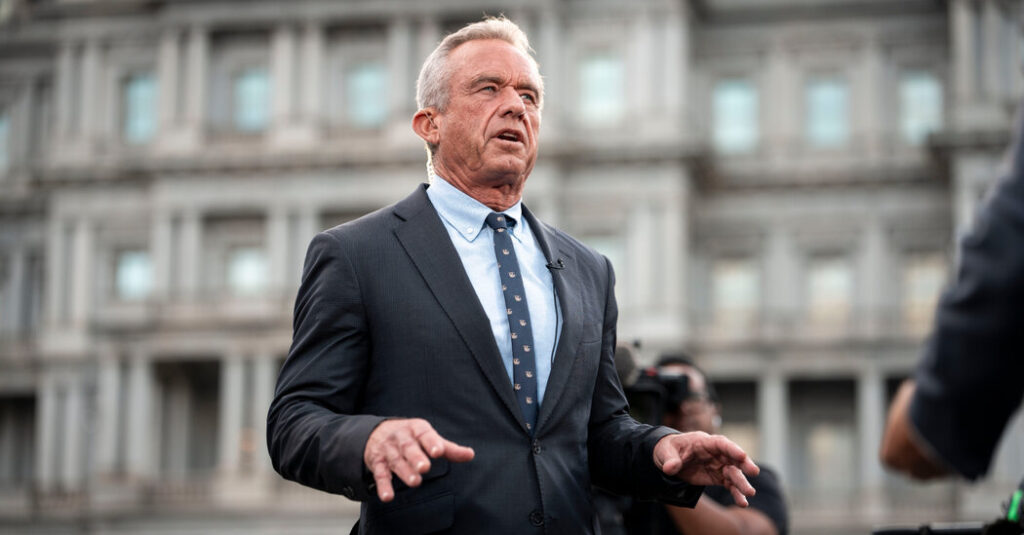
Health Secretary Robert F. Kennedy Jr. is quietly undermining an influential task force that has for years played a key role in combating chronic disease, making cancer screenings and medications accessible to millions of Americans.
The U.S. Preventive Services Task Force, an independent panel of experts, reviews evidence and makes recommendations for what screenings, counseling and preventive medications people should receive; by law, most insurance plans must cover these at no cost to the patient. Primary care physicians rely on the recommendations in their daily practice, whether screening patients in their 20s for sexually transmitted infections or prescribing statins to patients in their 50s to reduce the risk of a heart attack.
The task force has not met in person since March. Without citing a reason, Mr. Kennedy abruptly postponed its July meeting, when members were scheduled to discuss approaches to preventing heart disease. Amid the fall federal shutdown, his office also postponed the task force’s November meeting. Neither was rescheduled, according to two people from groups that typically attend the meetings.
The task force also issues a legally mandated report to Congress every year, highlighting evidence gaps that help set priorities for research funding, but no report was published in 2025. And the terms of five of its 16 members were scheduled to end in December; it is unclear whether they are being replaced. Neither the task force nor the Health Department responded to a request for comment before publication.
These changes amount to an erosion of the task force and its work, said Dr. Alex Krist, a family practice physician at Virginia Commonwealth University and Inova Health System who served on the body, including as chair, from 2015 to 2022. “The demise of the task force could endanger preventive care coverage for all insured Americans,” he said.
Because the task force was not able to meet, its work evaluating evidence and making recommendations stalled, according to people who have followed its work. In a typical year, it would publish, on average, about 20 draft and final recommendations, said Dr. Michael J. Barry, a professor of medicine at Harvard Medical School who served on the task force, including as chair, from 2017 to 2024. But in 2025, it published just seven, according to a review of its website.
Perhaps most pressing, experts said, are four draft recommendations awaiting finalization. These include recommendations to screen adults for unhealthy alcohol use, endorse self-swabs for cervical cancer screening and provide counseling to women at increased risk for perinatal depression, as well as a recommendation against vitamin D supplementation for the prevention of fractures and falls in older people.
On Monday, an agency under the Health Department endorsed the self-swab as an alternative to the Pap smear for cervical cancer screening, requiring it to be covered by most insurance providers starting next January — effectively serving the purpose the U.S.P.S.T.F. would have, had it finalized its draft recommendation.
The development of draft recommendations for 14 additional preventive services also remains on hold. Those include risk assessment and genetic testing for breast cancer, chronic kidney disease screening and interventions to help people quit smoking.
“I fear we’re really reaching a cliff in terms of recommendations for effective preventive care — ones that primary care clinicians and their patients nationwide have been counting on for more than 40 years,” Dr. Barry said.
Trump Administration: Live Updates
Updated
- 5 Democratic states sue the Trump administration over $10 billion funding freeze.
- Amid protests, ICE told agents to take ‘decisive action’ if threatened.
- Trump orders Fannie Mae and Freddie Mac to buy $200 billion in mortgage bonds.
First convened in 1984, the task force is traditionally made up of 16 experts in primary care and prevention.The group gives each procedure or medication it evaluates a grade; under the Affordable Care Act, services with the top grades of “A” or “B” must be fully covered by most insurance plans.
“If you’ve ever gotten a free mammogram or a free colonoscopy or a free H.I.V. screening, it’s because of the U.S.P.S.T.F.,” said Dr. Aaron Carroll, the chief executive of AcademyHealth, a nonpartisan organization that represents health and policy researchers and organized a letter from 104 health organizations in July urging members of Congress to “protect the integrity” of the task force.
The task force has historically had bipartisan support in Congress, and while the services it evaluates sometimes spark debate among medical experts, they rarely attract political controversy.
“We didn’t think a lot about what administration it was,” said Dr. Barry, who served during President Trump’s first term and the Biden administration. “The work was the same,” he added.
Members, who are all volunteers, typically serve staggered four-year terms, an arrangement meant to insulate the panel from changes in presidential administrations and to maintain its scientific independence. They are vetted for their expertise in areas of primary care and to avoid conflicts of interest.
The terms of four task force members who began their service in January 2022 were scheduled to end on Dec. 31, according to task force protocol. Another member who began in 2021 and stayed on an extra year was also expected to rotate off, reducing the total membership to 11 from 16 and creating “a major problem in terms of the task force continuing its work” if they are not replaced, Dr. Barry said. The task force divides some of its work among working groups; with fewer members, less work can get done. Typically, replacements are lined up several weeks in advance, Dr. Barry said, with new members beginning their terms Jan. 1.
A Supreme Court case last year reaffirmed that most insurance plans must fully cover preventive services recommended by the panel — and that the health secretary has the authority to appoint and remove members at will.
In June, Mr. Kennedy fired all members of another body — the Advisory Committee on Immunization Practices, which makes recommendations regarding vaccinations — and named a number of new ones, including several who had spoken out against vaccinations.
Health experts and former members of the task force have expressed concern that Mr. Kennedy might similarly dismiss its members, replace them with political appointees or otherwise undermine the group’s independence and credibility.
If Mr. Kennedy replaces members with newcomers whose expertise is unclear or questionable, that could reduce public trust in the panel, warned Dr. Bobby Mukkamala, the president of the American Medical Association. He said that could in turn create an information gap that leaves even more of the public vulnerable to medical misinformation.
“When there’s no authority — somebody useful to help fill in that gap in knowledge — then that gap gets bigger and bigger,” he said.
Nina Agrawal is a Times health reporter.
The post Kennedy Weakens U.S. Preventive Services Task Force appeared first on New York Times.