About 10 minutes into the astonishing news conference at which President Trump celebrated the lightning-strike operation to abduct Venezuela’s president, Nicolás Maduro, Trump wandered into a rambling disquisition on the success of American troops patrolling the streets of American cities.
“I just have to congratulate our military,” he said, name checking Secretary of Defense Pete Hegseth. “The job that they’ve done, whether it’s in Washington, D.C., where we have a totally safe city where it was one of the most unsafe cities anywhere in the world, frankly, and now we have no crime in Washington, D.C.”
To a casual listener, these might seem like the sleepy digressions of the oldest man ever to assume the presidency. But to my ear, his emphasis on domestic deployments of the American military, especially in the context of a foreign military action, crystallized the most chilling hallmark of Trump’s second presidency: the seamless fusion of domestic and foreign policy, bypassing America’s constitutional system of government to assume virtually boundless, unchecked power.
Over the past year, the Trump administration has repeatedly asserted an exceptionally expansive interpretation of the president’s power to act domestically against foreign threats. Clothing Trump’s actions in the garb of national security, the administration has shielded them from congressional or judicial oversight.
Tariffs? There was no need to go to Congress because the president is responding to an international economic emergency. Deportation of migrants without due process? Needed, on the president’s authority, to stop a foreign invasion. Deployment of federal troops on American soil? Necessary to secure the homeland from people the president has determined are lawless interlopers. In theory, Congress can curb these abuses of power, and many courts have ruled against Trump. But in practice, he has largely surpassed these checks without breaking a sweat.
Now, with the assault on Caracas, Trump has achieved the equivalent abroad. The removal of Maduro wasn’t the kind of act that requires invoking war powers or notifying Congress, the administration argued; it was merely a domestic law enforcement operation overseas, aided by the military and squarely under the purview of the executive branch. In Trump’s interpretation of the imperial presidency, practically any number of foreign endeavors can be transformed into a domestic affair. And all domestic activities can somehow be linked to foreign-menaced national security. It is one small trick to destroy constitutional and democratic rule.
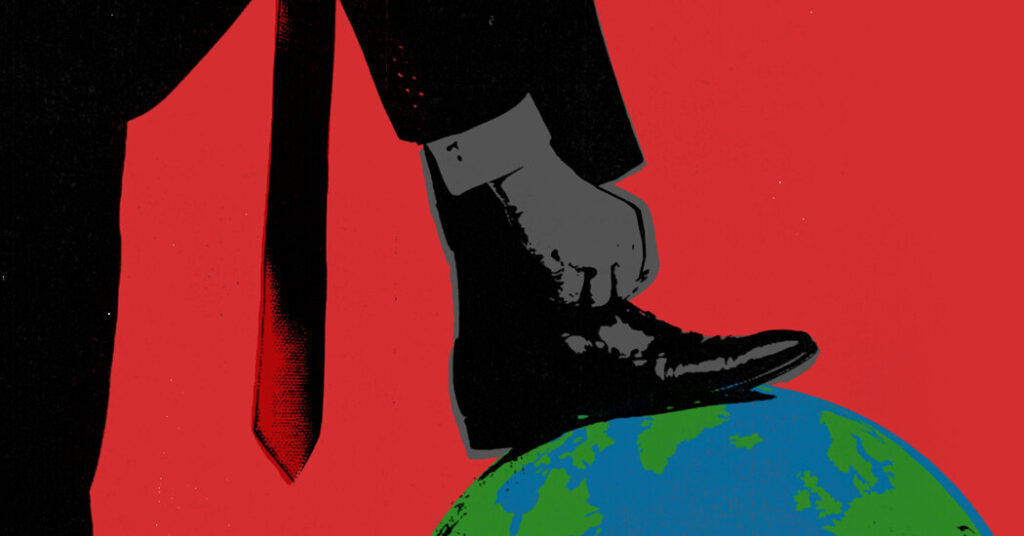
Adventures abroad have always come back to haunt the home front. There is even a term for this: “the imperial boomerang.” It describes how the violent exercise of power over other nations eventually returns to the metropole in the form of domestic repression and democratic erosion. Now it is happening in reverse. The toppling of Venezuela’s cruel dictator is not just an example of a resurgent American imperialism or a shredding of the last remnants of international law and the rules-based order. It is also an extraordinary demonstration of how Trump is collapsing the crucial binaries of America’s Constitution — between law enforcement and military action, between executive and legislative power and, above all, between foreign and domestic.
Trump has no ideology beyond his own power, just as he has no sense of America as an object beyond his own person. In his hands, the imperial boomerang has been transformed into a Möbius strip — a surface where the inside and outside have no meaningful distinction, forming an endless loop. In this dizzying dissolution of boundaries, there is little to stop him from feeding his hunger for limitless power. With the resources of the world’s richest nation and most powerful military at his disposal, Trump is claiming borderless license to turn on his perceived enemies. That should terrify us all.
From his earliest days as a presidential candidate in 2015, Trump has declared his opposition to foreign entanglements. He reiterated this stance in his 2024 campaign, promising an “America first” foreign policy. No more would the United States impose democracy or referee bloody free-for-alls in distant corners of the globe. No more would American taxpayers foot the bill to defend supposedly freeloading allies like the members of NATO. America’s commitment to the ideals of the postwar order it helped create and led for decades would take a back seat to a narrow, hardheaded calculus of the country’s interests.
Trump also pledged to be a president of peace, touting his image as a tough deal maker. Since he took office, he has claimed credit for ending more than half a dozen conflagrations, including a skirmish between India and Pakistan, the long-running Congolese conflict and the century-old territorial dispute between Thailand and Cambodia. His role in all these conflicts is questionable, to say the least, and none have been definitively solved — certainly not the war in Gaza, where a cease-fire persists in name only and no further steps toward a lasting peace have been made. On bringing Russia’s war in Ukraine to a halt, Trump has gotten nowhere, his blandishments to Vladimir Putin notwithstanding.
For all his peacemaking aspirations, Trump has leaned in to force. His second term has been marked by aggressive threats and acts of military violence against foreign targets, taken without informing Congress, much less seeking its approval in advance. In less than a year his administration has bombed seven countries — more than in his entire first term. The targets have included not just sworn enemies like Iran and Venezuela but also a friendly nation, Nigeria, on which the administration launched Tomahawk missiles — supposedly to strike Islamic State militants — on Christmas Day.
.op-aside { display: none; border-top: 1px solid var(–color-stroke-tertiary,#C7C7C7); border-bottom: 1px solid var(–color-stroke-tertiary,#C7C7C7); font-family: nyt-franklin, helvetica, sans-serif; flex-direction: row; justify-content: space-between; padding-top: 1.25rem; padding-bottom: 1.25rem; position: relative; max-width: 600px; margin: 2rem 20px; }
.op-aside p { margin: 0; font-family: nyt-franklin, helvetica, sans-serif; font-size: 1rem; line-height: 1.3rem; margin-top: 0.4rem; margin-right: 2rem; font-weight: 600; flex-grow: 1; }
.SHA_opinionPrompt_0325_1_Prompt .op-aside { display: flex; }
@media (min-width: 640px) { .op-aside { margin: 2rem auto; } }
.op-buttonWrap { visibility: hidden; display: flex; right: 42px; position: absolute; background: var(–color-background-inverseSecondary, hsla(0,0%,21.18%,1)); border-radius: 3px; height: 25px; padding: 0 10px; align-items: center; justify-content: center; top: calc((100% – 25px) / 2); }
.op-copiedText { font-size: 0.75rem; line-height: 0.75rem; color: var(–color-content-inversePrimary, #fff); white-space: pre; margin-top: 1px; }
.op-button { display: flex; border: 1px solid var(–color-stroke-tertiary, #C7C7C7); height: 2rem; width: 2rem; background: transparent; border-radius: 50%; cursor: pointer; margin: auto; padding-inline: 6px; flex-direction: column; justify-content: center; flex-shrink: 0; }
.op-button:hover { background-color: var(–color-background-tertiary, #EBEBEB); }
.op-button path { fill: var(–color-content-primary,#121212); }
Know someone who would want to read this? Share the column.
But the attack on Venezuela is something else entirely in scale, scope and brazen illegality. It involved a military extraction force — more than 150 aircraft supporting Delta Force and Army Rangers, acting on intelligence gathered by American spies — that operated in clear violation of international law and killed dozens of people, including some civilians. Yet it appears that there is essentially no ideological underpinning to Trump’s action in Venezuela. He seems to have gone out of his way to sideline María Corina Machado, the opposition leader whose party appeared to win the last presidential election by a landslide. Instead, the administration seems perfectly happy to work with the rest of Maduro’s regime despite its socialist avowals.
Trump could simply want to take Venezuela’s oil, of course. On Tuesday he announced that he had extracted an immediate tribute of millions of barrels of oil from Venezuela. He also reportedly demanded that the government cut all ties with China, Russia, Iran and Cuba and partner exclusively with the United States on oil production. Yet the world is in the midst of an oil glut, and tapping Venezuela’s reserves will require tens of billions of dollars of investment over the next decade or more. Besides, America is already the world’s top producer of oil; the 30 million to 50 million barrels Trump has demanded equal just a few days of American oil output. Even on the upper end, that’s worth around $3 billion at current prices.
Politics is clearly a motivation, too. The Venezuela operation offers up a classic example of political logrolling, with a little something for the disparate elites in Trump’s coalition. For long-exiled neoconservatives, there is the excitement of toppling an avowed socialist foe. For anti-immigration fanatics, there is the hope of the rapid expulsion of Venezuelan migrants. For the tycoons in the oil and military industries, there is the promise of lucrative business opportunities.
But there is nothing in it for ordinary Americans. Venezuela was already broke and heavily in debt. And for all the spectacular success of the military operation and the seeming savvy in co-opting the beheaded Venezuelan regime, it is not hard to spot a quagmire on the horizon. The country, with its armed paramilitaries loyal to Chavismo and security elite chafing at vassalage, could quickly become a sinkhole for American blood and treasure. Trump is clearly more interested in tending to his backers than the citizens he was elected to serve.
All the reasons above are necessary, as the philosophers say, but not sufficient. Trump has surrounded himself with officers who are either empty vessels for his ambition — Pam Bondi, Hegseth, JD Vance — or superpowered ideologues whose agendas align with Trump’s thirst for personal power, like Marco Rubio and the fanatical Stephen Miller. Whatever their motives, all are aligned in delivering to Trump the ultimate prize: limitless, unchecked power he can exercise anywhere he chooses, from the streets of Chicago to the presidential palace in Caracas.
Early accounts of Trump’s spurning of Machado fixed on his ire at her winning a Nobel Peace Prize he thought was rightly his and her failure to decline it as an act of fealty. Subsequent reporting has unearthed more substantive objections to handing power over to a hard-right ideological ally; Machado appears to have had no real plan to govern Venezuela. Still, personal pique seems to have played some role in Trump’s decision about the timing of Maduro’s overthrow: He was reportedly annoyed by Maduro’s dancing in recent public appearances, which Trump saw as aping his own fist-pumping dance moves. That may well have been the final straw.
Trump is a vain and petty man, and it is easy to impute psychological motives to his actions. But it is folly to assume the demands of his ego will be satisfied by symbolic victories. Revulsion and desire are two sides of the same coin, and it is clear that Trump covets the kind of unaccountable power Maduro enjoyed — to enrich his family and cronies, to intimidate political opponents, to muzzle the press, to flood the streets of his country with armed men who do his bidding. Trump has managed to do a measure of all of these things. No doubt he intends to do more.
But Maduro achieved the one thing that has, for now, eluded Trump: Maduro overturned the results of an election and remained in power despite his people roundly rejecting him. As the Republican Party faces a tsunami of opposition in this year’s midterm elections, I shudder to think of how Trump will choose to flex his newfound muscle at home and abroad and how that might influence the freedom and fairness of those contests. That this week also saw the anniversary of Jan. 6, Trump’s failed attempt to cling to power, feels almost too on the nose.
Last Sunday night, I wandered over to the federal courthouse in Manhattan where Maduro would appear the next day to face American justice for the first time. I wanted to speak to Venezuelan exiles who gathered there, draped in their national flag, to celebrate his ouster. The mood was jubilant, but in every conversation there was an edge of uncertainty. Trump had denigrated their hero, Machado, and was cozying up to the interim president, Delcy Rodríguez, a hard-line Maduro ally.
I met a Machado supporter named Franklin Gomez. He had been a dissident journalist and local activist in Machado’s conservative movement, winning a seat on his local City Council at the age of 22. He fled after being detained and tortured by the regime, going first to Colombia, then making the long, overland journey through the Darién Gap to the U.S. border, crossing over in 2022. He has a pending asylum case but hopes to return to a free Venezuela soon.
“I never came here looking for American dreams,” he told me.
I asked him if he was concerned about Trump’s plans to take Venezuela’s oil; he was strikingly sanguine. It already is being taken by Russia, China and Cuba, he said, and the profits stolen by a government he refers to as a mafia. Things could not go on as they had — and change brings opportunity. “It’s only necessary to return the freedom in Venezuela,” he said. As for the oil, “You deal with that later.” How much freedom the country will enjoy, given that Trump has declared that American oversight might go on for years, is an open question.
Yet as he spoke, an inescapable thought popped into my head. In the years ahead, might I find myself in some foreign city, a dissident journalist in exile, celebrating the arrest of the rogue president of the United States? I once would have scoffed at such sensationalism. But watching Trump and his allies blow past what once seemed like impregnable safeguards of American democracy, I marvel at the failure of my own imagination. It can happen here. In fact, it already is.
The Times is committed to publishing a diversity of letters to the editor. We’d like to hear what you think about this or any of our articles. Here are some tips. And here’s our email: [email protected].
Follow the New York Times Opinion section on Facebook, Instagram, TikTok, Bluesky, WhatsApp and Threads.
The post This Is Trump’s Small Trick to Destroy American Democracy appeared first on New York Times.