Gov. Gavin Newsom used his final formal address to the California Legislature on Thursday to pitch his state — and his own leadership — as the true standard for democracy in America in sharp contrast with President Trump.
Mr. Newsom, who is entering his final year as governor, delivered a speech with national implications in a California setting that closely resembled the annual State of the Union message given at the U.S. Capitol.
Officially, the State of the State address was Mr. Newsom’s platform for laying out his agenda for the year, a formal way of communicating his legislative and budget priorities to the lawmakers he must work with to achieve his goals. Unofficially, it was an opportunity for him to portray himself as a national leader of the Democratic Party and to define his legacy governing the nation’s most populous state in advance of an expected run for president in 2028.
In his 65-minute address, the governor described California as “a beacon” for the nation and the world, and argued that Mr. Trump had abandoned democratic norms and sowed chaos.
“We face an assault on our values unlike anything I’ve seen in my life,” he said.
“Federal government, especially — it’s unrecognizable,” he added, describing “masked men snatching people in broad daylight” and American cities being used as military training grounds.
In his two terms as governor, Mr. Newsom has generally tried to avoid giving formal speeches like the one that he delivered on Thursday to a joint session of the California Legislature. He does not like using teleprompters because he has dyslexia, and he has insisted in the past that he would rather speak to Californians around the state rather than in a legislative chamber.
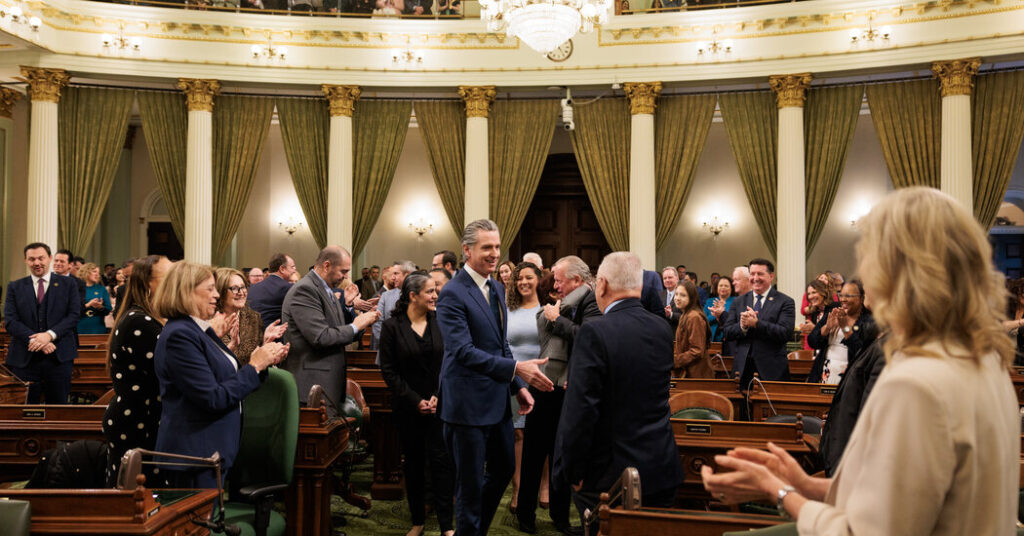
But because of term limits, this was Mr. Newsom’s last opportunity to give the annual address to legislators, and there has never been more national interest in his agenda than there is now, as the jam-packed camera bays could attest. The speech on Thursday was the first time since 2020 that he delivered his State of the State address in the chamber of the Assembly, California’s equivalent to the House of Representatives.
Mr. Newsom seemed to relish his return to the ornate chamber, greeting lawmakers with hugs and handshakes as he strode to the dais beneath crystal chandeliers. As a prelude, he took a moment to express gratitude to every lawmaker for shaping him over the course of seven years, almost like a college graduate thanking his classmates before moving on to the bigger world ahead.
Mr. Newsom used his speech to directly attack Mr. Trump, and to tell Californians, if not Americans, that his state had a stable democracy, unlike the nation under the current federal administration.
He said California was fighting back against Mr. Trump on every level: “We are not hunkering down. We are not retreating. We are a beacon.”
Convincing the nation that California is an example worth following may not be easy. The state has the nation’s highest unemployment rate after the District of Columbia, and the prices of housing, electricity and gasoline in California are among the highest in the country. Parts of Los Angeles are still in the early stages of rebuilding from the deadly fires of last year, which destroyed thousands of homes.
Firefighters and survivors of those blazes were guests at the speech, and received a long standing ovation from lawmakers when the governor introduced them.
Trump Administration: Live Updates
Updated
- House passes doomed bill to restore health subsidies.
- A vengeful Trump urges voters to oust Republicans, including Collins.
- Congress tries — but fails — to take a stand for Its own powers.
While Mr. Newsom suggests that California is a state to be emulated, Republicans have routinely portrayed it as the opposite, an example of liberal values gone too far. President Trump told California and several other Democratic-led states this week that he would freeze federal funding for child care and cash assistance programs because he believed the states had allowed too much fraud.
The states have disputed that claim and promised litigation over the freeze, though Mr. Newsom also told MSNow on Monday that he “can’t stand fraud” and would work with federal officials to stop it if they identified any. Some of the loudest boos during the speech on Thursday came when Mr. Newsom described how Mr. Trump was freezing child care funds.
On Thursday, Mr. Newsom stood on his record to outline his vision for California, and by extension, America: raising wages for the working class; combating climate change by advancing clean energy; lowering the cost of housing, health care and energy.
“Affordability,” he said, is “not a word we just discovered. And it’s certainly not a hoax.”
Homelessness is still pervasive in California, but Mr. Newsom signaled that he plans to embrace the efforts he has made to address the problem, saying that the number of unsheltered people in the state was on the decline and suggesting that some local officials have been dragging their feet.
Mr. Newsom did not shy away from the high-speed rail project that Mr. Trump and Republicans have called a boondoggle and cut off from federal funding. The project was initially supposed to have begun whisking travelers between San Francisco and Los Angeles by 2020.
“We’re finally laying the tracks,” Mr. Newsom said, calling the project a “21st century transportation network.”
His remarks hearkened back to his first State of the State speech in 2019, when Mr. Newsom said he wanted to focus on building a short segment of the long-planned project in the Central Valley so that the state could “just get something done.”
Mr. Trump’s two terms in office have been bookends to Mr. Newsom’s eight years as governor, providing him with a convenient foil at key points in his political career. In 2018, Mr. Newsom ran for governor as a leader of the Democratic resistance to Mr. Trump, with advertisements that included a cartoon of Mr. Trump, depicted with bushy eyebrows and tiny hands, scampering across the country to try to stop the “bold, progressive future” that Mr. Newsom promised for California. On Thursday, the governor expanded the map, casting himself as a defender of American values.
The speech was a return to tradition. Mr. Newsom’s predecessors as governor had, since the mid-20th century, delivered State of the State speeches in the State Capitol each year as a way to set the state’s agenda. But he broke with that practice after 2020, instead releasing his addresses most often on video and announcing policy proposals during visits to cities around the state. Once, during the height of the Covid-19 pandemic, he spoke by livestream video to an empty Dodgers Stadium.
Last year, the State of the State message was such an afterthought that the governor sent it to lawmakers as a letter — not early in the year, but in the final week of the legislative session in September.
Mr. Newsom received a warm welcome on Thursday from the Democratic-dominated legislature when he entered the Assembly chamber. But it was not an effusive reception, which he acknowledged by musing, after the new State Senate leader, Monique Limón, drew louder cheers than he had, that perhaps she should have given the speech in his place.
Matt Bennett, a Democratic strategist who worked on presidential campaigns for two former governors, said that if Mr. Newsom runs for president, he would be better off focusing on a message about the future of the country, rather than his record leading California.
Mr. Bennett recalled that in the 1988 election, Gov. Michael Dukakis of Massachusetts highlighted his state accomplishments to win the Democratic presidential primary, but he lost the general election to George H.W. Bush.
Four years later, Bill Clinton drew very little on his experience as the governor of Arkansas when he defeated Mr. Bush, said Mr. Bennett. Instead, Mr. Clinton focused on a centrist vision for the Democratic Party.
A presidential campaign may test whether Mr. Newsom can be authentic about his deep roots in California while honing a message that goes beyond his work in the state.
“Nobody cares about his legacy,” Mr. Bennett said. “When it comes to voters in South Carolina, that is not what concerns them. What they’re going to be wondering is, does he have a vision of the future that seems realistic, and am I a part of it?”
Laurel Rosenhall is a Sacramento-based reporter covering California politics and government for The Times.
The post In Address, Newsom Lays Out a Vision for California and the Nation appeared first on New York Times.