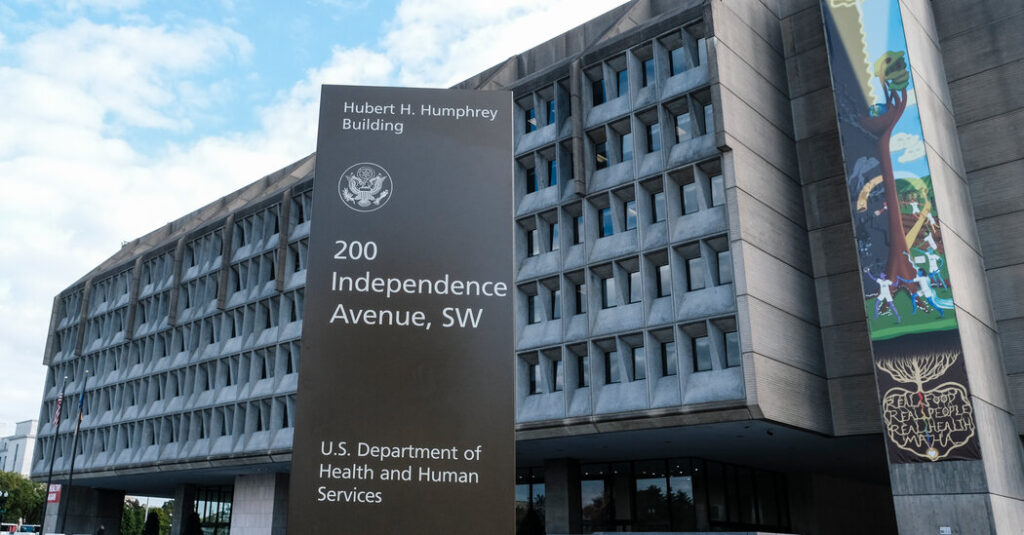
Five states controlled by Democrats sued the Trump administration on Thursday for freezing $10 billion in funding for child care subsidies, social services and cash support for low-income families, asking a federal judge to declare the pause illegal and restore the money.
The lawsuit, filed by New York and joined by California, Colorado, Illinois and Minnesota, came two days after the administration moved to shut off the funding to the five states. The Department of Health and Human Services, which distributes the funds, cited without evidence “potential” fraud and misuse by ineligible noncitizens like undocumented immigrants across the five states, invoking a major welfare fraud scheme that has rocked Minnesota.
The freeze could jeopardize programs that serve hundreds of thousands of low-income households in the five states, including more than 200,000 families in New York and around 100,000 families in Illinois. New York will run out of funds for the affected programs by the end of January unless the money is unblocked, according to the governor’s office.
The lack of a clear reason for the pause has stirred state officials to accuse the administration of using low-income families and children as “political pawns” to punish perceived enemies and political opponents. Those charged with fraud in Minnesota were accused of abusing a pandemic-era program for feeding children, not the ones the administration has targeted, and were overwhelmingly U.S. citizens.
Instead, some state officials said, the freeze fits a Trump administration pattern of withholding money from places where he is not popular, as it has with disaster funds and with programs during the government shutdown. Letitia James, New York’s attorney general, characterized the freeze as a “campaign of chaos and retribution” that would harm “the most vulnerable families.”
“I will not allow this administration to play political games with the resources families need to help make ends meet,” she said in a statement.
Ms. James herself has faced President Trump’s campaign of retribution, as the Justice Department brought unsuccessful charges of bank fraud against her and is said to be pursuing a new investigation of her. Ms. James brought a civil fraud suit against the president before he began his second term.
The White House and the Department of Health and Human Services did not immediately respond to requests for comment on Thursday. But Andrew Nixon, a department spokesman, portrayed the freeze as a protection of taxpayers’ money earlier this week. “Democrat-led states and governors have been complicit in allowing massive amounts of fraud to occur under their watch,” Mr. Nixon said in a statement. “Under the Trump administration, we are ensuring that federal taxpayer dollars are being used for legitimate purposes.”
The department said on Tuesday that it would require the five states to submit documentation like receipts and to justify their spending before releasing any payment.
In their complaint, the five states labeled the freeze as a “shoot-first-ask-questions-later approach” and took issue with a two-week deadline the department gave them to submit documentation, calling the short turnaround “an impossible task” and a “pretext to maintain the freeze.”
The complaint added that the administration violated the Constitution by unilaterally pausing funds that Congress approved for disbursement.
The freeze is set to cut off around $7.3 billion in funding for the Temporary Assistance for Needy Families program, which provides cash assistance to households with children, as well as nearly $2.4 billion for the Child Care and Development Fund, which supports child care for working parents, and around $870 million for social services grants that mostly benefit children at risk of abuse and other harm.
The three programs that the administration targeted had allowed states broad discretion to design specific ways to support families and children in need.
In New York, for example, the federal dollars for the cash assistance program, TANF, also fund emergency homeless and domestic violence shelters, where victims take refuge from their perpetrators. The loss of the funds would force many shelters to close, said Michael Polenberg, a vice president of Safe Horizon, a nonprofit that provides services for victims of domestic violence.
Without the funding, “tens of thousands of domestic violence survivors and their children” would be “forced to make impossible choices to stay in an abusive household and face a violent encounter or to be homeless,” Mr. Polenberg said in an interview.
“Freezing federal funding based on what, an assumption, a hunch?” he added. “It’s crazy.”
Minho Kim reports on breaking news for The Times from Washington.
The post 5 Democratic States Sue Trump Administration Over $10 Billion Funding Freeze appeared first on New York Times.