At 2 a.m. last Saturday, inside his sky blue apartment building in Catia La Mar, a city on Venezuela’s northern coast, Wilfredo González said he was jolted awake by the sound of whistles and explosions. He had just managed to stand when the shock wave from a blast knocked him back to the ground.
“They are bombing us,” he recalled.
After it was over, his relatives rushed to find survivors amid the debris in his unit. Mr. González, 61, said he found his 80-year old aunt, Rosa Elena González, pinned under a washing machine. “She was saying, ‘I can’t breathe, I can’t breathe,” Mr. González said, adding that she died shortly afterward at a hospital.
At roughly the same time as the first lights of dawn on Saturday revealed Mr. González’s shattered apartment, American aircraft were delivering the captured president of Venezuela, Nicolás Maduro, and his wife, Cilia, to a U.S. warship.
That is when American officials “exhaled,” Defense Secretary Pete Hegseth told the Charlie Kirk Show, a podcast, and began to celebrate an operation that Mr. Trump described as “perfectly executed.”
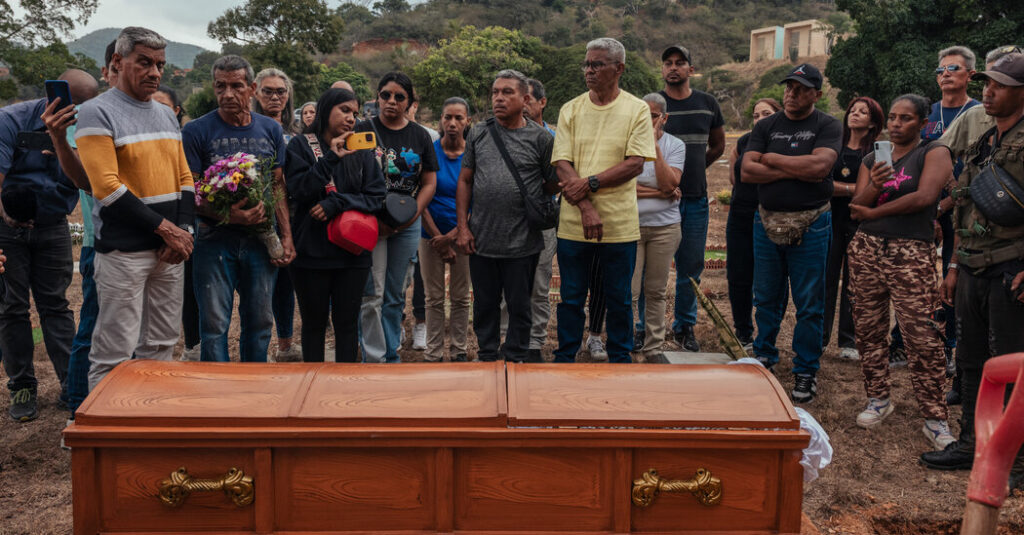
For Venezuelans, the nighttime raid opened a period of deep uncertainty. For much of the world, it marked an escalation of President Trump’s assertion of U.S. dominance in Latin America. But for dozens of Venezuelan families, it ushered in the grim task of burying relatives killed in the strikes.
“My heart is aching,” said a relative of First Sgt. César Augusto García Palma, 30, a member of Mr. Maduro’s inner security circle, who was killed in the strike and who was part of an official funeral. The relative asked not to be identified for fear of retribution from the government.
The authorities in Venezuela have yet to release an official list of those killed, and they have offered different tallies, its communication on the deaths mixing obfuscation and propaganda.
Most recently, Diosdado Cabello, Venezuela’s interior minister, said that 100 people had been killed, and as least as many wounded. The majority of those killed appear to have been members of the military.
The Cuban government said 32 of those killed were Cuban citizens — members of the country’s armed forces or its interior ministry, on a mission in the country at Venezuela’s request.
The Venezuelan government published obituaries for 23 service members who it said had been killed in the raid, and The New York Times was able to confirm at least two civilian deaths.
Some legal and military experts questioned the legality of the strikes. Congress did not authorize them and had not declared war on Venezuela. The U.N.’s top official, Secretary General António Guterres, said the Trump administration had violated the U.N. charter.
U.S. government officials called the attack a law enforcement operation. Parsing the difference between an armed conflict and a law enforcement action influences how casualties could be regarded, experts said.
“The laws of war allow for quite a lot of collateral damage,” said Charli Carpenter, a professor of political science at the University of Massachusetts. “For law enforcement operations, the bar is much higher.”
The Defense Department said it was conducting an assessment of the damage resulting from the attack. “We are currently not aware of any civilian casualties,’’ the Defense Department said in an email. “Every strike was precisely planned to achieve operational objectives and at no point were civilians intentionally targeted.”
The White House directed requests for comment to the Pentagon.
In Venezuela, government officials have accused the United States of killing innocent civilians, and it honored the servicemen who died as martyrs in the struggle against the “cowardly” U.S. attack.
“The imperialists know they have committed a terrible crime, that they have murdered civilians,” Mr. Cabello said, adding that the United States has “generated an anti-American sentiment” for having “murdered a group of Venezuelans who had nothing to do with this.” Mr. Cabello, like Mr. Maduro, is also under indictment in the United States on drug charges
In a beleaguered nation worn down by years of authoritarian rule, the deaths also became a political wedge. Mr. Maduro was a deeply unpopular leader, and as many Venezuelans celebrated the U.S. attack, on social media some directed scorn at the soldiers who died attempting to protect the president.
The tone was different among the many Venezuelans who mourned for those killed. And in the tightly controlled narrative on state television, and in official speeches, the government emphatically glorified the soldiers’ actions.
At a memorial ceremony for killed Venezuelan service members, Maj. Gen. Javier Marcano Tábata sought to portray Anais Molina, a dead service member, as dying heroically.
“Anais,’’ he said, “was about to be evacuated, and she said, ‘Never. I want to die the way the brave die, looking at the helicopter that is illuminating me — before it tears me apart — right in the face.”
On social media, the Venezuelan military released a deluge of cinematic videos from wakes and funerals. The footage showed wooden caskets draped in the tricolors of the national flag and blanketed in flowers, hoisted to the sounds of patriotic eulogies delivered by officers in full dress uniform. “The battle is not over, the homeland demands that we follow the example,” one officer declares in a video.
Behind the pomp and the propaganda, families were just heartbroken.
In the early morning of Jan. 3, when they caught news of the attack, relatives of First Sergeant García Palma said they immediately thought of him since they knew he was part of Mr. Maduro’s inner security.
“We started writing to him,” said his relative, who read out the text messages that the family sent him on that morning: “Tell me you’re OK, tell us something, I don’t know, call me.’”
The following day, they received a call to identify his body at the Fuerte Tiuna military complex in the hear of Caracas, where Mr. Maduro had been staying when he was captured by U.S. Special Forces. The sergeant, 30, an upbeat salsa dancer, was among those who had been killed there.
On Wednesday, First Sergeant García Palma was honored in a mass funeral for Venezuelan servicemen.
The grieving reached across the Caribbean, to Havana, Cuba’s capital, where families also had lost relatives and friends in the raid. Mr. Maduro had increasingly turned to Cubans, known for their highly trained and efficient security apparatus, for his protection.
Outgunned by U.S. forces, dozens of them were killed, the Cuban government said. As in Venezuela, their family members were scared of retribution by the country’s autocratic government, and many refused to talk.
In Rio Cauto, a remote and impoverished area in a southeastern part of Cuba recently devastated by Hurricane Melissa, the killing of a young resident was the latest blow to the tight-knit community. The death of Fernando Antonio Baez Hidalgo, a 26-year-old soldier, “shook the community to its core,” said Yoandrys, 28, a childhood friend who did not want his last name divulged because he said he feared government retaliation.
“I feel very hurt, a mix of helplessness and pain,” Yoandrys said.
In Cuba, the state-run newspaper, Granma, ran a two-page articles with photos and identities of the dead under the headline, “Honor and Glory!” Senior officials emphasized their loyalty and framed their deaths as a result of what Havana called a foreign military aggression.
Back in Venezuela, neighbors and friends helped clear the debris from homes damaged in the strikes. One building, residents said, was inhabited mostly by older people, like Tibisay Suárez, who is in her 80s.
Her neighbor, Jesús Linares, said he found her lying unconscious among the collapsed walls and shattered glass of her apartment. Her head was bleeding, Mr. Linares said, and he thought she was dead. Using a bedsheet, he fashioned an improvised bandage to stem the bleeding. She survived, he said.
Johana Sierra, a caretaker in El Volcán, in the southern part of Caracas, did not.
She was killed on Jan. 3, in a strike presumably targeting antennas, including some belonging to the government, near the house where she worked.
A neighbor, Maikel Linares, 14, said he saw shrapnel hit Ms. Sierra across the chest.
Her son, Juan Alejandro Morales Sierra, who lives in Madrid, said his mother, 45, “loved her country,” adding, “She hoped in a better Venezuela.”
Patricia Sulbarán contributed reporting from New York and Hannah Berkeley Cohen contributed reporting from Curaçao.
Emma Bubola is a Times reporter covering Argentina. She is based in Buenos Aires.
The post Venezuela Mourns the Dozens Who Died in U.S. Operation appeared first on New York Times.