New York is poised to vastly expand free and low-cost child care for families across the state over the next several years, and to put New York City on track to become the first city in the United States to provide free universal child care.
On Thursday, Gov. Kathy Hochul and Mayor Zohran Mamdani stood together to announce a plan that would begin by expanding child care options for nearly 100,000 young children, putting the mayor on a path toward realizing the most ambitious and costly promise of his campaign and handing him a significant political victory barely a week into his term.
In proposing to spend $4.5 billion on child care in the upcoming fiscal year, Ms. Hochul underscored how the lack of affordable child care has, over the last few years, transformed from a back-burner policy debate into an urgent political concern.
It has united Democratic politicians, business leaders who worry that unaffordable child care is harming the local economy, and parents who fear they will have to leave the city because of soaring costs.
Child care was one of the signature issues that galvanized the progressive coalition that propelled Mr. Mamdani to victory last year. Now, the mayor and the governor, who is up for re-election later this year, are staking their political futures in part on whether they can create a universal child care system.
The initiative is equally important to both politicians: Mr. Mamdani, a democratic socialist, is seeking to show that his affordability agenda is not merely aspirational, and that by highlighting the same issues over and over, he can force a major policy shift.
In Ms. Hochul, he found an enthusiastic — if not surprising — partner who, despite profound ideological differences, had the power and desire to drive change. She, in turn, will now have a popular plan to trumpet in an election year.
The expansion is hardly a done deal.
The State Legislature will still have to approve Ms. Hochul’s funding requests, although her strategy of using existing state funds rather than raising taxes significantly increases the chances that lawmakers will sign off.
If and when the funding is secured, the city and state will then have to tackle an enormous operational challenge that will involve hiring and training scores of teachers and constructing a high-quality, unified system out of a scattered existing network of child care providers in schools, day care centers and private homes.
Still, the mayor and governor were effusive on Thursday.
“This is the day that everything changes,” Ms. Hochul said Thursday morning at a news conference, which was held at a Brooklyn Y.M.C.A that is home to a child-care center, as Mr. Mamdani stood beside her, smiling and nodding. “The era of empty promises ends with the two of us, right here, right now.”
Mr. Mamdani sought to frame the announcement as proof that the enormous expansion of the social safety net he had promised New Yorkers was coming into focus.
“To those who think that the promises of a campaign cannot survive once confronted with the realities of government, today is your answer,” he said.
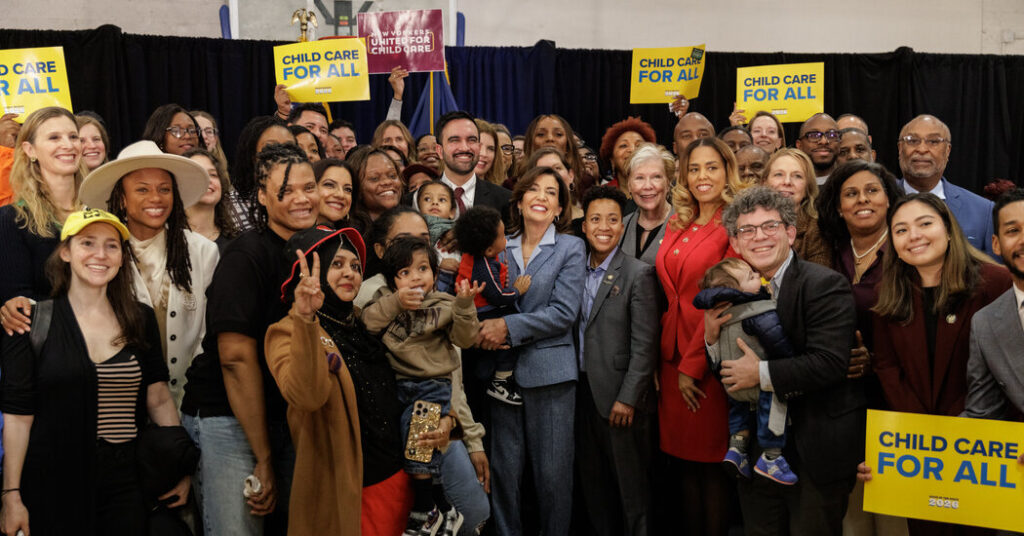
Behind Mr. Mamdani and Ms. Hochul, the stage was overflowing with politicians — from the state’s most progressive elected officials to more moderate Democrats — all eager to show they supported the expansion. Some had brought their children, who squirmed and giggled onstage as the mayor and governor spoke.
Ms. Hochul has proposed spending $1.7 billion on the expansion plan, which would bring the state’s total spending on child care during the next fiscal year — which begins on April 1 — to $4.5 billion. The plan will be included in Ms. Hochul’s proposed executive budget, which she will negotiate with leaders of the State Senate and Assembly in the coming months.
The funding would help the governor work toward a goal of expanding child care to all 4-year-olds statewide by the fall of 2028. It would also enable Mr. Mamdani to make New York City’s preschool program for 3-year-olds, known as 3-K, truly universal, and create a new free child care system for the city’s 2-year-olds, starting with 2,000 toddlers this fall and expanding each subsequent year.
The governor is proposing to spend $73 million in the first year to cover the cost of the creation and expansion of that program, which would be known as 2-Care. In the second year, as infrastructure and capacity could allow more children to enroll, that number would rise to $425 million.
The city would first offer 2-Care seats in what it describes as “high-need areas,” a similar strategy to the one used when the 3-K program began in 2017. An additional 10,000 2-Care seats would become available a year later, and by Year 4 of the program’s expansion, all families with 2-year-olds who want a seat would be offered one. Advocates have estimated that about 55,000 children would enroll in the program once it is fully built out.
The state would also spend $100 million to shore up the 3-K program, which faced cuts under former Mayor Eric Adams, leaving many families unable to find seats near their homes, or any seats at all.
“No longer will a family in Flatbush be offered a seat, but have to find out that that seat is in Astoria,” Mr. Mamdani said, referring to far-apart neighborhoods in Brooklyn and Queens.
Ms. Hochul also proposed a child care expansion outside the city, though the path will be longer. She will increase funding for statewide prekindergarten in her executive budget, with the goal of achieving universal access for 4-year-olds by the fall of 2028, with further expansions to come. Today, outside New York City, only some lower-income parents can receive assistance, leaving most others largely on their own.
Perhaps the most important piece of Thursday’s announcement is the city and state’s new focus on 2-year-olds. It does not appear that families participating in the 2-Care program would need to demonstrate proof of need, which represents a win for Mr. Mamdani, who is opposed to means-tested government programs.
There are political reasons that many experts and politicians support universal child care programs over means-tested ones: When middle-class families, and not just poorer ones, are invested in government programs, they are more likely to push their elected officials to maintain and eventually increase funding for those services.
That is precisely what has happened over the last few years, as working parents who may make six-figure salaries have found themselves increasingly unable to afford life with children in one of the most expensive cities on the planet. Those parents have helped fuel an advocacy movement and a new pool of voters who support candidates basely largely on their child care plans.
The state and city still have to flesh out many important details, including where the first 2-Care seats will be available.
And though Ms. Hochul has promised to fully fund that program for its first two years, unlocking money to get universal child care off the ground is just a first step in what could be one of the most complex operational undertakings that city government has attempted in at least a decade, since former Mayor Bill de Blasio created the universal pre-K system for 4-year-olds.
Ms. Hochul was blunt on Thursday in saying she was unsure how the child care expansion would be funded in the future, despite her commitment to keeping it going, and whether it would require future tax increases. It can be risky for politicians to create new entitlements that voters will expect to continue without putting in place a dedicated funding source.
Andrew Rein, president of the Citizens Budget Commission, a budget watchdog group, praised the plan but expressed concerns about how it would be funded in the long term.
“The state should fund this sustainably, within its existing budget plan, to ensure that New Yorkers in need have reliable access into the future,” he said. “That means making smart, hard choices, shifting money from less effective programs to deliver on this priority.”
Another challenge will involve pay and training for a vastly expanded work force.
One of the unintended consequences of the city’s pre-K rollout, which began in 2014, was that it created a two-tiered payment system for educators, with teachers in the pre-K programs housed in the city’s public schools earning considerably more than those in community-based programs.
Advocates and politicians, including Mr. Mamdani, have spent years pushing the city to raise pay for the second group of teachers.
Doing so would not only be costly for the city, but would require delicate maneuvering between the two unions that represent early-childhood educators, the United Federation of Teachers and District Council 37.
In a recent interview, Mr. Mamdani said he understood that the obstacles to creating a universal child care system went far beyond money.
“Child care is not just a question of finding the funding,” Mr. Mamdani said. “It is also a question of building infrastructure and the apparatus around it, and that requires you to stage this, as opposed to being able to do it all in one swoop.”
Experts and advocates across the state cheered Thursday’s announcement.
“It’s huge,” said Peter Nabozny, director of policy for the Children’s Agenda, a children’s policy and advocacy organization in Rochester.
Rebecca Bailin, executive director of New Yorkers United for Child Care, said the plan “offers a real path to making New York affordable for working families.” Emmy Liss, who helped develop that organization’s blueprint for a citywide 2-Care program, now runs Mr. Mamdani’s child care office.
Ms. Hochul also said she would look for ways to expand the voucher program that subsidizes care for lower-income families across the state. The governor has already poured billions of dollars into the program, which has a wait list in some areas. Her office said she would propose adding another $1.2 billion, bringing the total amount available to $3 billion to serve more families.
Ms. Hochul, who will include the child care proposals in her State of the State address next week, will also announce several related initiatives. They include the creation of a new Office of Child Care and Early Education, an expansion of the child and dependent care tax credit, and added support for child care providers.
Benjamin Oreskes is a reporter covering New York State politics and government for The Times.
The post Hochul and Mamdani Announce Plan to Make N.Y. Child Care Universal appeared first on New York Times.