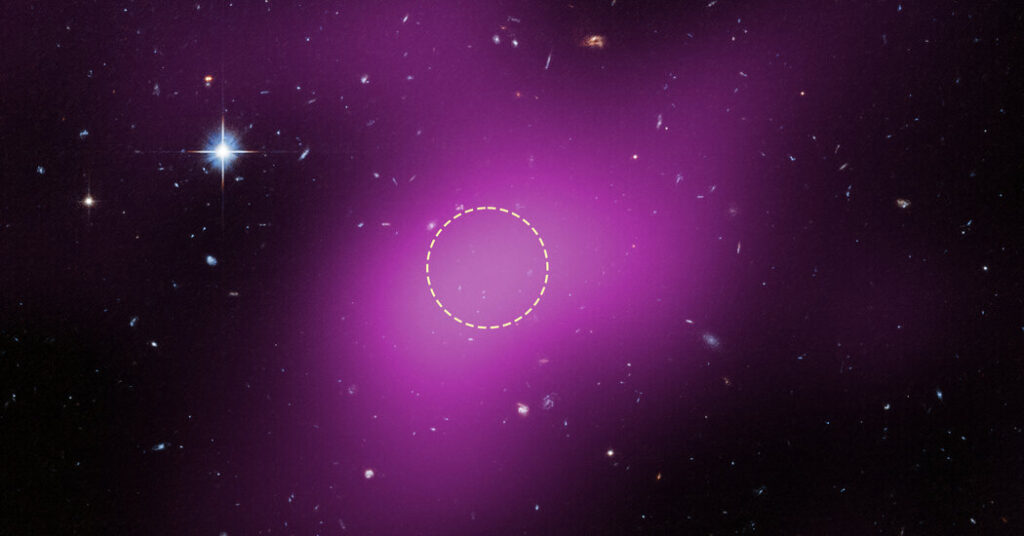
The universe continues to surprise those who study it. This week, astronomers announced the discovery of a new kind of cosmic object, something that is very nearly a galaxy, save for one crucial, missing ingredient: stars.
The almost-galaxy is about 14 million light-years from Earth. It was the ninth cloud found to be associated with a nearby spiral galaxy, leading to its serendipitous name: Cloud-9. The object is starless, consisting of only a haze of hydrogen gas that astronomers believe is swaddled in a much more massive clump of dark matter, the invisible substance that permeates the cosmos and shapes its overarching structure.
“There’s nothing like this that we’ve found so far in the universe,” Rachael Beaton, an astronomer at the Space Telescope Science Institute, said at a meeting of the American Astronomical Society in Phoenix on Monday.
“It’s basically a galaxy that wasn’t,” she added.
Cloud-9 is the first confirmed example of what astronomers call a RELHIC, short for Reionization-Limited H I Cloud and pronounced “relic.” Such objects are rich in gaseous hydrogen but devoid of any stars. They are failed galaxies thought to be nearly as old as time itself, primordial fossils that can help astronomers understand the conditions required for galaxies to grow.
Studying such objects will also help astronomers better understand the nature of dark matter, including what type of particle it may or may not be. Such research could also help explain how exactly dark matter influences the shape of the universe that can be seen.
The leading theory for cosmic structure and evolution posits that structures of dark matter, known as halos, are abundant across the universe. Above a certain mass, the gravity of these halos can attract enough gas to ignite the creation of stars, eventually forming a galaxy.
But the theory also predicts that dark matter halos of a slightly lighter mass can exist, and that these objects can accumulate gas without bearing stars. Because they produce no starlight, astronomers searching for these objects instead try to detect radio waves emitted by the gas itself.
Astronomers in China first reported Cloud-9 as a potentially starless object using the Five-hundred-meter Aperture Spherical Telescope in 2023. Follow-up observations, collected with the Green Bank Telescope in West Virginia and the Very Large Array in New Mexico, strengthened the hunch that the object did not contain any stars.
Still, astronomers could not yet rule out the possibility that Cloud-9 was a dark dwarf galaxy, with stars too dim to find using observatories on the ground.
In 2025, a team of astronomers observed Cloud-9 with NASA’s Hubble Space Telescope. They determined that the amount of dark matter in Cloud-9 is about five billion times as massive as our sun, a halo that surrounds about a million solar masses worth of hydrogen gas.
According to Gagandeep Anand, an astronomer at the Space Telescope Science Institute who led the analysis, other dwarf galaxies with a similar amount of hydrogen gas also have a comparable amount of stellar mass. But the astronomers identified only one object in the vicinity of Cloud-9 that could be a star. (That object may also be a background galaxy.)
“It’s clear that there is no substantial amount of stars here,” Dr. Anand said. “This is not a faint dwarf galaxy.”
Priyamvada Natarajan, an astrophysicist at Yale who was not involved in the work, called the discovery of Cloud-9 “very tantalizing,” and a solid first step toward testing different theoretical models for dark matter, as well as identifying other dark structures in the universe that have thus far evaded detection.
The next question to tackle, Dr. Natarajan said, is how abundant RELHICs are in different epochs of cosmic time, something that will require a future telescope with more sensitive observation techniques.
“I think it’s time to start plotting and planning for one,” she said.
Dr. Anand considers his team lucky to have found even one RELHIC; it is a window through which astronomers can study the dark part of the universe that exists beyond the bright glow of stars and galaxies. But he does not believe Cloud-9 is unique.
“This is just the first one we’ve found,” he said. “There have got to be others like it.”
Katrina Miller is a science reporter for The Times based in Chicago. She earned a Ph.D. in physics from the University of Chicago.
The post This ‘Galaxy That Wasn’t’ Never Bore Any Stars appeared first on New York Times.