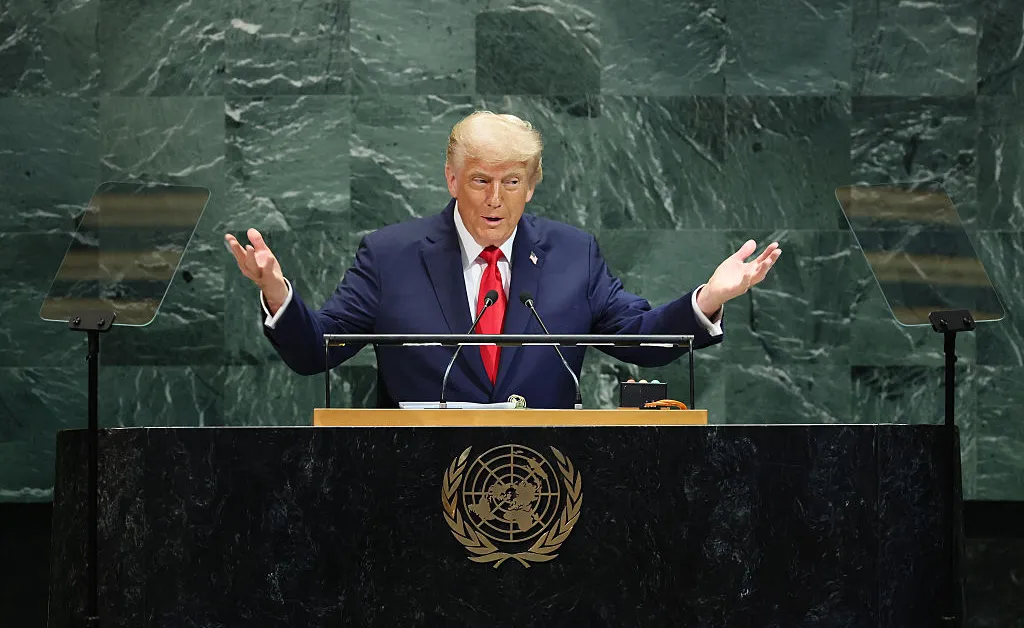
On Wednesday night, President Trump announced that the U.S. would be withdrawing from the United Nations Framework Convention on Climate Change (UNFCCC), a landmark global treaty that sets a legal framework for international negotiations to address climate change.
The move comes after the Trump Administration asked the State Department to review the country’s involvement in various international organizations last February. The result is that the president has now withdrawn the United States from a total 66 international organisations, including 31 United Nations entities. Other groups included U.N. Oceans, the Intergovernmental Science-Policy Platform on Biodiversity and Ecosystem Services, and the International Renewable Energy Agency.
[time-brightcove not-tgx=”true”]
In doing so, the United States has become the first country to turn its back on the framework it played a pivotal role in creating in the early 1990s. “It’s a terrible signal of the U.S.’s commitment to international climate action,” says Jake Schmidt, senior strategic director of international climate at the Natural Resources Defense Council. “Russia, Iran, Venezuela, countries that are not super strong climate leaders are still party to the agreement. So the U.S. will be the only big outlier in the global international conference.”
Given that the Trump Administration has already rolled back a number of climate initiatives, experts say that leaving the UNFCCC is unlikely to have a tangible impact.
“The federal government, over the last 11 plus months, has already done everything they can to put the brakes on energy transition and climate action,” says Max Holmes, president and CEO of the Woodwell Climate Research Center.
The move will put the U.S. further behind other countries that are looking to take advantage of the growing clean energy movement.
“The U.S. is missing out on a huge economic opportunity,” says Jake Schmidt, senior strategic director of international climate at the Natural Resources Defense Council. “With the Inflation Reduction Act and some of the investments that were starting to come into the U.S. after it, there was a sign that the U.S. could both be a domestic player on clean energy economy and also positioned to potentially export some of those efforts to the rest of the world and play a role in this growing clean energy market. Unfortunately the moves of the Trump Administration is going to make it much harder to compete in this growing clean energy market.”
In a statement published on Thursday, Simon Stiell, UNFCCC executive secretary, said that the decision would only hurt the United States in the long run.
“While all other nations are stepping forward together, this latest step back from global leadership, climate cooperation and science can only harm the U.S. economy, jobs, and living standards, as wildfires, floods, mega-storms, and droughts get rapidly worse,” he said. “It will mean less affordable energy, food, transport, and insurance for American households and businesses, as renewables keep getting cheaper than fossil fuels, as climate-driven disasters hit American crops, businesses, and infrastructure harder each year, and as oil, coal, and gas volatility drives more conflicts, regional instability, and forced migration.”
Stiell also said that “the doors remain open” for the U.S. to return to the treaty in the future.
The rest of the world doesn’t seem to be waiting around, Schmidt says, noting that the annual U.N. climate conference, dubbed COP30 last year, chugged on without U.S. involvement. “We saw clear signs that the rest of the world is continuing to move forward with climate change action at home… I think that’s a sign that the rest of the world is a bit disappointed that the U.S. is sitting out, but it’s not stopping its own action.”
Still, it doesn’t mean that it’s game over for climate action in the United States. Across the country, state and local governments have continued to push forward on climate action locally and represent the United States on the international level, notes Holmes. “Just because the federal government tries to stop things doesn’t mean everything stops,” he says. “The U.S. government is by no means the only show in town.”
The post Trump Is Leaving U.N. Environmental Bodies. What That Means for the Climate appeared first on TIME.