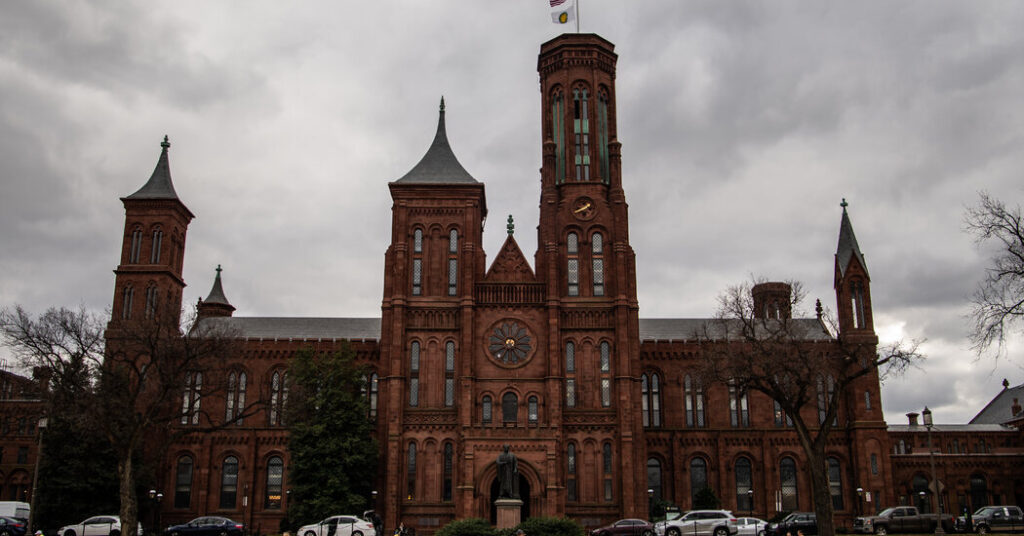
After a monthslong lull in tensions, the Smithsonian is facing an ultimatum from the White House to comply next week with a comprehensive review of the institution’s content and plans — or risk potential cuts to its budget.
The Trump administration’s campaign to pressure the Smithsonian into presenting a primarily positive view of America has been part of the president’s agenda since last March, when he issued Executive Order 14253, “Restoring Truth and Sanity to American History.”
The urgency of the effort seemed to flag last fall, in part perhaps because Lindsey Halligan, the White House aide tasked with scrutinizing the Smithsonian for “improper ideology,” was rerouted by Mr. Trump to serve as the U.S. attorney for the Eastern District of Virginia. In addition, the Smithsonian acceded to the White House’s demand last summer to begin turning over records about operations at eight of its 21 museums.
But the institution, which has long been regarded as independent from the executive branch, has produced only part of the lengthy list of requested documents. Now the administration is demanding all of the outstanding materials by Tuesday.
In a strongly worded Dec. 18 letter to the Smithsonian’s secretary, Lonnie G. Bunch III, White House officials said the Smithsonian had fallen far short of meeting their deadlines or fulfilling their requests. The letter made a pointed reference to the fact that the Smithsonian’s $1 billion budget is largely dependent on federal funds.
“As you may know,” the letter said, “funds apportioned for the Smithsonian Institution are only available for use in a manner consistent with” the executive order and the fulfillment of the document request.
“This appears to be a dramatic ratcheting up of the pressure campaign being directed toward the Smithsonian,” said Samuel J. Redman, a history professor at the University of Massachusetts Amherst who has written about the Smithsonian.
In a letter to staff after the White House demand, Mr. Bunch said the institution had sent over documents responsive to the request in September and would be sending a second set at the end of last year. But he noted that it would be impossible to turn over the full volume of records sought in the time frame, and he reiterated that the institution is autonomous.
“As we all know, all content, programming, and curatorial decisions are made by the Smithsonian,” the letter said. “With this mission and commitment in mind, we look forward to continuing to work collaboratively with all our government stakeholders.”
The Museums Special Section
-
Black Cowboys Ride Again: Museums have taken up the cause of dispelling the perception of a whites-only West.
-
A Symbol of Hope in St. Louis: The 19th-century Old Courthouse is set to reopen in May after a $27.5 million renovation.
-
A Museum and the Sea: Rising sea levels are forcing the Mystic Seaport Museum in Connecticut to address the sustainability of its campus.
-
Ai Weiwei’s World: A show now at the Seattle Art Museum is the largest in the U.S. in the 40-year career of the renowned Chinese artist.
-
More on Museums: Artists and institutions are adapting to changing times.
The White House did not respond to a request for comment on what action it might take if the Smithsonian does not fully comply with the document request.
The pressure from the White House comes as the Smithsonian faces potentially significant turnover in its governing Board of Regents, a 17-member panel that includes Democratic and Republican elected officials as well as nine citizen members. Mr. Bunch, whose relationship with the White House is, at best, strained, has enjoyed the support of the board in asserting that the Smithsonian, created by Congress as a federal trust, operates outside the purview of the executive branch.
But Mr. Trump’s executive order directed Vice President JD Vance, a Smithsonian regent, to ensure that new appointees to the board are in line with the Trump agenda. As many as six seats on the board could open up this year and, though the board nominates its own candidates, the appointments need to be approved by the Republican-led Congress and signed off on by the president.
As a matter of logistics, the administration’s document request for the eight Smithsonian museums is daunting. In his letter to staff, Mr. Bunch said that “some aspects of the White House request are not readily available and will require a significant amount of time, labor, and coordination from various departments across the Smithsonian.”
The museums, including the National Museum of American History and the National Museum of African American History and Culture, have been asked to hand over all the wall text from their galleries, all inventories of permanent holdings and all exhibition plans and budgets, including those for programming associated with the country’s 250th anniversary this year, which has been of particular interest to Mr. Trump.
“We wish to be assured that none of the leadership of the Smithsonian museums is confused about the fact that the United States has been among the greatest forces for good in the history of the world,” wrote Vince Haley, director of the Domestic Policy Council, and Russell T. Vought, the director of the Office of Management and Budget, in the letter last month to Mr. Bunch.
The president’s executive order had accused the institution of promoting “narratives that portray American and Western values as inherently harmful and oppressive.” Mr. Trump further tested the Smithsonian’s independence by announcing last May that he was firing Kim Sajet, the director of the institution’s National Portrait Gallery, calling her “a highly partisan person, and a strong supporter of D.E.I.”
The Smithsonian did not follow through, publicly insisting it held the reins on personnel matters. But Ms. Sajet resigned on her own, saying in a statement that she thought her decision was in the best interests of the institution.
Conservative commentators have joined Mr. Trump in criticizing the Smithsonian for taking an unduly negative view of the nation’s history that focuses too much on matters like racial inequality.
“We have a great story to tell — this is a fantastic society with historical levels of liberty and prosperity,” said Mike Gonzalez, a senior fellow at the Heritage Foundation, in an interview. “The Smithsonian has failed by portraying that heritage as being ugly and filled with tyranny and oppression and in need of replacement.”
He added: “I don’t see how any of the reforms that the Trump administration wants to accomplish at the Smithsonian are possible as long as Lonnie Bunch remains at the helm of the institution.”
The administration’s efforts have at the same time drawn strong criticism from historians and others who say they are concerned that the wide-ranging review of exhibits at the Smithsonian is part of a campaign to rewrite history and compromise the truth.
“He is trying to turn culture into propaganda,” said Janet Marstine, the former founding director of the Institute of Museum Ethics at Seton Hall University.
Until the letter last month, though, there had been something of an uneasy standoff between the Smithsonian and the White House. Mr. Bunch, the founding director of the National Museum of African American History and Culture, has a reputation for diplomacy and a track record of working with officials from both sides of the aisle. He attempted to walk a careful line — insisting on the Smithsonian’s independence while acknowledging the administration’s concerns.
He said the institution would conduct its own review to ensure there were no instances of inappropriate bias or partisanship in its museums or galleries. The Smithsonian also agreed to set up a team to review turning over materials to the White House, as requested, while insisting it was doing so as an autonomous institution. And Mr. Bunch had lunch with the president in August, a meeting the White House described as productive.
Some have expressed concern that the Smithsonian has shown too much deference to Mr. Trump and was even engaging in self-censorship. In July, the painter Amy Sherald withdrew her blockbuster show at the National Portrait Gallery over worries about whether or how the museum would display her portrait of a transgender Statue of Liberty.
Tuesday’s deadline to turn over additional records is shaping up as a critical moment in the impasse. As the White House letter made clear, Mr. Bunch’s submissions so far have failed to meet the administration’s expectations, and the discretion he has shown in what should, and should not, be shared is unlikely to assuage those officials who already view him with antipathy.
In April, Steven Cheung, Mr. Trump’s communications director, described Mr. Bunch in a statement as a “rabid partisan,” liar and failure.
So far Mr. Bunch has been able to rely on the backing of the Smithsonian’s Board of Regents, but that support could diminish if the White House is successful in installing its favored candidates onto the panel. In a meeting in October, the board voted to renominate two current members, Denise O’Leary of Colorado and Franklin D. Raines of the District of Columbia, to second terms. The terms of four other citizen regents will expire this year.
The search for their replacements is being assisted by the executive search firm Korn Ferry, and the nominees will be pushed forward by the current board. But the final decisions on who gets to sit on the panel — which directs Smithsonian affairs and appoints its secretary — will remain with Congress and the president.
Some 62 percent of the Smithsonian’s funding is derived from the federal government, including funds received through direct congressional appropriation. Once the funding is authorized, though, its disbursement is controlled by the Office of Management and Budget, which has announced that the money must be spent in line with the president’s agenda.
In several recent cases, White House officials have withheld money already authorized by Congress, such as education funding to states and funds for the National Institutes of Health.
“It’s an abuse,” Sam Berger, senior fellow at the Center on Budget and Policy Priorities, a progressive research center based in Washington, said of those instances. “They are trying to substitute their views for those of Congress.”
Graham Bowley is an investigative reporter covering the world of culture for The Times.
The post The Smithsonian Faces New Pressure to Submit to Trump’s Will appeared first on New York Times.