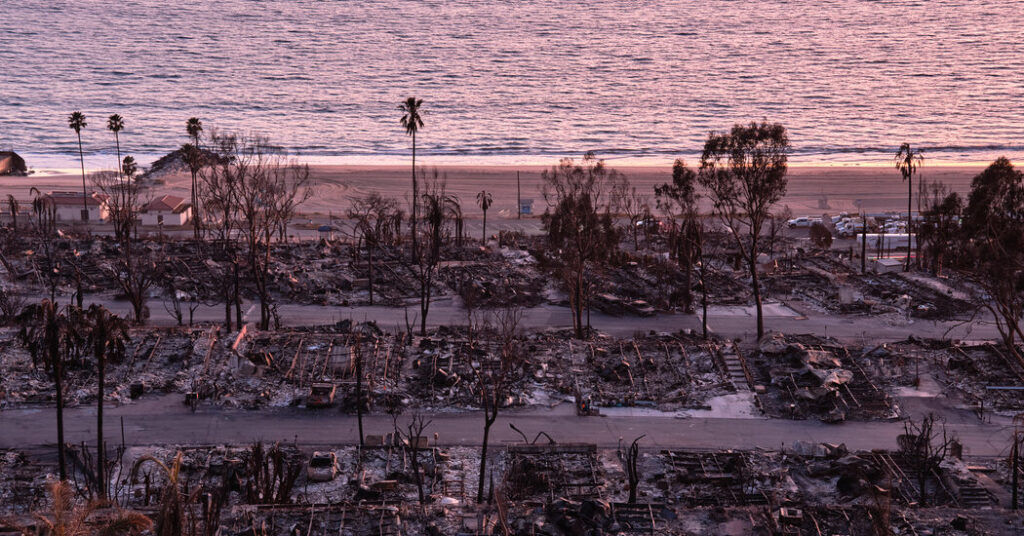
In 2025, frequent and severe thunderstorms and the Los Angeles wildfires drove U.S. disaster damage costs above $100 billion, reaching that level for the fifth time in the past six years, according to data released Thursday. And that was without a single hurricane striking U.S. shores for the first time in a decade.
A record-setting 21 thunderstorm systems that spawned tornadoes, large hail and damaging wind each caused at least $1 billion in damages, according to researchers at Climate Central, a nonprofit group.
It was a sign of both intensifying weather systems and population sprawl in storm-prone areas, which put more people and property into harm’s way.
Climate Central took over what is known as the ”billion-dollar disaster” database last year, after the Trump administration announced that the government would no longer track such information. The database had been maintained by the National Oceanic and Atmospheric Administration.
With a total of $115 billion in disaster damage, the data show, 2025 was the least costly year for disasters since 2019, but still above the $67 billion annual average dating back to 1980.
“Not having any billion-dollar severe storms or hurricanes in the fall was a nice break, and one that we have not seen as much of in recent years,” said Adam Smith, who had led the NOAA database for 15 years, until he left the agency last spring to run it at Climate Central as a senior climate impacts scientist. “Still, it was an impactful year.”
More than half of 2025 disaster costs, $61 billion, were tied to the wildfires that burned in Los Angeles last January. Angelenos are still recovering from that disaster.
But otherwise, severe thunderstorms drove extreme weather-related losses across the country. Such storms accounted for about $51 billion in damages, the researchers found.
Most of the storms occurred or originated in the central United States, where humidity from the Gulf of Mexico flows inland and clashes with colder and drier air moving down from Canada to fuel towering clouds.
The storms produced tornadoes that wracked the Southeast and the Mississippi River valley, as well as hail that hammered areas from Colorado to Texas to Tennessee. One high-wind storm, of a type known as a derecho, caused hundreds of thousands of power outages from Ohio to Quebec and blew out high-rise windows in downtown Pittsburgh.
While climate change is causing heavier downpours and causing hurricanes to intensify more quickly, the rise in thunderstorm damage is strongly linked to increased property development, Mr. Smith said.
“Denver or Dallas or Minneapolis can get easily hit by a billion-dollar hailstorm in an afternoon,” he said. “Twenty or 30 years ago, that might not have been the case.”
Still, a warming planet is increasing the potential severity of all storms. For every 1 degree Celsius (1.8 degrees Fahrenheit) of warming, the air is capable of holding about 7 percent more moisture, which carries energy that storms unleash. As average global temperatures rise, surging to 1.5 degrees Celsius (2.7 degrees Fahrenheit) above preindustrial levels in 2024, that capacity for moisture, and potential fuel for storms, is growing.
Researchers have found that, as the planet warms, hail could be forming less frequently, while individual hailstones are growing larger. It is less clear how global warming may be changing tornado activity. Scientists have seen a trend of tornado outbreaks shifting from the traditional “Tornado Alley” of the Great Plains states toward the Southeast.
After NOAA stopped tracking billion-dollar disasters and Climate Central announced it was taking over the disaster database last year, Kim Doster, a NOAA spokeswoman, called it a project “based in uncertainty and speculation.”
But the data is of interest to emergency managers, public officials and insurance executives, who are all seeking to plan around changing disaster risks.
“The strongest value is in public awareness,” said Franklin Nutter, who served as president of the Reinsurance Association of America until last month. The trade group represents companies that insure insurance companies, helping protect them against catastrophic losses, including those from natural disasters.
The disaster data comes from public agencies, including the National Weather Service, the U.S. Department of Agriculture and federal and state emergency managers, as well as the insurance industry. It goes back to 1980, adjusted for inflation, because of the consistent and reliable data and methodologies employed over that era, Mr. Smith said.
Last year’s list of billion-dollar disasters did not include the July 4 Texas floods that killed at least 137 people, including children at a summer camp, because they struck in the state’s Hill Country, in an area that was sparsely developed.
Scott Dance is a Times reporter who covers how climate change and extreme weather are transforming society.
The post Even Without Hurricanes, U.S. Disaster Costs Surpassed $100 Billion Last Year appeared first on New York Times.