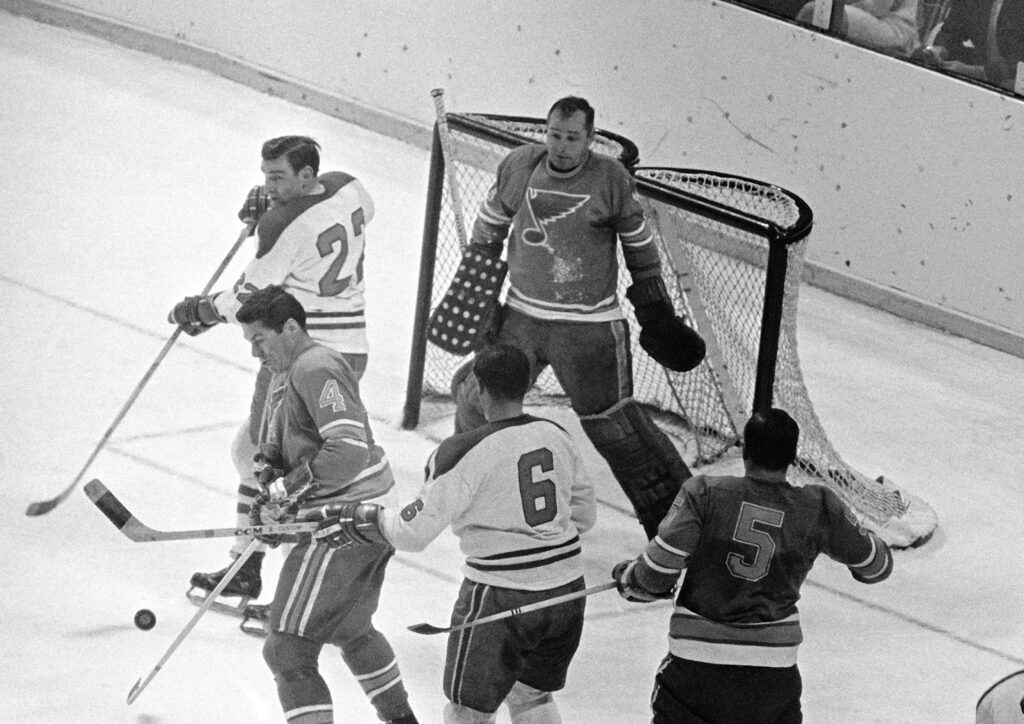
Glenn Hall, a Canadian goalie who played an unprecedented 502 consecutive complete National Hockey League games — all without a protective face mask — and pioneered a netminding style that later became standard, died Jan. 7 at a hospital in Stony Plain, Alberta. He was 94.
His death was announced in a statement by the NHL, which did not cite a cause.
In an era when goaltenders risked taking pucks to the face and stood straight up while blocking low shots, “Mr. Goalie,” as Mr. Hall was nicknamed, dropped to the ice with his leg pads extended to either side, in what is now known as the butterfly technique. He was one of the first goalies to do it regularly, before it was fine-tuned by others and became a routine part of playing the position.
Blocking shots, however, wasn’t the only thing on Mr. Hall’s mind.
“Our first priority was staying alive,” he told Sports Illustrated in 1992, describing an era when head injuries to goalies were far more common. “Our second was stopping the puck.”
After a few seasons in the minor leagues, during which his name was misspelled “Glin Hall” on the Stanley Cup as a nonplaying reserve in Detroit’s 1952 victory over Montreal, Mr. Hall earned a starting role with the Red Wings, winning the Calder Trophy as rookie of the year in 1955.
He didn’t miss a game until 1962 — a record streak for a goalie that ended after he threw out his back while bending over to adjust a strap while playing with the Chicago Black Hawks.
Mr. Hall’s routine involved psyching himself up before games to the point of vomiting, then playing against hard-shooting greats such as Detroit’s Gordie Howe and Montreal’s Maurice “Rocket” Richard, and regularly ending the night with a fresh set of stitches.
With the Black Hawks, led by superstars Bobby Hull and Stan Mikita, Mr. Hall backstopped the team’s 1961 Stanley Cup victory, its first in 23 seasons. The championship came against the team that traded him, the Red Wings.
Over his 18 seasons, the intensity Mr. Hall brought to the game and the strain of sustaining facial injuries took a toll. He said he sometimes screamed into open fields at his farm to relieve stress, and wavered until the last minute to sign new contracts. He once didn’t report to training camp because he claimed he had to paint his barn, even though he had no barn.
In 1967, Mr. Hall joined the expansion St. Louis Blues and did something for the first time in his career: He wore a protective mask, joining other goalies who found the extra protection better than nothing, although they took some getting used to and didn’t fully protect the head.
The Blues made three consecutive appearances in the Stanley Cup finals, with Mr. Hall in net. They were swept in each series, twice by Montreal and once by Boston, but Mr. Hall won the 1968 Conn Smythe Trophy as the playoffs’ most valuable player — an honor rarely given to a player on the losing club.
Against Boston in 1970, Mr. Hall had the misfortune of being involved in the losing end of a celebrated play, as Bruins superstar defenseman Bobby Orr scored the championship-clinching goal against him in overtime. The scene of a gleeful Orr in midair, with Mr. Hall behind him, became one of the most memorable images in hockey history.
While the play stung at the time, Mr. Hall later found humor in it.
“We were signing that photo, over and over again,” he told NHL.com in 2017. “I think I turned to him that day and said, ‘Bobby, was this the only goal you ever scored?’ ”
Glenn Henry Hall was born in Humboldt, Saskatchewan, on Oct. 3, 1931. His father was an engineer with the Canadian National Railway.
Mr. Hall played at the junior hockey levels before signing with the Detroit Red Wings in 1949. After retiring in 1971, he tended to his farm in Alberta and worked part-time with the Blues and Calgary Flames, as a consultant and goaltending coach.
His wife of 55 years, the former Pauline Patrick, died in 2009. They had four children. Information on survivors was not immediately available.
Mr. Hall won three Vezina Trophies in his career as the goalie who allowed the fewest goals in the league. He was inducted into the Hockey Hall of Fame in 1975 and, in 2017, was voted one of the 100 greatest players in NHL history.
“I liked everything about hockey,” he once said, “except the game.”
The post Glenn Hall, Hall of Fame goalie with enduring iron man streak, dies at 94 appeared first on Washington Post.