One year after two of the most destructive wildfires in California’s history erupted just hours apart, survivors commemorated the day in Altadena and Pacific Palisades with a mixture of anger and somber remembrance.
At the American Legion veterans post in the Palisades, hundreds gathered at a military-style white-glove ceremony to pay respects to the 12 families who lost loved ones in the Palisades fire.
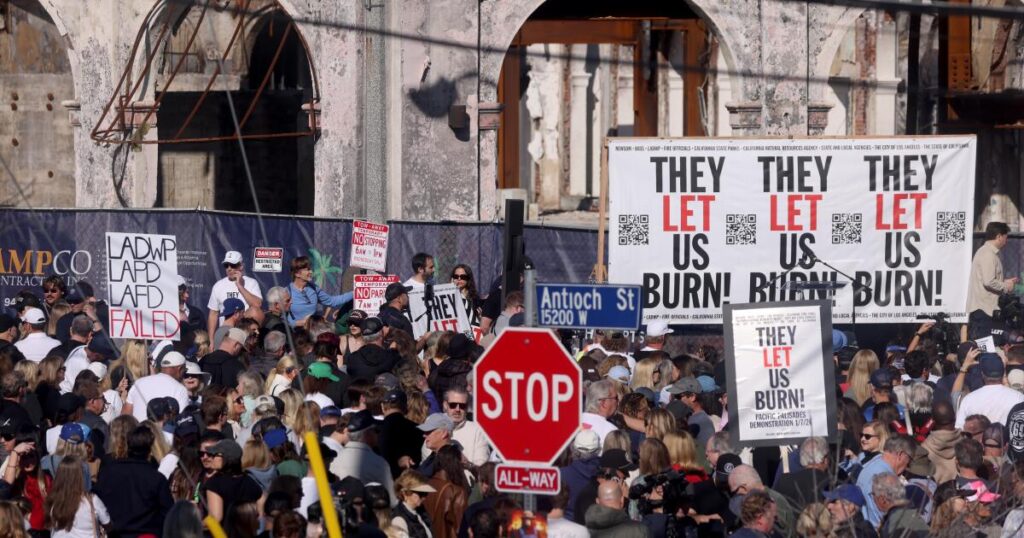
Just down the street, an even larger crowd shouted the rally cry “They let us burn,” to demand comprehensive disaster planning, relief for families working to rebuild and accountability for government missteps that they say enabled the disaster and have slowed the recovery.
In Altadena, survivors congregated at the Eaton Fire Collaborative’s community center with a clear message: They were not backing down in the fight to return home.
“This year has been the hardest year of our lives,” said Joy Chen, executive director of the Eaton Fire Survivor Network. “Unimaginable grief. The 31 people who died that day, and the hundreds who have died prematurely since. Home lost. Jobs lost. Incomes lost. A sense of safety and identity stripped away.”
In the evening, Atladenans plan to gather at a beloved family-owned burger joint that miraculously still stands amid a sea of empty lots. The restaurant, Fair Oaks Burger, reopened an outdoor kitchen for residents and recovery workers just weeks after the fire and has become a lifeline for the neighborhood.
Jessica Rogers, who lost her home in the Palisades fire and has since become the executive director of the Palisades Long-Term Recovery Group, which organized the remembrance ceremony, said that people are still processing what happened over the last year.
“The five different stages of grief — you can feel them. Sometimes people can feel them almost all at the same time,” she said. “There is no right or wrong way to process grief. Everybody processes it in their own way, at their own speed and their own time. And some need to do it at home, behind closed doors; others need to do it very vocally, out in public.”
Very different communities, the Palisades and Altadena share similar frustrations — with insurance companies, government agencies and disaster scammers. But on Wednesday, they directed their wrath on contrasting targets. In Altadena, activists are focused on real estate speculators and Southern California Edison, suspected of triggering the Eaton fire. In the Palisades, anger continues to mount against Los Angeles Mayor Karen Bass, the city’s Fire Department and state agencies.
Inside the Palisades Legion Post, the 11-year-old daughter of Jim Cragg, the Post’s former commander, handed white roses to the families of fire victims. One of these was a family member of Rory Sykes, who perished in the blaze, who told Cragg: “He would have loved this.” Both held back tears.
The families then led hundreds of Palisadians waiting outside — many wearing “They Let Us Burn” T-shirts — in a procession down to a small community park, where the legion had placed 13 memorials: One for each victim, and one for the many uncounted lives lost in the fire’s wake.
In a moment of silence, Palisadians called out the names of loved ones who had died in the aftermath. Many sobbed.
Researchers estimate the January fires resulted in upward of 400 excess deaths in L.A. County beyond the official death toll.
“People burned alive in their homes. There was nobody going to get them,” Kathleen Boltiansky said through tears as she watched the ceremony.
Boltiansky, who lost her house in the fire, planned to attend the “They Let Us Burn” rally after the service. “Public safety should be item No. 1 — if they cannot provide public safety, what are they doing?”
Just across the street, Billy Joel’s “We Didn’t Start the Fire” played over a loudspeaker as protesters gathered in front of the burned husk of the historic 1924 Business Block Building.
Rally organizer Jeremy Padawer, who lost his home in the Palisades fire, took the stage. “The days of gaslighting should be over,” he called out.
Padawer asked the audience to raise their hands if their home burned or remains contaminated.
Hundreds of hands shot up.
Josh Lederer, clutching a “They Let Us Burn” banner, described how he, his wife and 2-year-old daughter moved five times since the fire and are still unable to return to their home amid fights with their insurance company. He’s glad his child is too young to really understand what’s going on.
“You feel, when there’s an emergency, your city’s going to be there to protect you, and we had nobody,” said Lederer, 42. “And since then, we’ve had nobody helping us. All we get is lip service from Karen Bass and Newsom that it’s somebody else’s fault or we’re trying to profit off this. We’re not trying to profit off anything. We want our lives back.”
When ABC 7 Eyewitness News asked Bass if she thought the “They Let Us Burn” rally is how residents should commemorate the one-year anniversary, she dismissed the event.
“I don’t think so,” she said. “But again, I think there are people who are profiting off this, and that is what I find very despicable.”
Padawer said he had invited Bass and Gov. Gavin Newsom to the rally to listen to survivors and accept accountability, but neither joined.
A spokesperson for Newsom’s office said the governor would meet directly with survivors in Los Angeles this week. Bass started the day at a private vigil at the Self-Realization Fellowship Lake Shrine in Pacific Palisades, then presided over a flag-lowering ceremony at City Hall to honor the victims.
Several elected officials attended the American Legion ceremony — including state Sen. Ben Allen and county Supervisor Lindsey Horvath — but only one attended the rally too: City Councilmember Traci Park. She stepped on stage at the rally in a far less somber tone than at the memorial.
“Let’s end this culture of half-assed solutions,” she said — also noting that there were “some folks” who “didn’t want me to come here today.”
“What happened on Jan. 7 was catastrophic failure and to pretend otherwise is just insulting,” she told the crowd. “You did not imagine what happened, and you are right to be angry.”
In Altadena, a coalition of lawmakers, survivors and advocates at the Collaboratory community center set the tone for the second year of recovery.
Recently, a survey from the nonprofit Department of Angels found that more than 7 out of 10 Altadena residents remain displaced from their homes. Nearly half have exhausted their savings, and over 40% have taken on personal debt to survive, said Miguel Santana, co-founder of the nonprofit.
Among them are people like Ada Hernandez, who owned a 1950s home on Mountain View Street with her husband, Miguel, where they lived with their 5-year-old son, Mason, 2-year-old Sadie and 14-year-old dog Bentley. They moved into their home in 2018, on the same day she lost her firstborn son. But in the fire, she said, she lost every physical memory of him, including his neonatal intensive care unit pillow and handprint.
Now, the pain has compounded as her family has been forced to move three times over the last year. They have spent the last two months in an Airbnb with help from the Salvation Army, she said, but that runs out next Wednesday.
“We feel forgotten,” Hernandez, 37, said. “We feel like we’re at a standstill.”
Bass and Newsom have touted L.A.’s recovery as one of the fastest in modern California history. Bass, in particular, points to her work in cutting red tape at the Department of Building and Safety, which is reviewing and signing off on the rebuilding plans. But to many survivors, recovery still feels painfully slow.
As of December, L.A. County had issued rebuilding permits for about 16% of homes destroyed in Altadena, and the city of L.A. issued permits for just under 14% for the Palisades, The Times found. Many whose homes survived the fire but were contaminated by smoke and ash are still fighting with their insurance companies to remediate their homes. Many homes in Altadena remain contaminated even after remediation.
Mark Mariscal, a longtime Altadena resident, said he faced months of delays by his insurance company but, with help from the Eaton Fire Survivors Network, finally got a check in the mail. He became emotional as he remembered the lives lost and everything that transpired since Jan. 7.
“It’s just a battle, a good one because we’re pretty sure we’re never moving again,” he said. “After we build this house the way we want it, we’re not moving again. Unless I’m sent up to my higher power.”
For many survivors, finding a sense of peace in their healing journeys one year into recovery has proved difficult without closure. Investigations and reports into the failures that led to and exacerbated the disasters have left residents with more questions than answers.
In October, federal investigators announced the Palisades fire appeared to explode from a small brush fire still smoldering from a week prior. Ongoing litigation has suggested that Los Angeles Fire Department leaders limited their firefighting techniques to protect sensitive plants at the request of California State Parks, and investigations by The Times found that leaders ordered firefighters to leave the site even though it was still smoldering and subsequently covered up their mistakes.
Meanwhile, emergency officials failed to issue evacuation orders for west Altadena, a historically Black enclave, until five hours after the fire began to engulf homes in the neighborhood. An investigation by The Times found that even as the fire progressed far into the west side of town, the majority of Los Angeles County Fire Department resources remained elsewhere.
“So many different layers of mistakes had to be made for this to occur,” Padawer told The Times. He said the rally was intended to highlight both the “gaslighting” and “solutions that can help our neighbors come home.”
Sue Kohl, president of the Pacific Palisades Community Council, said she had mixed feelings early Wednesday as reporters gathered for a news conference on the barren front lawn of what will be her new home on Iliff Street in the decimated Alphabet Streets neighborhood.
Construction on her two-story home — surrounded by empty lots — is well underway. But she has no memories here, she said. It’s not the place where she lived for 32 years and raised five children and three stepchildren.
The anniversary, she said, is “like emotional ping pong. You want to be positive. But at the same time — I mean, look around. At least now you see a lot of construction.”
Many survivors say a hope for the future is the one thing that motivates them. In five years, or maybe ten, Rogers looks forward to all the little things that make the Palisades the Palisades.
“I’d like to see children running down the streets happily. I’d like to hear them, see them on their bikes, watch the teenagers hang out at CVS, in the parks. I’d like to see all Angelenos from all parts of Los Angeles back up in our hiking trails,” she said.
“That would bring me a lot of joy, to see our schools thriving again, and I’d love to complain about the 3 p.m. traffic — the kids’ pickup time from schools in the village,” she said. “That’s what I’d like to see come back in our community as soon as possible.”
The post Survivors in Palisades and Altadena mark anniversary of deadly fires with anger and mourning appeared first on Los Angeles Times.