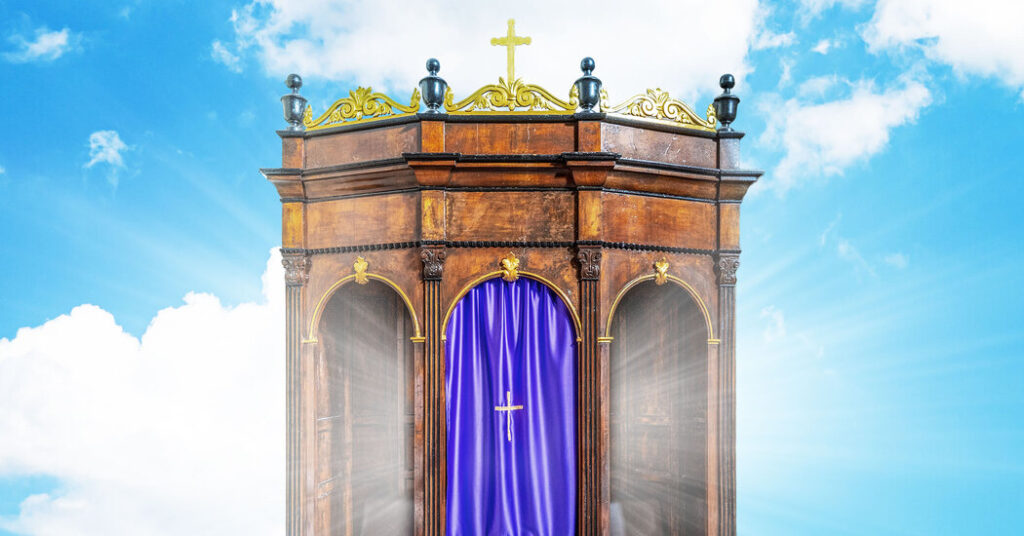
In “The Guilty Vicarage,” an essay on detective fiction, W.H. Auden argues that the most successful detective novels take place in an apparent Eden (the cozy village, the ivied college, the country house at Christmastime) that’s tainted by a hidden thread of evil, and “the job of the detective is to restore the state of grace.”
In “Wake Up Dead Man,” the latest installment in Rian Johnson’s series of “Knives Out” whodunit movies, Auden’s religious analysis is literalized: The setting is a rural Catholic parish, the key action revolves around the confessional, and the climax of the story sees the skeptical detective deferring to a youthful Catholic priest, who induces a confession that both resolves the mystery and — more important — delivers absolution to the repentant killer.
I watched the movie, coincidentally, just after taking my children and myself to confession, a few days before Advent gave way to Christmas. This is the sacrament’s most crowded time of year, when you need to arrive 10 minutes early if you want to be shriven before noon, and we experienced a novelty: After hearing our sins the priest offered no advice at all, just moved straight to the act of contrition, dispensing absolution and keeping the line moving. (Presumably, no one delayed him by confessing to a baroque locked-room murder plot.)
Wondering if this streamlined approach was an example of the “trad” turn among younger Catholic priests, I consulted “For I Have Sinned: The Rise and Fall of Catholic Confession in America,” a recent book by the Boston College historian James O’Toole. There I learned that priestly advice wasn’t just some innovation that came in with the touchy-feely 1970s. At the midcentury high tide of confessional practice in America, when the lines my family experienced at Christmas would have been part of a normal Catholic weekday, a “guide for newly ordained priests said the most important quality for a good confessor was ‘giving every penitent some words of advice.’” So our brisk confessor was perhaps less a throwback than an innovator, reducing the sacrament to its essentials, whether as an adaptation to a hectic age or as an austere counterpoint to its psychologizing spirit.
That the sacrament of confession might have any place in 21st-century religion is barely considered in O’Toole’s otherwise illuminating history, which traces how frequent confession became deeply embedded in Catholic life and then how the practice dissolved under myriad pressures — the aftereffects of the Second Vatican Council, the sexual revolution, the priest sex-abuse crisis, American culture’s therapeutic turn. His story is told as though the ending is settled: Confession is a “ghost sacrament,” practiced only by a “tiny minority of Catholics,” sufficiently anachronistic that the faith clearly awaits some entirely “new form” of self-scrutiny and repentance to make its moral vision stick.
This seems wrong to me. Yes, the particular role that frequent confession played in the intense pre-1960s Catholic culture is unlikely to return. But the sacrament itself is more resilient than ghostly, and “Wake Up Dead Man” is as good a window as any into why it’s likely to endure.
Johnson, a non-Catholic director, sets out to tell a story about religion using familiar post-1960s tropes — pitting an intolerant, puritanical form of Christianity, associated with the older generation (embodied by Josh Brolin’s ranting Monsignor Jefferson Wicks), against a gentler, more merciful form associated with youth (embodied by Josh O’Connor’s Father Jud Duplenticy). As in the prior outings of his great detective, Daniel Craig’s Benoit Blanc, Johnson is especially interested in satirizing MAGA conservatism and all its pomps and works, and his gallery of suspects doubles as a crude sketch of the sorts of people he imagines would be drawn to a crusading, anti-modern Christianity.
But the portrait of Father Jud, crucially, is not the secularized or therapeutic vision of Christian ministry that predominated in some liberal circles after Vatican II, and it’s certainly not a vision that suggests that the traditional priestly vocation is somehow obsolete. No: What Johnson, the strident political liberal, seems to want from his virtuous, non-MAGA Christian cleric is a sacramental and mystical vocation, carrying with it the special capacity to hear confessions and forgive sins, to bind and loose.
In my experience, this impulse is common among younger religious believers, Catholic or otherwise, who are alienated from Christianity’s Republican or Trumpian expressions: They may want a more liberal form of religion, but they don’t want a more secularized form, and they’re much more interested in the mystical and sacramental than their 1970s antecedents were. They may not have a rite like confession integrated into their lives in the routinized weekly or monthly pattern that once prevailed in American Catholicism, but they don’t regard such things as obsolete or unimportant, and they want sacramental possibilities to be there when they really need them.
And “there when you really need it” seems like the place where confession has settled in American Catholicism’s current complicated epoch. If you look at recent data from the Pew Research Center, for instance, it shows that 23 percent of Catholics go to confession at least once a year — which is extremely low compared with the Catholic world of 1962, but roughly comparable to the share of Catholics who currently attend Mass at least weekly (28 percent in the same survey).
.op-aside { display: none; border-top: 1px solid var(–color-stroke-tertiary,#C7C7C7); border-bottom: 1px solid var(–color-stroke-tertiary,#C7C7C7); font-family: nyt-franklin, helvetica, sans-serif; flex-direction: row; justify-content: space-between; padding-top: 1.25rem; padding-bottom: 1.25rem; position: relative; max-width: 600px; margin: 2rem 20px; }
.op-aside p { margin: 0; font-family: nyt-franklin, helvetica, sans-serif; font-size: 1rem; line-height: 1.3rem; margin-top: 0.4rem; margin-right: 2rem; font-weight: 600; flex-grow: 1; }
.SHA_opinionPrompt_0325_1_Prompt .op-aside { display: flex; }
@media (min-width: 640px) { .op-aside { margin: 2rem auto; } }
.op-buttonWrap { visibility: hidden; display: flex; right: 42px; position: absolute; background: var(–color-background-inverseSecondary, hsla(0,0%,21.18%,1)); border-radius: 3px; height: 25px; padding: 0 10px; align-items: center; justify-content: center; top: calc((100% – 25px) / 2); }
.op-copiedText { font-size: 0.75rem; line-height: 0.75rem; color: var(–color-content-inversePrimary, #fff); white-space: pre; margin-top: 1px; }
.op-button { display: flex; border: 1px solid var(–color-stroke-tertiary, #C7C7C7); height: 2rem; width: 2rem; background: transparent; border-radius: 50%; cursor: pointer; margin: auto; padding-inline: 6px; flex-direction: column; justify-content: center; flex-shrink: 0; }
.op-button:hover { background-color: var(–color-background-tertiary, #EBEBEB); }
.op-button path { fill: var(–color-content-primary,#121212); }
Know someone who would want to read this? Share the column.
So an annual confession — which is what the church formally requires — is still a pretty normal part of being a consistently practicing Catholic in the 2020s. Then, among those weekly-attending Catholics, about a quarter go to confession several times a year or more, while even among Catholics who attend less often, once or twice a month, only about 30 percent say they “never” go to confession. And while generational data is a bit fuzzy, there is some evidence that practicing Gen Z Catholics are more likely to go to confession than their elders.
Again, relative to confession rates 60 years ago, these patterns still look like a steep decline. But if your base line is our much more secularized and atomized and individualistic culture, confession remains one of the more commonplace and concrete forms of Catholic practice even now.
I am a case study in this new dispensation: The world of weekly confession that O’Toole describes is entirely alien to me, and my own confessional practice is usually Advent, Lent and moments of major guilt.
Is that something to build on? A stable equilibrium? A level place with more decline ahead? You’ll have to ask my kids in 30 years. But I tend to think that what the doubter and the seeker and the Hollywood director expect of Catholic priests still matters, and the artistic power of the moment when Father Jud whispers to a dying murderer, “I absolve you of your sins, in the name of the Father and the Son and the Holy Spirit,” is an indicator that the sacrament of penance still has a long life ahead.
Breviary
Dan Wang on America and China and A.I.
Oliver Traldi on masculinity and monstrosity.
Stephanie Wakefield on the making of aesthetic movements.
Aaron Renn on the safest edgelord.
Josh Konstantinos on sterile polygamy.
Richard Rushfield on Hollywood’s last stand.
The post A Future for Confession appeared first on New York Times.