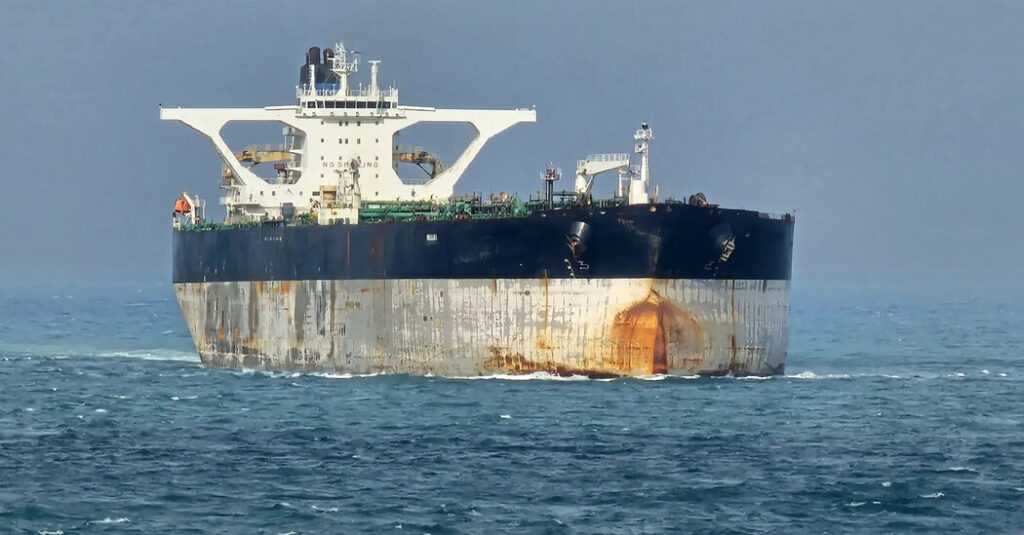
The U.S. military seized two oil tankers on Wednesday, including a Russian-flagged ship that had been evading American forces for weeks, as the Trump administration moved agresssively to take control of Venezuela’s multibillion-dollar oil industry.
The seizure of the Russian-flagged vessel in the North Atlantic, between Scotland and Iceland, escalated a confrontation with Moscow days after a U.S. military raid ousted a Russian ally, President Nicolás Maduro of Venezuela. The U.S. military said it had seized the vessel for violating U.S. sanctions.
The military said that it had intercepted the second tanker in international waters in the Caribbean, where it was “conducting illicit activities,” and that it was escorting the “stateless” vessel to the United States.
The seizures came as senior Trump administration officials outlined plans to take control of Venezuela’s oil sales and impose their will on Venezuela’s leaders. The White House press secretary, Karoline Leavitt, told reporters in Washington that any actions taken by Venezuela’s interim government “are going to be dictated by the United States of America.”
Venezuelan officials have not commented publicly on the U.S. government’s plans, and it was not clear what legal authority would allow the United States to oversee Venezuela’s oil, which forms the backbone of the country’s economy. But Venezuela’s state-run oil company confirmed for the first time that it was negotiating the sale of crude oil to the United States.
“This process is being developed under frameworks similar to those currently in effect with international companies, such as Chevron, and is based on a strictly commercial transaction,” the company, Petróleos de Venezuela, said in a statement.
The United States was moving to take control of Venezuela’s oil when the Coast Guard boarded the Russian-flagged tanker on Wednesday morning.
The tanker, once called Bella 1 and now named the Marinera, had been pursued by the Coast Guard for more than two weeks after being briefly stopped in the Caribbean on its way to pick up oil in Venezuela. Its crew then painted a Russian flag on the hull and Russia dispatched at least one naval vessel to join the ship.
The United States mobilized a large force to assist the Coast Guard, including a Navy P-8 submarine-hunting aircraft and AC-130 gunships. Several U.S. military aircraft left bases in Britain on Wednesday morning heading toward the tanker, according to flight-tracking sites.
Britain said it had helped the United States by providing air surveillance and a naval support vessel, as well as bases for American military assets. Britain said it had joined the operation because of the sanctions imposed on the vessel by the United States. A federal magistrate judge issued a seizure warrant last month, based on the tanker’s history of transporting Iranian oil for groups linked to terrorism.
In a statement, the British defense ministry said that the tanker was “initially flying a false flag” and that it had “turned off its transponders while at sea and sought to reflag while being pursued.”
No Russian vessels were in the area when the Coast Guard and U.S. military forces stopped the tanker, according to two U.S. officials briefed on the operation who spoke on the condition of anonymity to discuss a sensitive matter. The Coast Guard encountered no resistance or hostility from the crew when it boarded, one of the officials said. The vessel was not carrying oil at the time.
The Russian Ministry of Transport confirmed that U.S. forces had boarded the tanker in international waters and that it had lost contact with the vessel. The ministry said that under the 1982 U.N. Convention on the Law of the Sea, “no state has the right to use force against vessels duly registered in the jurisdictions of other states.” The U.S. has not ratified the convention but generally recognizes its provisions.
Asked if the seizure of the Russian-flagged tanker signaled a larger conflict with Moscow, Ms. Leavitt did not respond directly. She called the ship a “Venezuelan shadow fleet vessel that has transported sanctioned oil” and said that the tanker’s crew could be brought to the U.S. for prosecution “if necessary.”
The Russian Foreign Ministry called on the United States to ensure the “humane and dignified treatment” of Russians aboard the vessel and to respect their rights.
The second oil tanker intercepted, the M Sophia, was not flying a valid national flag, allowing the Coast Guard to board it, according to a U.S. official.
The U.S. Southern Command said that the Coast Guard would escort the ship to the United States for “final disposition.” It released a video showing American forces descending onto the M Sophia’s deck from a helicopter.
The Treasury Department placed the ship under sanctions in January 2025 for its involvement in the Russian oil trade. But the American authorities did not have a judicial warrant to take possession of the vessel, as they did with the Russian-flagged vessel, according to a U.S. official.
Hours after the tankers were seized, the Secretary of State Marco Rubio sketched out a three-step plan for Venezuela’s lucrative oil industry.
The first step, Mr. Rubio said, is for the United States to seize and sell some 30 to 50 million barrels of oil, roughly what Venezuela produces in two months. It is unclear what, if anything, Venezuela would get in return for the oil, which is worth between $1.8 billion and $3 billion at current market prices. Mr. Rubio said the U.S. was “about to execute on a deal to take all the oil,” and would control the profits.
Once Venezuela is “stabilized,” he said, the second step will ensure that “American, Western and other companies have access” to Venezuela’s oil market.
Mr. Rubio described the third step as “one of transition,” although Ms. Leavitt, the White House press secretary, said it was “too early” to discuss when Venezuela might hold elections.
The U.S. energy secretary, Chris Wright, said that the United States would oversee the sale of Venezuela’s oil “indefinitely.”
“We need to have that leverage and that control of those oil sales to drive the changes that simply must happen in Venezuela,” Mr. Wright, a former oil executive, said on Wednesday at a Goldman Sachs energy conference near Miami. He said some of the profits “can flow back into Venezuela to benefit the Venezuelan people.”
Even before the capture of the Venezuelan leader, a partial blockade imposed by the United States prevented many oil tankers from leaving Venezuela. That choked off a vital source of revenue for the country’s government and forced it to keep oil in storage tanks and ships floating off the coast.
Mr. Rubio said that Washington had “tremendous leverage” over Venezuela’s interim leaders and “tremendous control” over what they were “doing and able to do.” The administration, he said, is “not just winging it.”
The secretary of state spoke after administration officials gave members of Congress a classified briefing on Venezuela.
After the briefing, Senator John Cornyn, Republican of Texas, praised the operation that captured Mr. Maduro and said American officials expected to play a direct role in steering the decisions made by Mr. Maduro’s successor, Delcy Rodríguez.
“Secretary Rubio is, obviously, working on that,” Mr. Cornyn said. “But I would just say that the U.S. has a lot of levers to persuade her compliance.”
The House speaker, Mike Johnson, described the capture of Mr. Maduro as a one-off military operation with the goal of having the Venezuelan people govern themselves. “We don’t anticipate boots on the ground,” he said.
But a prominent Democrat, Senator Chuck Schumer, the minority leader, said there were still unanswered questions. “How many troops” he asked. “How much money? Are there guardrails?”
Senator Tim Kaine, Democrat of Virginia, noted that American troops had been injured in the raid on Caracas and that there were “U.S. forces arrayed around Venezuela.” The Republican-controlled Senate and House, he said, are unwilling “to hold a single public hearing to put these facts before the public.”
“Why not?” he told reporters. “We need to start doing our job.”
The Trump administration’s plans would amount to a sharp reversal in U.S. policy on Venezuela. The nation’s oil production and exports have been severely restricted since 2019, when President Trump imposed sanctions on the country, including Venezuela’s state-owned oil company.
Reporting was contributed by Rebecca F. Elliott, Emma Bubola, Robert Jimison, Stephen Castle, Megan Mineiro, Anushka Patil and Paul Sonne.
Nicholas Nehamas is a Washington correspondent for The Times, focusing on the Trump administration and its efforts to transform the federal government.
The post U.S., Cementing Control on Venezuelan Oil, Seizes Russian-Flagged Tanker appeared first on New York Times.