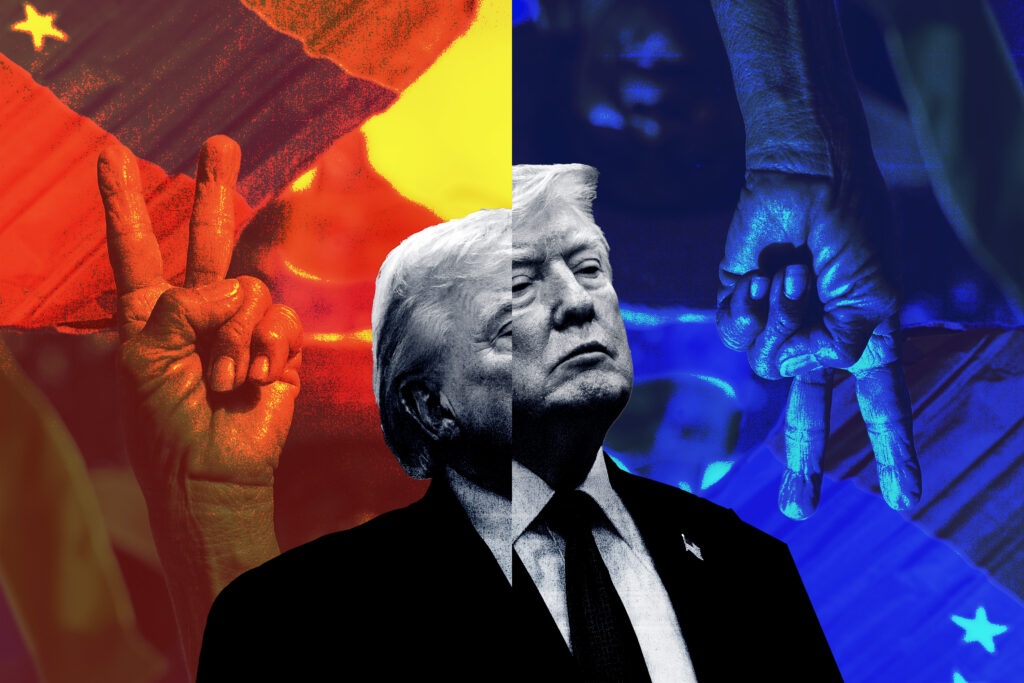
With his decapitation strike against the Venezuelan government, President Donald Trump is betting against two ideas that have often guided U.S. foreign policy.
The first is that the external behavior of a regime follows from its internal character, and thus that the most obdurate foes of the United States will remain so unless they are forcibly transformed. The second is that presidents should get congressional approval for foreign interventions even if they do not believe the Constitution requires it.
Arguments for U.S.-led regime change have varied depending on the target country, but the common thread has been that tyrannies pose threats to the U.S. because of their nature. They treat opposition to America as a guiding mission that justifies their repression and excuses the resulting misery at home. Other countries, the theory continues, are much more likely to live in peace with democracies like the U.S. if they are free societies.
Leaving Saddam Hussein in power in Iraq after the Gulf War, many Republicans and Democrats concluded in the decade afterward, demonstrated the necessity of regime change. He used that time to slaughter his own people, attempt to assassinate a former U.S. president, and — intelligence services mistakenly thought — stockpile chemical weapons and make progress toward building nuclear weapons.
The fact that Iraq didn’t have those weapons, combined with the protracted bloodshed during the U.S.-led occupation of the country, discredited regime change. But it continued to have advocates. Opponents of President Barack Obama’s nuclear deal with Iran said that it failed to address the true root problem: the character of the country’s government.
Opponents of Hugo Chávez and Nicolás Maduro’s rule over Venezuela made a similar case: The government would continue to traffic drugs, imprison Americans baselessly and ally with our enemies unless it were replaced.
But that’s not the approach the Trump administration seems to be taking, at least for now. It looks instead as though it is willing to leave the regime mostly intact while forcing it to modify its behavior. But Trump’s intentions are unclear given that he said in the news conference following the capture of Maduro that the U.S. would “run” Venezuela for a time, and even put in a good word for “regime change” during an interview.
If you ask Trump’s supporters why they back him on Venezuela while also thinking the Iraq War represents everything they do not want in foreign policy, you’ll get a variety of answers. The most convincing distinction is that this isn’t a regime-change war. The mission is faster and less complicated than nation building. The war was over in minutes.
The apparently limited scope of the intervention has also muted any complaints that Congress did not vote for it. While Congress has ceded a lot of power to the executive branch over the years, presidents typically seek congressional buy-in before embarking on large-scale military operations. Presidents received congressional approval before the Vietnam, Gulf, Afghan and Iraq wars.
The first President Bush said that he had the constitutional power to act to against Iraq without Congress. He nevertheless asked Congress to approve military action on the stated ground that it would “help dispel any belief that may exist in the minds of Iraq’s leaders that the United States lacks the necessary unity to act decisively” — and the unstated ground that he would not be the only official accountable if the conflict went badly.
This two-step — I have the power, please grant me the power — can be awkward, as when Obama said he had “the authority” to strike Syria but still wanted Congress to “authorize” it. (It didn’t, and he held off.) Presidents, especially in recent years, have avoided asking permission from Congress before undertaking smaller-scale actions. The first Bush acted in Panama, and Obama did in Libya, without any legislative blessing.
If, however, the U.S. gets pulled into a drawn-out campaign in Venezuela, Trump may regret not having gone to Congress first. If that were to happen, the decision to move against Maduro would turn out to have been more reckless than going into Iraq, since that commitment was at least preceded by an extended national debate.
Venezuela is not yet a quagmire, and may never be. Celebrating Maduro’s ouster is well warranted. But judging the wisdom of the manner it happened is premature.
The post Trump may regret bypassing Congress on Venezuela appeared first on Washington Post.