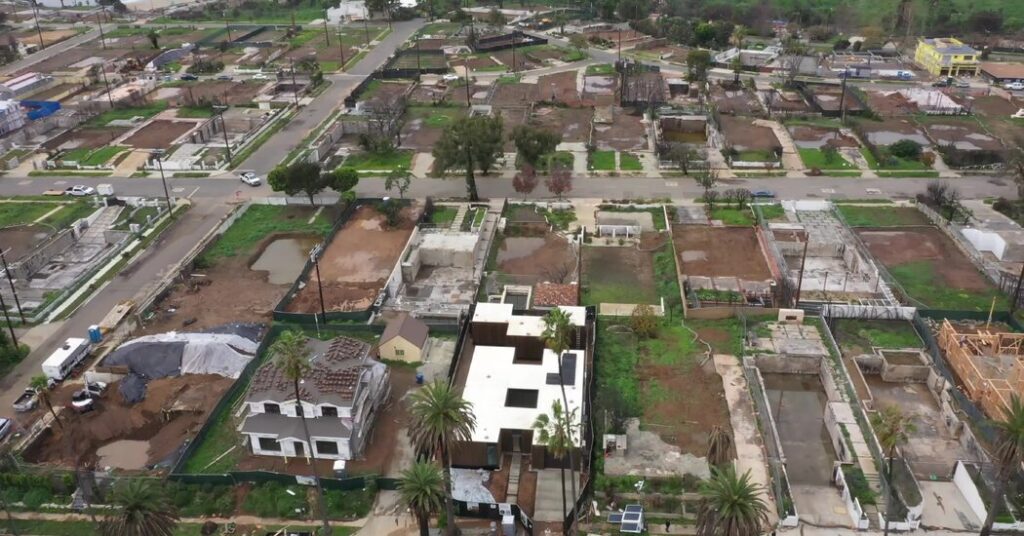
In Pacific Palisades, schools in the burn scar have started to reopen. Debris by the ton has been trucked away. Where walls of flame reduced coastal mansions to ashes, morning carries the scent of lumber and the clatter of construction crews, hammering.
Thirty-five miles to the east in Altadena, the wooden frames of new homes have started to rise from among the weeds and wildflowers. There has been so much rain lately that you have to look hard for the spots where the San Gabriel foothills behind them were scorched black — the color has returned to a lush green.
It has been exactly one year since wildfires erupted on Jan. 7, 2025, across the Los Angeles region, claiming at least 31 lives, destroying more than 16,000 buildings and obliterating almost everything across nearly 80 square miles. Thousands of destroyed houses are being rebuilt or are in the planning stages. Los Angeles city and county officials have issued more than 2,600 building permits, more than five times the number issued at this point in the aftermath of the Camp fire, which destroyed a similar number of Northern California homes in 2018.
But 12 months later, the disaster remains a raw wound — economically, politically, geographically, environmentally and even psychologically. Mile after mile, bare dirt stretches to the edge of the sea in the Palisades and to the base of the snow-capped San Gabriel Mountains in Altadena. Legions of displaced survivors are still battling with insurers. Fury has seeped into politics at every level, as stricken voters ask whether government should have done more to head off the devastation.
Even with numerous state and local executive orders suspending red tape and streamlining construction, experts in disaster recovery say the rebuilding could take another five years or longer. Survivors fear time and geography will erode compassion. Los Angeles County holds some 10 million people across more than 4,000 square miles. Most were not in the fire zones, and those people have moved on.
For those in the burn scar, however, the fires and their aftermath remain visceral.
Thousands of people whose homes were destroyed or damaged have moved away from the Palisades and Altadena, and hundreds have sold or are in the process of selling their properties. Those whose homes remained intact worry that smoke has contaminated their properties with heavy metals and carcinogens.
More than 70 percent of residents who were displaced remain so, while four out of 10 fire survivors have taken on debt and almost half have wiped out much of their savings, according to the most recent survey by the Department of Angels, a nonprofit advocacy group for survivors of the Los Angeles wildfires.
“I feel like I’m stuck,” said Karim Jaime, 50, whose home of 25 years in West Altadena survived the Eaton fire but was rendered uninhabitable by wind damage and lead and asbestos contamination. She said that her insurer, Allstate, had not paid any living expenses since February, claiming that the documentation she had sent was insufficient. Allstate declined to discuss her case, but said it has paid out more than $1.2 billion to thousands of customers affected by the fires.
Ms. Jaime and her husband have exhausted their savings and maxed out their credit cards to pay $3,000 in rent each month for a two-bedroom apartment in nearby Pasadena, where they live with their son, their dog and Ms. Jaime’s nearly 80-year-old mother. Because of the fire, the bus company where her husband works lost a contract with the Pasadena school district, so he now works two hours away in Barstow, Calif., where he spends the workweek in company-provided housing away from the family.
When their mortgage forbearance ends later this month, Ms. Jaime said, they will confront a $30,000 bill for back mortgage payments. If they cannot persuade their insurer to retroactively cover their living expenses, she said, their lender will likely foreclose.
“I see people rebuilding, and I think, ‘Oh my gosh, they’re rebuilding’,” she said. “And I see my house still standing, but I can’t live there.”
The Damage, and the Blame
Fire is a fact of life in Southern California, but even for longtime residents of Los Angeles, last January’s onslaught was sobering. At least 12 wildfires erupted across Los Angeles and Ventura Counties between Jan. 7 and the end of the month, fueled by drought and extreme winds. During the first two days of the disaster, six separate wildfires ignited, with fire crews stretched at one point across five simultaneously.
Two of those fires — the Eaton fire in Altadena and the Palisades fire in Pacific Palisades — left historic levels of devastation. The fire in Altadena was the second most destructive wildfire in the history of California, and the fire in the Palisades was the third most. Both are among the 10 deadliest. And both ignited in dense metropolitan suburbs near fire-prone wilderness — a development pattern that is becoming increasingly common in California, raising the risk of future blazes.
The numbers tell part of the story of the damage and recovery.
Researchers at the University of California, Los Angeles, have estimated property and capital losses at as much as $131 billion. State officials have asked the federal government for about $40 billion in federal disaster assistance, but have so far received only about $6 billion, most of it awarded right after the fires during the last days of the Biden administration.
More than 400 rebuilding projects were under construction in Pacific Palisades as the year began, according to the Los Angeles mayor’s office, with plans in the pipeline for nearly 1,300 addresses. County data showed more than 500 new residential rebuilds under construction in the Altadena area and more than 1,800 in the planning stages.
Foundations, institutions and individuals have drawn a staggering level of local charity — nearly $1 billion in fire recovery donations, with GoFundMe alone generating $265 million, according to a Milken Institute analysis of philanthropy’s role in the recovery.
But beyond the damage and the rebuilding costs, the issue that seems to have captured the most public attention and outrage in Los Angeles is the blame.
Federal investigators have attributed the Palisades fire to buried embers that smoldered for days after Los Angeles city firefighters declared a small Jan. 1 brush fire extinguished. A 29-year-old Uber driver has pleaded not guilty to federal arson charges in connection with starting that initial blaze that later rekindled into the Palisades fire.
The exact cause of the Eaton fire remains under formal investigation. But the Department of Justice filed a lawsuit against Southern California Edison, one of the state’s major utilities, accusing it of failing to properly maintain power lines, an oversight prosecutors said sparked the blaze. In October, the utility began offering settlements to Altadena households and businesses affected by the fire.
Firefighters have said that the flames seemed unstoppable once they started. By dusk on Jan. 7, walls of flames driven by hurricane-force winds swept over the region like a giant blowtorch and thwarted aerial surveillance. The homes packed into the coastal chaparral in the Santa Monica Mountains and the tall pines of the Angeles National Forest became storms of flying embers.
The sense that the fires could have been better mitigated or even prevented has hung over the past year. The idea has enraged survivors, haunted political leaders, fueled policy fights, lawsuits and social media misinformation, and seeped into this year’s races for governor and Los Angeles mayor. Local, state and federal authorities have launched at least half a dozen investigations and reviews.
The Los Angeles Fire Department has been hammered by allegations that it did not use every possible tool, such as thermal imaging, to check for embers after the Jan. 1 fire. It has also been accused of failing to adequately deploy firefighters and equipmentahead of time in and near Pacific Palisades despite forecasts about the increased risk of fire.
The Los Angeles Department of Water and Power has been sued over a disastrous loss of water pressure to fire hydrants in the Palisades that survivors say might have been prevented if a key city reservoir had not been emptied.
Mayor Karen Bass of Los Angeles has been criticized as well, for being out of the country on a diplomatic trip to Ghana when the fire started. The mayor apologized for her absence and replaced the fire chief— and then replaced the replacement. She has issued executive actions to accelerate rebuilding and suspended related fees.
The Palisades represents slightly more than one-half of one percent of the city’s population, and its voters mostly backed her opponent in the last mayoral election. Still, its residents are influential, and lawn signs calling on Ms. Bass to resign still dot vacant lots where the fire destroyed homes.
The mayor — a nationally known Democrat who ordinarily would cruise to a second term in the overwhelmingly Democratic city — is facing a significant re-election challenge from a civic leader who supported her last time.
In an interview, Ms. Bass said much of the criticism leveled against her has been fueled by political opportunism and misinformation, but added that she understood the public’s frustration.
“I am the mayor,” she said, “and the buck stops with me.”
Survivors are also seeking to hold others accountable for the disaster. A long list of plaintiffs has sued Southern California Edison for its suspected role in the Eaton fire. More survivors have sued Los Angeles County, which had jurisdiction over the response, over late evacuations in an area of Altadena where at least 18 people died.
High wind grounded helicopters that might have tracked the Jan. 7 fire via aerial surveillance, reviews commissioned by the state and county have since noted, and formal communications were hampered by cumbersome protocols and old equipment. But the reviews also cited reports of spot fires, radio calls and other conversations indicating that fire crews may have known as early as six hours before the first alert that the fire was spreading toward a community where Black and Latino middle-class homeowners had been rooted for generations.
“I find it very difficult — very difficult — to believe that the chain of command was not aware of the need to evacuate,” said Kathryn Barger, the Los Angeles County supervisor who represents Altadena. The county’s fire chief, she added, has initiated an internal investigation into “who knew what, when.”
President Trump has increasingly shifted the cost of disaster recovery onto states, communities and victims — delaying aid, withholding grants and reducing federal support, particularly to areas led by perceived political opponents. The president also has heaped scorn on California’s Democratic leaders, claiming falsely at various points that environmental protections worsened the fires.
Officials in California and Los Angeles said Mr. Trump has yet to transmit the remainder of California’s aid request — $34 billion — to Congress. Last weekend, after Mr. Trump boasted that his administration had “saved Los Angeles,” Gov. Gavin Newsom, who is widely viewed as a 2028 presidential contender, reiterated his previous criticism of the administration.
“Unless Trump is finally delivering the federal aid survivors need to rebuild after the horrific fires — nearly a year after California first requested it — he should keep Los Angeles out of his mouth,” the governor posted on X.
‘Everything Is Different’
As survivors work to build out their physical surroundings again, it is perhaps the emotional landscape that remains the most in flux.
“My wife is traumatized,” said Don Griffin, 79, a Southern California native whose tile-roofed home in Pacific Palisades had to be gutted to remediate smoke contamination. They could probably leave their rental in nearby Santa Monica now, he said, but they find themselves reluctant to go back to their old street on a hillside not far from where the Palisades fire started.
“She can’t stand the Santa Anas,” he said, referring to the hot desert winds that routinely sweep over the region. “To her, the wind means fire now.”
Black lifelong residents of West Altadena, like Kimberly Jones, 53, say that no amount of repair or financial compensation will bring back a community that was already being eroded by gentrification.
“It’s nothing but poor Black and Mexicans who live over here, and who cares about y’all?” Ms. Jones said on a recent afternoon, standing on the lot, now mostly overgrown with grass, where her home once stood. “That’s the way I feel.”
In Pasadena, Becky Smith, 84, said that she and her husband had watched last Jan. 7 as the first embers from the Eaton fire landed and burst into flames on the mountainside behind their house, and then ballooned to envelop her lemon and tangerine trees and her jacaranda.
Their home survived. Their daughter’s did not.
Now the grandchildren who lived just minutes away have moved to the Pacific Northwest with their parents, she said, and at least half a dozen properties in her area have been put up for sale by her neighbors. Despite the toxic soot that they believe remains, she said on a recent afternoon, she and her husband, who uses a wheelchair, have stayed put. In part it’s because the house, where they have lived for a half-century, is familiar.
She paused for a moment, the living room still except for the sound of a clock ticking. “Everything,” she said, “is different.”
Shawn Hubler is The Times’s Los Angeles bureau chief, reporting on the news, trends and personalities of Southern California.
The post One Year After the Fires: Los Angeles Tries to Heal appeared first on New York Times.