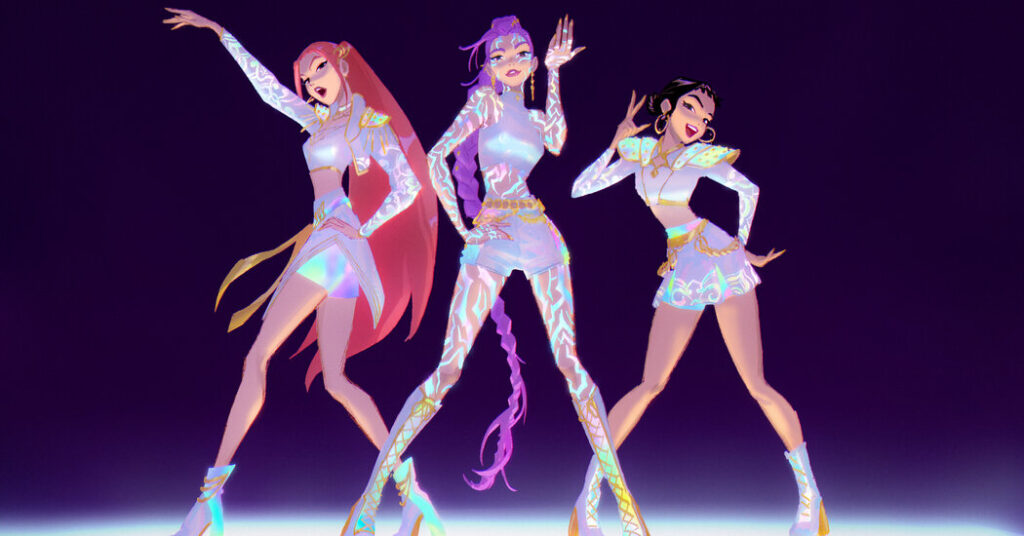
Before Rumi was the purple-haired superstar of “KPop Demon Hunters,” she was a painting on the bottom of a skateboard. Maggie Kang, a director of the movie, and her husband, Radford Sechrist, a director and storyboard artist, designed the character for another project; a friend painted the deck.
That project was about a skate crew. But “I liked her so much,” Kang said, “I just plucked her out and made this movie around her.” (And the name stuck: The couple also christened their daughter Rumi.)
The fictional Rumi was born around nine years ago, evolving into the heroine of “KPop Demon Hunters,” the stylish animated megahit about K-pop vocalists who moonlight as demon slayers. It is a front-runner in several Oscar categories, including best original song, for the chart-topping anthem “Golden,” performed by Huntr/x, Rumi’s all-female trio, in a battle of the bands with the rival Saja Boys.
It took years to bring this unlikely idea to fruition — and it spawned an even more unexpected fandom, with singalong screenings and kids around the globe dressing as the characters. Although, Kang said, “we didn’t craft this movie thinking that it was for children. It was really for a more mature audience. And really for ourselves.”
In interviews from New York, Los Angeles and Seoul, members of the creative team as well as the stars Arden Cho, who voiced Rumi, and Ahn Hyo-seop, who played Jinu, the Saja Boys’ leader, filled in the back story behind the most-watched movie in Netflix’s history.
The Origins
In 2018, Kang developed a pitch for the producer Aron Warner; as a storyboard artist, she had worked on a “Shrek” movie with him.
MAGGIE KANG (director) I wanted to do something with demons. I grew up hearing stories about the grim reapers of Korea — the black hat guys; they were visually iconic. And I really liked this type of female character that was cool but also a little silly. I had been in so many animation writing rooms where we were scared to make female characters really silly, and that was always frustrating. My husband was like, why don’t you take all the ideas you have and put them together?
I used K-pop as the selling point. I’m an artist, but I also came up from DreamWorks. I’m trained to have a marketing mind. And I’m just an O.G. K-pop fan.
EJAE (songwriter and singing voice of Rumi) There was so much buzz around K — K-beauty, K-pop, K-food, K-drama. I didn’t doubt it would get a lot of attention.
Just a week after the pitch, Kang had a development deal with Sony Pictures Animation. Chris Appelhans, the film’s co-director, had also worked with Warner (“Wish Dragon”).
KANG Chris came in about eight or nine months afterward. The first thing we tried to figure out was, how do we connect music to demon hunting? Koreans have this mudang tradition, which is basically shamanism, and using song and dance to ward off spirits.
EJAE Shamanism is big in Korea. Using that as a hidden identity behind a K-pop star, that was so genius to me. Also, the boy band being demons, and showing the kind of dark side of Korea, or the K-pop industry — that’s when it really sold me.
KANG This silly K-pop movie idea could represent so many aspects of my culture. Once I realized that, it was full force, making the most Korean movie I could make.
CHRIS APPELHANS (director) My wife of 20 years, Maurene Goo, is Korean and she’s an author. She has always written these Korean American characters that are very funny and smart and also very flawed and weird and make stupid choices and love boys. She was always like, why are there not better female characters in animation?
Our first meeting, Maggie was like, I have this vision of these women that are so badass and so stupid. Even though it was weird to say as, like, the most generic white person in the world, I was like, I know exactly what you mean! I’m married to a really smart, funny, weird, angry, vengeful Korean person. When I told my wife about the project — how it could be about the power of music, and tap into so many cool things about Korean culture — she got quiet for a minute. Then she said, Dude, if you screw this up. …
KANG It was a wild journey for me. I sat down to storyboard the first sequence, as proof of concept. You start to realize how many layers of figuring out needs to happen for this scene to work. First there’s mythology questions, and then, OK, what is the choreography? What is the music? The fashion? The fight choreography? You start panicking because there are just so many things. And we have to do this for this entire movie.
The Production
MICHELLE WONG (producer) I joined the project three and a half years ago. We immediately planned a trip to Korea, to steep us in Korean culture. We needed to actually experience how people act, speak. Seeing the textures and even the foliage, how many trash cans there are in Korea.
KANG I wrote a lot of things in Korean first, in my head, and thought about, what is the best way to translate this emotion or dialogue into English? Because Korean is just more expressive.
APPELHANS In the first year or so, we started to find a unique design language for the characters that was not conventional Western faces. One of the breakthroughs was Ami [Thompson, an art director] did this page of Rumi looking incredibly glamorous and beautiful and authentically Korean, and reacting to things — making like a triple-chin and chugging a kimbap [a Korean rice roll]. It had this range of realness and comedy that was right next to the glamour. And Helen [Mingjue Chen, a production designer, who had also painted the skate deck] was doing these paintings that sold the idea of the mudang, or the ancient hunters, as superheroes wielding gifts of music; and inventing a visual language for the honmoon [a made-up word signifying a kind of spiritual togetherness]. Those are weird ideas that once you see them designed elegantly, you are like, oh, of course.
WONG Maggie and Chris really leaned into making our boys very unique and very attractive. You don’t see a lot of attractive male characters in animation, and definitely not attractive Asian men.
AHN HYO-SEOP (voice actor, Jinu) Jinu’s actually really hot. I didn’t expect him to be that good looking.
KANG One of our biggest goals was: Let’s finally give female characters really good makeup. In animation, all we get is blue or purple eye shadow. So we spent a lot of time creating these very fashionable looks. Our references were Givenchy, Jean Paul Gaultier and Alexander McQueen, and infusing Korean traditional elements with haute couture. [Rumi] had a braid because braids are iconic to traditional Korean hair, and it gave her that fun punk-rock silhouette. And we have nail art. We have nails on the boys, individual ones.
We also had a no-makeup look, to show all aspects of a female character, especially when they’re the most vulnerable. The artists were asking, do you really want this much bags under their eyes? Yes, we do.
APPELHANS The benchmark was so often live action. It all had to compete with real K-pop. Even the concert lighting.
One of our favorites, which was one of the last things we got the studio on board with, was that opening sequence [a montage of female singers through Korean history]. This mash-up of traditional costumes and sets with very elevated lighting and colors that are straight out of Vogue. It was hard for people to picture. But once we stuck it, I think the identity of the movie fully was finished.
The Stars
WONG It was important for us to have all-Korean talent, not [just] Korean American talent, but Korean talent that is known internationally. Casting was a journey of almost three years. Some of our cast didn’t come together until six months out.
ARDEN CHO (voice actor, Rumi) In 2022, I sent a voice note audition for Celine [Rumi’s mentor]. I don’t think I heard anything for almost a year. And I got a callback for Rumi. I remember calling my agent and being like, hey, was there a typo? Are you sure?
I’m 40. I kind of canceled myself out of it because of my age.
Rumi in a way reminded me so much of who I was in my 20s, when I was always battling this — hiding who I am so I can be perfect. For me, it took until my 30s to really be OK with: This is who I am. I feel like I grew with Rumi.
Ahn Hyo-seop, a star in Korea, had lived in Canada as a child but never performed in English. It took him “a week or two,” he said, before he agreed to play Jinu.
AHN I was so nervous. I haven’t been speaking English for at least 10 years. I got really rusty.
But I’m a big fan of animation. So I was just thinking about how I can use my voice 200 percent to actually make this guy alive.
CHO I got to see Rumi come to life through the process. There were days that we would record on black-and-white outlines. The hardest thing was the kimbap, because Maggie had a very specific, Homer Simpson funny [gurgling] sound she wanted.
They nailed the food. I mean, honestly, Korean food slaps.
AHN Maggie and Chris really dug into how Korean people think and live. Through Jinu, my message was, we can’t be afraid of our past. There might be choices you’re regretting. But it’s all about accepting who you are.
The Music
The filmmakers worried “every day for six years” about the soundtrack, Appelhans said.
KANG This concept is so wackadoo, the songs had to be fantastic for it to be accepted. And it was important for us that the songs served the story but then, as stand-alone pop songs, could be on the Billboard charts.
EJAE, an established K-pop songwriter, joined the movie around 2020. Her demos, created with the composer and producer Daniel Rojas, helped sell the film’s sound. She is the singing voice of Rumi, and among her first assignments was to write a mantra for Huntr/x.
EJAE I didn’t even know what a mantra was, I had to look that up. I was very familiar with traditional Korean music, like pansori, “Arirang” — the [unofficial] Korean anthem. It’s a sad kind of melody; I incorporated that in the mantra.
Pansori, the way the singer sings — it’s very guttural, almost as if you’re crying out loud. Showing that pain and the determination to protect the honmoon — when you hear Rumi kind of break down, you hear techniques from that.
APPELHANS The song Jinu sings in the demon world, we could not crack how to make that cool. Then we found this old Bill Withers track that was part spoken word, with minimal guitar.
[The songwriting demand] was really ambitious. We were actually so naïve that we didn’t know how hard that was.
KANG Chris and I were very, very hard on the songwriters. Animation is just such an iterative process that we were like, no, do it again.
EJAE They would give us extensive notes of what they want sonically, what they want the characters to say, highlight certain words. Our diction was so important. It was actually really hard because there’s limited words we can use — certain words work in musicals but sound corny in pop. Like: “We can’t stray from the light.” You don’t hear that in a pop song. Instead it’s, “I’m done hiding.”
APPELHANS “Golden,” our references were a Biggie track called “Juicy.” There was Drake, Eminem, Lil Wayne. Those were songs about starting as nobodies and finding yourself through music.
Around 2022, the filmmakers asked EJAE to sing for Rumi.
EJAE I was hesitant, I’m not going to lie. I don’t like singing in the studio; I love being behind the scenes. It was just a lot of pressure — it’s the lead. What made me say yes is the efficiency. I wrote the song; I know the nuances and how to sell it. I was confident about that.
KANG We did like eight versions of “Golden.” The last one came in, I was in a car in Vancouver going to the airport. I heard the first tingly notes and I knew, that was it. Not even the lyrics yet, just the track. When we asked EJAE to go as high as she could with her voice, she was like, I hope I don’t ever have to perform this.
EJAE It’s not a comfortable register for me. I can hit the notes, obviously. But it would be impossible to sing live. There’s no breathing [room] — 90 percent of it is Rumi singing. That’s unrealistic as hell.
I am dealing with [performing] the best I can. Trying to convince myself that this is not anxiety; it’s excitement, right? And literally using the theme of the movie — depending on my loved ones. Not trying to do it alone, because I can’t.
APPELHANS We’ve had this experience in the last six months of realizing that the honmoon — a word Maggie made up — is a thing. One of the folks at a Q. and A. said, I think people have adopted this word because it’s always existed — at a concert, or alone in your car when somebody hits a beautiful note. This strange thing that only music can do. We gave it this funny name, but it is real in the world.
CHO Every time I run into people, they’re like, Are you working hard to protect the honmoon?
The Afterlife
Since its release last June, the movie surpassed mere popularity to became a phenomenon. When did the filmmakers and cast know something special was happening?
WONG When Maggie went to Korea and was invited to meet the president.
APPELHANS The National Museum in Seoul, which is kind of a bridge to Korean history. The curator explained how visitation had been up twofold, both Korean and tourists. Interest in the movie had prompted that. That’s as validating as anything.
AHN I searched up reaction videos on YouTube. You just can’t miss how big this was online. [Fans began leaving notes at Namsan Tower in Korea, a meaningful spot for Jinu.] It’s really tall; you have to walk up a lot of stairs. To send that much energy into this movie, I was just really thankful.
EJAE To have these kids who are not Asian, like all races, dress up as a Korean girl, meant so much to me.
CHO I would have dreamed to have a movie like this as a kid, to have a character like Rumi for me to aspire to. There’s like an army of little Huntr/x now.
Melena Ryzik is a roving culture reporter at The Times, covering the personalities, projects and ideas that drive the creative world.
The post ‘KPop Demon Hunters’ Oral History: The Making of a Smash appeared first on New York Times.