Despite the Trump administration’s claims that it was targeting Venezuelan president Nicolás Maduro over the flow of illegal drugs into the United States, the administration is now fixated on a very different Venezuelan export: oil.
In the days since the extraordinary capture of Maduro in Caracas, which appeared to violate the United Nations Charter, President Trump and his allies have repeatedly talked up their plans to revive the Venezuelan oil industry.
Trump said the U.S. would “spend billions of dollars, fix the badly broken infrastructure” and “start making money for the country.” Echoing the language he has used to describe the American fossil fuel business, Trump said “we’re going to be taking out a tremendous amount of wealth out of the ground.”
All of that, of course, is easier said than done. Whatever transpires will have profound implications for geopolitics and the environment, and a number of key questions remain unanswered.
Can Venezuela increase oil production?
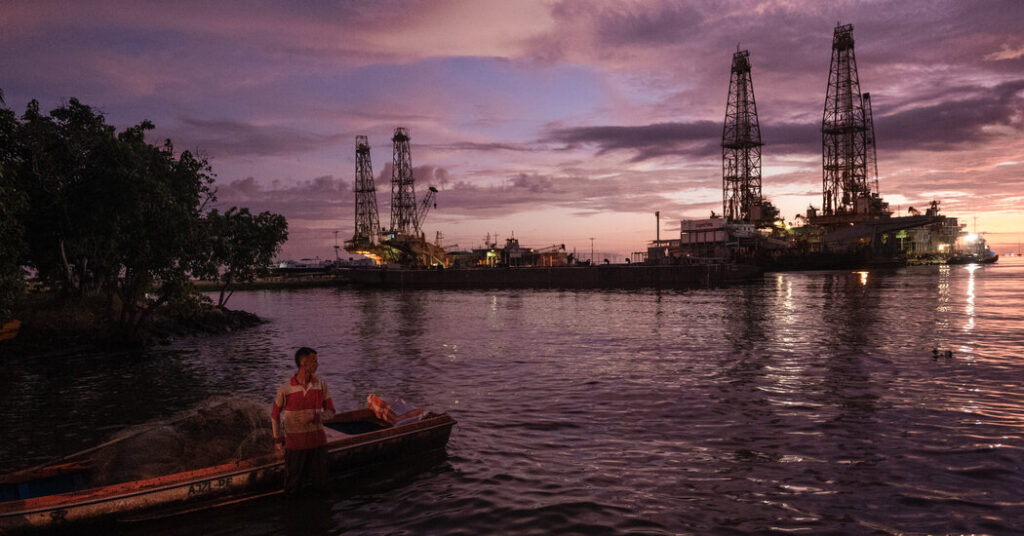
Venezuela has about 17 percent of the world’s known oil reserves, or more than 300 billion barrels, larger reserves than any other country. But its production is only about 1 percent of the world total.
That is partly because of decades of underinvestment, mismanagement and U.S. sanctions. But it is also because Venezuela’s tar-like oil is difficult and expensive to refine. As Lisa Friedman reports, it also generates far more carbon dioxide than lighter oils. (Trump has called it the “dirtiest” of oils.)
Despite all that, oil remains the linchpin of the Venezuelan economy. Dozens of tankers ferry the oil out of the country, with most of the supply going to China.
It’ll be a challenge to increase production, however. The kinds of investments needed could take several years and tens of billions of dollars, all at a time when oil prices are subdued and global demand is expected to peak in the coming years.
Another factor is U.S. sanctions that have limited the market for Venezuelan oil. So long as those remain in place, the market for additional exports is limited.
What will Venezuela’s new leaders do?
When asked what he needed from the acting leader of Venezuela, Delcy Rodríguez, a vice president under Maduro, Trump responded: “We need access to the oil.”
Rodríguez was initially defiant in the hours after Maduro’s capture. But in the face of threats from Trump, she has softened her tone and said the country is ready to work with the U.S.
Meanwhile, Venezuela’s main opposition leader, María Corina Machado, has signaled her support for renewed privatization of the oil industry.
“I am talking about a $1.7 trillion opportunity,” Corina Machado said last month, weeks after winning the Nobel Peace Prize for challenging Maduro.
What about the environment?
Venezuela’s oil industry has been struggling for a long time and its stagnation has had environmental consequences: As Isayen Herrera and Sheyla Urdaneta reported in 2023, forgone maintenance and shoddy equipment have resulted in oil residue showing up miles from refineries on plants, in raindrops and on the shores of lakes.
And because refineries burn off methane, a potent greenhouse gas, they are major polluters.
According to a recent report from the International Energy Agency, the emissions intensity of oil and gas operations in Venezuela is six times the global average. The country produces 1 percent of the world’s oil but 45 percent of all methane released in Central and South America, the I.E.A. found.
Will a history of nationalizations scare off private investment?
Informing the Trump administration’s view that the United States has a claim to Venezuela’s oil is a long and complicated history.
In the decades after World War II, American companies helped build the country’s oil business. Then, in 1976, Venezuela took control of the assets of ExxonMobil, Shell and Chevron, using them to create the state oil company Petróleos de Venezuela.
“We built that whole industry there, and they just took it over like we were nothing,” Trump said on Saturday. (Venezuelans, however, have long viewed oil as a point of national pride, a conviction that has fueled the country’s revolutionary movements. “It is difficult to overstate the mythical importance oil holds in Venezuela,” Simon Romero wrote last month.)
International oil companies returned to Venezuela in the 1990s. But in 2007, Maduro’s predecessor, Hugo Chávez, pushed to nationalize the industry again, sparking legal battles with U.S. oil giants like ExxonMobil and ConocoPhillips, which claimed they were owed billions of dollars.
Given this history, it may be hard to lure other companies back.
“Not many companies are going to rush to go into an environment where there’s not stability,” Ali Moshiri, who oversaw Chevron’s operations in Venezuela until 2017 and now runs a private oil company that has interests in the country, told Rebecca Elliott.
What role will Chevron play?
Major American companies including ExxonMobil and ConocoPhillips pulled out of Venezuela after Chávez tried to nationalize the industry. But one American company, Chevron, has remained.
Chevron today produces about a quarter of Venezuela’s oil. This summer, as the Trump administration’s campaign against Maduro took shape, Chevron’s chief executive, Mike Wirth, encouraged the president to continue letting the company operate in the country. What exactly that looks like now that Maduro is gone remains to be seen.
“We play a long game,” Wirth said last month at an event in Washington. The company, he added, “would like to be there as part of rebuilding Venezuela’s economy in time when circumstances change.”
Our Antarctic voyage
Fighting through the sea ice
Over the course of a few hours on Monday, the sea ice changed completely.
No longer was it disconnected plates that you could plausibly walk across. Instead, it was a huge icy plain in all directions, as if the ship were sailing atop snow-covered land.
Before, the floes had been dynamic, bumping and jostling against one another as the wind pushed them around. Now, the world around us was stock-still, as if physics itself had been suspended. Even the giant icebergs looked trapped, unable to break the hold of the much punier-looking sea ice around them.
On Monday afternoon, as the Araon was barreling through the sea-ice zone with ease, I found Won Sang Lee, the chief scientist on our expedition, gazing out the windows of the bridge. We had been so lucky on this trip, I told him. No storms, minimal swells. And no impassable sea ice.
Dr. Lee was unmoved. “It’s like we’re about to face the real challenge,” he said. — Raymond Zhong
And follow along on our voyage here.
More from our voyage
A month of no darkness begins
Watch more video dispatches from the Antarctica expedition here.
Number of the day
27 million fewer cars
It’s been one year since New York City began its landmark congestion pricing program, which charges drivers $9 to enter areas of Manhattan during peak times of the day. During that year, roughly 27 million fewer cars entered Manhattan’s central business district, The Upshot reports.
Other ways that life has changed for some New Yorkers: traffic is faster, particularly in some notoriously congested areas, there are fewer serious car injuries and more transit riders. Readers who spoke to the Times also “described experiencing safer crosswalks, less stressful bike rides and what feels like cleaner air.”
In case you missed it
The Trump Administration Approved a Big Lithium Mine. A Top Official’s Husband Profited. A high-ranking official in the Interior Department is drawing scrutiny from ethics experts because she failed to disclose her family’s financial interest in the nation’s largest lithium mine that had been approved by her agency, according to state and federal records. — Lisa Friedman
More climate news from around the web:
-
The Trump administration sued two California cities, The Guardian reports, seeking to block local laws that restrict natural gas infrastructure and appliances in new construction.
-
The Washington Post reports that the Environmental Protection Agency, under Lee Zeldin, is pursuing a “shock and awe” strategy. “By undoing so many rules as quickly as possible,” it writes, the agency “aims to rapidly provoke lawsuits that can then work their way through a court system more favorable than ever to Trump.”
-
“Millions of people living on the expanding outskirts of Australia’s major cities face an increasing risk of urban wildfires similar to the deadly blazes in Los Angeles last year,” Bloomberg reports.
Read past editions of the newsletter here.
If you’re enjoying what you’re reading, please consider recommending it to others. They can sign up here.
Follow The New York Times on Instagram, Threads, Facebook and TikTok at @nytimes.
Reach us at [email protected]. We read every message, and reply to many!
David Gelles reports on climate change and leads The Times’s Climate Forward newsletter and events series.
The post The Unanswered Questions About Venezuela’s Environmental Future appeared first on New York Times.