Oil markets have remained relatively calm since the ouster of President Nicolas Maduro of Venezuela on Saturday, reflecting how the country’s influence as a global energy player has dwindled in recent years.
Despite sitting on what are ranked as the world’s largest untapped oil reserves, Venezuela has little clout because of a combination of domestic political turmoil, economic turbulence and punishing sanctions imposed by the United States. But in the long term and under the right circumstances, Venezuela could attract investment and emerge as a force in the oil markets once again.
Because the country is capable of producing large amounts of what is known as extra heavy oil, even a modest revival of the Venezuelan industry has the potential to shake up the oil markets in the United States and elsewhere, analysts say, including by reducing gasoline prices.
“It could make a difference,” said Debnil Chowdhury, the head of refining and marketing in the Americas and Europe for S&P Global Energy, a research firm.
Does the world need more oil?
For now, the markets are saying “no.”
Venezuelan oil production, estimated at 820,000 barrels a day in November, could drop further in the short term because of a U.S. naval blockade, yet prices remain around $61 a barrel for Brent crude, the international benchmark.
In fact, many analysts believe that there is likely to be too much oil in the early part of the year, regardless of what happens in Venezuela. Were more oil to hit the market, prices might fall to about $50 a barrel, analysts say. At that price, industry profits are slim and many oil companies are less inclined to drill.
How quickly could Venezuela produce more oil?
If the Trump administration decides to ease the pressure on Venezuela, exports could rebound and attract more investment.
Energy analysts at the research firm Wood Mackenzie said that in the right circumstances, Venezuelan oil production could rise by up to 300,000 barrels a day in the coming months. Reaching two million barrels a day — a level last achieved nearly a decade ago, when Venezuela accounted for roughly 3 percent of global oil output — is “another matter altogether for an industry already ravaged” by U.S. sanctions, the analysts wrote.
However, Mr. Chowdhury said even an increase of 250,000 to 500,000 barrels a day could have an effect because of the characteristics of Venezuela’s oil.
What type of oil does Venezuela produce?
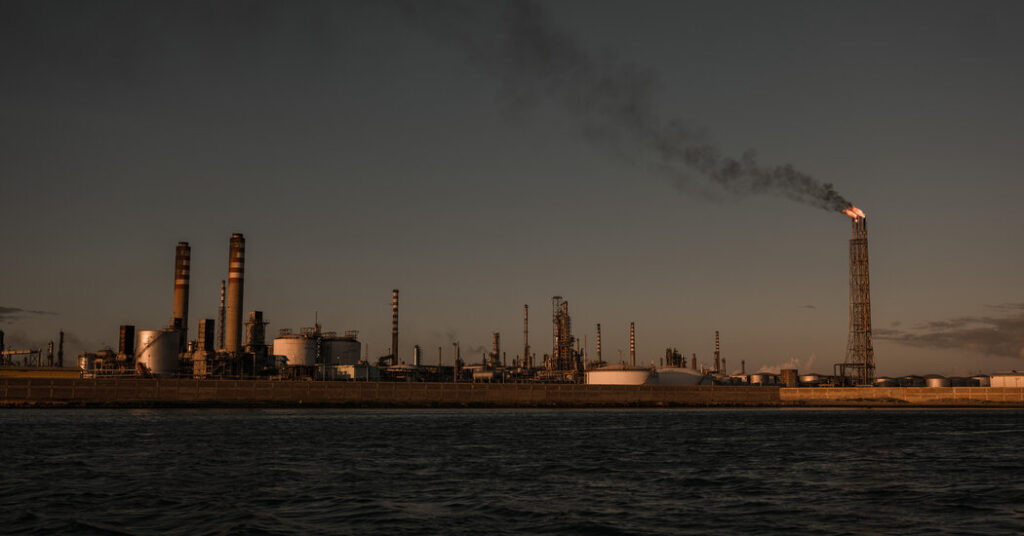
A lot of Venezuela’s oil is heavy, which means it is dense and viscous compared with the lighter oil produced by activities like shale drilling. Special equipment is required to process such crude, Mr. Chowdhury said. It must also be diluted with a lighter petroleum derivative for shipping, adding to costs.
Mr. Chowdhury said that from 1990 to 2010, before the shale-drilling boom in the United States and the deterioration of U.S.-Venezuelan relations, refineries spent an estimated $100 billion on equipment and alterations to handle heavy crude, figuring that Venezuela would be a mainstay for decades.
Instead, Venezuelan flows have dropped precipitously, and refiners have scrambled for permission from Washington to import what they can. They have also purchased heavy substances like fuel oil to add to the lighter oil that is available, creating a less than optimal substitute.
How would U.S. refineries benefit from more Venezuelan oil?
Refineries equipped to handle heavy Venezuelan crude would likely prosper, Mr. Chowdhury said. Venezuelan crude would probably flow to the United States, assuming that Washington lifts its restrictions.
Mr. Chowdhury said that U.S. refiners might be able to pass along the discounts of up to 30 percent compared with what S&P Global Energy figures refiners in countries like China, Malaysia and India have paid Venezuela for its oil.
These U.S. refineries, which are concentrated on the Gulf Coast, would also be able to extract more gasoline and diesel from the crude, increasing supply and putting downward pressure on prices.
“You could have some lower pricing there, right there at the pump,” Mr. Chowdhury said.
Stanley Reed reports on energy, the environment and the Middle East for The Times from London. He has been a journalist for more than four decades.
The post Does the World Need More Oil From Venezuela? appeared first on New York Times.