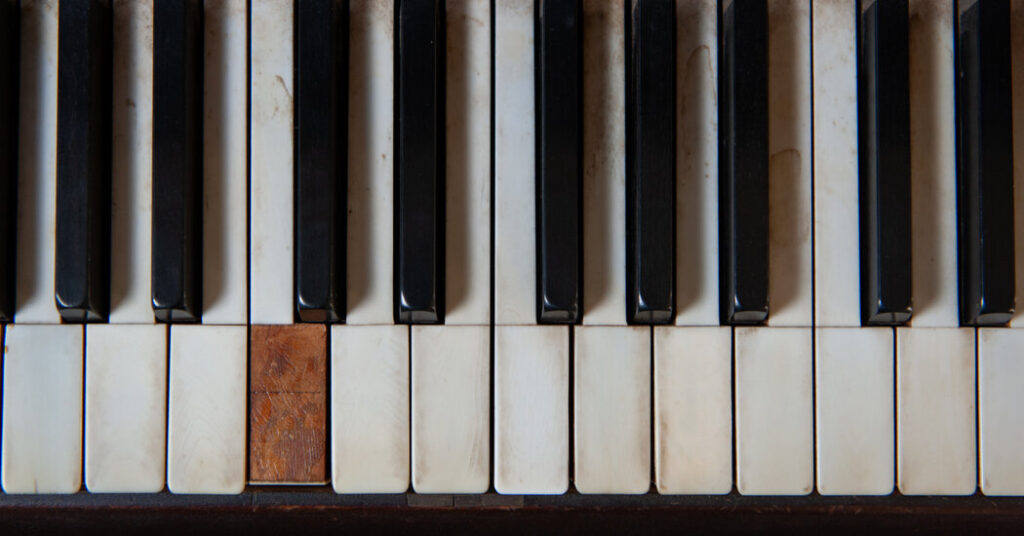
Is there an area of your life in which you strive to be perfect? Perhaps you’re aiming for the highest grades, the best jump shot or a flawless violin performance.
Does trying to avoid mistakes ever take the fun and enjoyment out of what you’re doing? Or, is doing the absolute best you can a worthy goal in and of itself?
In the guest essay “The Quest for Perfection Is Stunting Our Society,” Jonathan Biss, a concert pianist “trained not to make mistakes,” writes about the problem of perfection in classical music and beyond:
Playing an instrument well is phenomenally difficult. It takes a lifetime of arduous work and can become all-consuming, making it easy to forget that technical mastery is a means to an expressive end, not the goal. Mastery is a prerequisite if one is to communicate the essence of a piece of music. In and of itself, it is uninteresting.
This fetishization of perfection might not be surprising, but that doesn’t make it any less damaging. You cannot learn or grow while trying to appear as if you have everything figured out. You cannot talk to God by trying to avoid doing something wrong. Perfection is stagnation.
It is not only musicians who are stunted by the search for perfection. The need to be, or seem to be, perfect is harming many aspects of our lives and sectors of our society.
Take education. The debate over grade inflation usually centers on whether today’s students are working hard and performing well enough. More worrying to me is the notion that a G.P.A. of less than 4.0 represents a failure — that the purpose of an education is to accumulate credentials, rather than to learn. The realization that there is more to know about a particular subject should inspire excitement and curiosity; instead, for the performer or student who wants to seem invulnerable, it might inspire shame.
Social media might well be ground zero for this phenomenon. The obsessively curated and controlled Instagram profile has become so ubiquitous that it has birthed a new profession: the influencer. Like just about any societal development, this has some upside. Some voices social media have elevated are genuinely interesting and would have struggled to make themselves heard in an earlier era.
More often, they peddle a lifestyle without the messiness of life. We see idealized homes, idealized bodies, idealized dinners on idealized tableware. What we do not see is the struggle that forms the core of the human experience, that forces us to think in new ways and encourages us to forge connections with people who might see the world in ways we so far have not.
Predictably, this attitude has affected our politics as well. In a culture in which erring is unforgivable, inaction is incentivized. Our society faces serious, complex problems that cause real suffering and that pose serious threats. Finding solutions to those problems will involve imagination and courage, qualities that flourish only when we embrace uncertainty and acknowledge all that we do not, and perhaps cannot, know.
True perfection is an illusion, just as true safety is an illusion. Seeking perfection keeps us from exploring, even when we sense that we would be happier and more fulfilled if we did so. It makes us live smaller lives and stymies our creativity, both as individuals and as a society. It is the enemy of art.
Students, read the entire essay and then tell us:
-
Did you see yourself or people you know in Mr. Biss’s writing? What ideas about perfectionism in his essay stood out to you the most, and why?
-
Do you ever feel pressure to be perfect in an area of your life? If so, how does that pressure affect you?
-
The essay includes this statement: “You cannot learn or grow while trying to appear as if you have everything figured out.” What does this mean to you? Do you have any examples that illustrate this idea?
-
The author writes that the quest for perfection has infected many areas of society, including education, social media and politics. Where else have you seen the need to be perfect become harmful? How so?
-
Mr. Biss ends the essay by describing a performance in which he felt “absolutely connected to the music” even though it “was far from perfect.” Afterward, his colleague texted him: “Last night was special. We have to find the truth of tomorrow.” What do those words mean to you? Have you ever had an experience like this one, where there’s a tension between avoiding errors and feeling “in total alignment” with the experience itself?
-
In the end, do you agree with Mr. Biss that seeking perfection “makes us live smaller lives and stymies our creativity, both as individuals and as a society”? Which do you think matters more: creativity or mastery? Why?
Students 13 and older in the United States and Britain, and 16 and older elsewhere, are invited to comment. All comments are moderated by the Learning Network staff, but please keep in mind that once your comment is accepted, it will be made public and may appear in print.
Find more Student Opinion questions here. Teachers, check out this guide to learn how you can incorporate these prompts into your classroom.
The post Do You Ever Feel Pressure to Be Perfect? appeared first on New York Times.