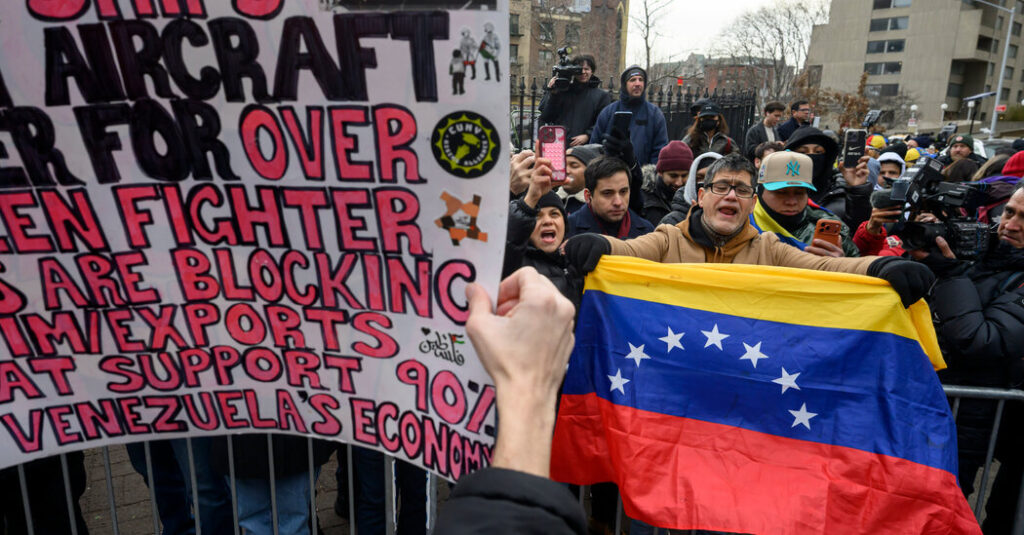
The crowd filtered into Lower Manhattan in the chilly early hours of Monday morning, some wearing Trump red; others the red, blue and yellow of Venezuela; others the Palestinian kaffiyehs that have become a near universal symbol of resistance.
The New York ritual of public protest soon began, a distillation of a global fury in the span of half a block, two sides separated by metal barricades.
Next to them stood Manhattan’s looming federal courthouse, where Nicolás Maduro, Venezuela’s captured president, and his wife, Cilia Flores, sat quietly behind a defense table in a courtroom on the 26th floor, two days after the U.S. raid that wrested them from their home country.
The chants outside, in Spanish and English, could be faintly heard in parts of the building.
“Libertad!” one group cheered, shouting in Spanish: “It already fell; it already fell; this dictatorship already fell.” Across the narrow divide, the other group waved signs that said “U.S.A. Hands Off Venezuela” and “U.S. Out of Latin America.”
It was a microcosm of the reactions that have taken hold across the United States and the globe since Mr. Maduro’s was snatched from a military base in Caracas on Saturday and brought to New York to face federal drug trafficking charges. In the city, the U.S. military action has been polarizing, with large numbers of residents turning out in opposition, and many Venezuelan immigrants taking to the streets to rejoice.
That tension was on clear display outside of the Manhattan courthouse on Monday. Chants of “No blood for oil, hands off Venezuelan soil!” mingled in the air with shouts of “You’re not from Venezuela!”
A man waved a large red flag that read “Trump for King” and bore a crowned image of the president. Another brandished a sign saying “Mobilization against the Yankee Pirates.”
For Pedro Reyes, 39, a native of Venezuela who stood among those celebrating Mr. Maduro’s capture on Monday, the events of the weekend were personally meaningful. Mr. Reyes was imprisoned in the country for days after participating in a student movement opposing Mr. Maduro’s administration.
He recalled being doused with water and gasoline and shot at close range with rubber bullets, some of which he said were still lodged in his body. He held up pictures of the injuries, his skin red and pocked with deep wounds.
“They abused me,” he said.
In the center of Caracas, Venezuela’s capital, a futuristic building called El Helicoide, once intended as a shopping mall, is a constant and visible reminder of repression. It is the headquarters of the secret police and a jail for political prisoners.
Manhattan’s classically columned courthouse offered a different symbol. Alejandro Flores-Velazco said Mr. Maduro’s prosecution — and his detention in Brooklyn’s Metropolitan Detention Center — held deep meaning.
“This is about the people that are right now in jail, in Venezuela,” said Mr. Flores-Velazco, 34, who said he had left himself. “This is about the people that died during the last 26 years.”
Some of the Venezuelan protesters said that Mr. Maduro’s capture had left them hopeful for change at home after more than two decades of authoritarianism.
“The most I feel is freedom,” said Nievelys Hernandez, a journalist who said she had left Venezuela because she did not feel free to speak her mind.
Across the barricades, those protesting Mr. Maduro’s arrest likened the weekend’s events to previous American military interventions.
“This is the same playbook that they used in Iraq, in Afghanistan, to justify the deaths of hundreds and thousands of people in America’s forever wars,” said Ysabella Titi, 24, an organizer with the Palestinian Youth Movement.
“It is up to the Venezuelan people, not the American government, to decide their path of development,” she said.
Inside the courthouse, Mr. Maduro sat beside his lawyer, composed but sometimes unsteady in the unfamiliar environment of a New York courtroom. Ms. Flores sat two seats away, her face bruised and covered in bandages, but her head held steady and high. Later, as she was escorted from the room, she clutched the arm of a U.S. marshal to steady herself.
But the energy of protest found its way into the courtroom. When Mr. Maduro rose to leave at the end of the hearing, a man in a white shirt and black coat stood suddenly in the gallery and addressed him.
The man, who later identified himself as Pedro Rojas, 33, spoke to Mr. Maduro in the otherwise silent courtroom, saying in Spanish that he would pay for his crimes.
Outside on the street afterward, Mr. Rojas said he had traveled to New York City from Georgia to see the moment Mr. Maduro faced criminal charges. He said he had left Venezuela in 2019, after being imprisoned by the government for four months for his political activities.
“For me, it’s very important, it’s very important to represent everybody in Venezuela,”
He hopes to be able to return to Venezuela soon, he said.
Hurubie Meko and Maria Cramer contributed reporting.
Maia Coleman is a reporter for The Times covering the New York Police Department and criminal justice in the New York area.
The post Outside the Courthouse: Flags, Chants and Venezuelans’ Quiet Pain appeared first on New York Times.