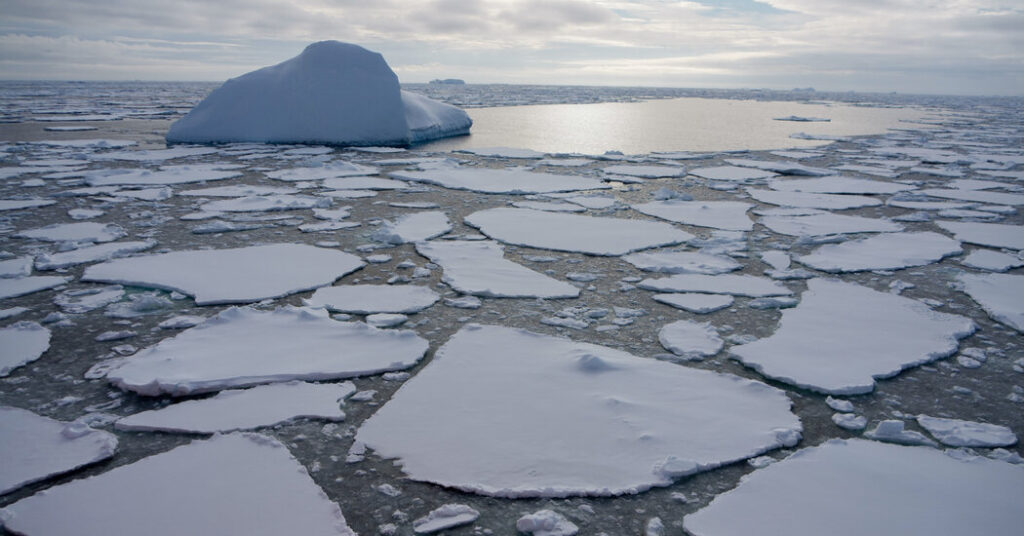
After 10 days with nothing in sight but open ocean and the odd iceberg, the Araon entered the zone of sea ice that surrounds Antarctica at roughly 5 a.m. on Monday, and the world was made anew. Suddenly there was floating ice as far as the eye could see, as brilliant and white as the open sea had been forbidding and inky.
The edges of the floes were rough and polygonal, almost like the plates of a turtle’s shell, but their surfaces were pillowy and pristine, with soft-sculpted contours like frosting on a cake. Filling the cracks between the ice was a messy mix of slush and seawater and broken icy bits. Lounging on top was the occasional seal, as apparently unimpressed by our ship as it was by the magnificent scene around it.
At 5:15 a.m., I hurried up to the bridge to talk with Siobhán Johnson, a sea ice scientist on the expedition. This was the day she’d been waiting for the whole trip.
Ms. Johnson, a doctoral student at the University of Cambridge and the British Antarctic Survey, didn’t set out to make a career out of studying sea ice, though she knew early on that she wanted to do something related to climate change.
After a school viewing of “An Inconvenient Truth,” the documentary about former Vice President Al Gore’s campaign to warn the world about global warming, Ms. Johnson walked out thinking, “This is the thing that I need to do.”
Sea ice comes in many forms, and scientists have devised an exotic vocabulary to describe them. Through the bridge’s panoramic windows, Ms. Johnson pointed out a few types as we steamed past. Frazil: small, delicate crystals, sea ice in its most nascent form. Grease ice: coagulated crystals that gather at the surface, like globules of fat on a meat stew. Shuga: spongy white lumps that are tossed into long bands by wind and waves.
In the distance, a huge, torqued chunk of blue ice towered above the broken plates of sea ice around it. It was an iceberg that had been tipped onto its side, perhaps. Ms. Johnson grabbed a pair of binoculars.
“That’s so weird! That’s so cool!”
One of Ms. Johnson’s goals is to improve estimates of the thickness of sea ice using satellite measurements. Sea ice reflects sunlight and keeps heat from being absorbed by both water and land. The ice is an essential habitat for phytoplankton, the base of the Antarctic food chain.
While satellites can measure the approximate area of ocean covered by sea ice, they’re still not great at telling us the ice’s thickness and volume, Ms. Johnson said. That leaves a big gap in the understanding of how sea ice interacts with the movement of water and heat through the ocean.
On this expedition, Ms. Johnson plans to collect cylindrical cores of the ice floes near the Thwaites Glacier. After analyzing these samples, she hopes to incorporate the data into methods for inferring sea-ice thickness from satellite readings.
Antarctica’s sea ice comes and goes with the seasons, melting in spring and summer and forming in winter, with an annual peak in September. Lately, these peaks have been well below average.
In 2025, the area around Antarctica that was covered by sea ice in September was the third lowest annual maximum since satellite-based records began in 1979, according to the National Snow and Ice Data Center at the University of Colorado Boulder. Only 2023 and 2024 had less sea ice for that time of year.
The recent record lows mark a big change for Antarctica, where for decades sea ice was either stable or above average. But since 2015, these figures consistently come in below average, and scientists aren’t exactly sure why. (The situation is very different at the opposite pole: Arctic sea ice has been on the decline for decades because of human-caused warming.)
Rising ocean temperatures have likely been a major reason Antarctic sea ice has been low, Ms. Johnson said. But it will be hard to say for certain until we have a more complete picture of the sea ice and how it’s changing. Which is what keeps bringing Ms. Johnson back to these frozen waters.
“I’ve never felt bored” studying sea ice, Ms. Johnson said. This is her fifth trip to Antarctica, and seeing the sea ice is still a thrill. “This is more exciting than Christmas to me,” she said.
Raymond Zhong reports on climate and environmental issues for The Times.
The post Entering the Antarctic Sea Ice, and a New World appeared first on New York Times.