NEW YORK — Imagine you’ve been a loyal line manager at a paper factory for 25 years. Your workers love you. The company just sent over some fresh eel, a pricey delicacy in your country, to celebrate your work anniversary. This, you think, is the good life.
Then, within days, you’ve been fired. Laid off. Made redundant.
You’re middle-aged, out of work and out of practice selling yourself for jobs. The bills are piling up, and so are the indignities. You have to send the dogs to live with your in-laws because you can’t afford to feed them. Soon you’ll have to ax cello lessons for your prodigiously talented daughter, who already hates you because of the dogs. The house you built with your own hands on your father’s defunct pig farm will go next. You’ve even had to (horrors!) cancel the family Netflix account. And so many men are in your position. You start to wonder, Okay, if I’m the third-most-qualified candidate for the one available job, how can I make sure I get it?
What if those other guys weren’t there?
How could you eliminate them?
Permanently.
A plan forms. An insane, violent, drop-to-your-knees-with-demented-laughter plan that could be brought to life only by a perfectionist director with one of the most twisted minds in the world: Park Chan-wook.
When I meet with Director Park, as his collaborators call him, at the sunlit restaurant of the Ritz-Carlton NoMad in Manhattan on a brisk morning in December, not a soul seems to realize they’re in the presence of one of the most revered filmmakers on the planet — the South Korean whose crime obsessions, black humor and incredibly inventive blood-splattering have produced such revered fare as 2003’s “Oldboy,” 2016’s erotic masterpiece “The Handmaiden” and 2022’s Hitchcock-inspired “Decision to Leave.”
Quentin Tarantino, Jordan Peele and Denis Villeneuve have all cited him as a foundational influence. Spike Lee honored him by remaking “Oldboy.” His good friend, “Parasite” director Bong Joon-ho, has credited him with legitimizing modern Korean cinema on the world stage.
And at least among cinephiles, his latest film, “No Other Choice” — a spookily relevant dark comedy about a paper executive who turns to murder to get a new job because he believes he has “no other choice” — is one of the most anticipated releases of the year. (It opens in D.C. on Jan. 9.)
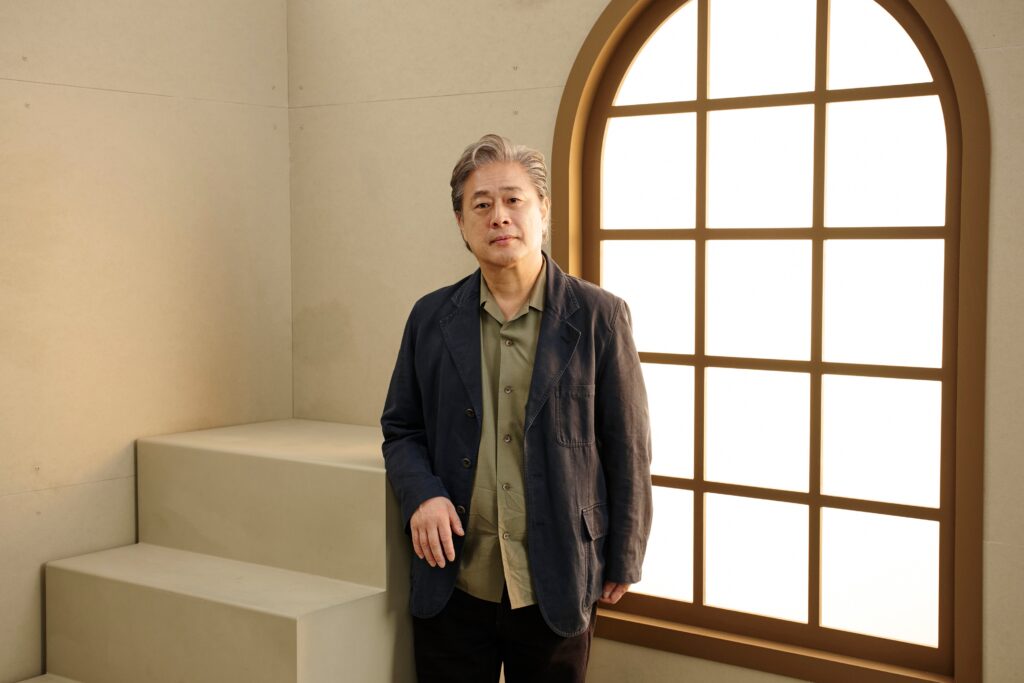
In contrast to the outrageous images he puts on screen, Park looks as if he beamed into our restaurant booth through a desaturation camera filter — a study of muted colors with his silver hair, delicate wire glasses, moss green T-shirt and dark gray khakis. He’s quick to laugh and such a fast talker that his heroic interpreter, Jiwon Lee, barely has time to scribble and transmit Park’s thoughts before he’s moved on to the next idea. I’m shocked when I look up the filmmaker’s age and realize he’s 62; he seems likely to live to 125.
When I mention I saw “No Other Choice” at the Venice Film Festival in late August, he lights up but is disappointed to find out I was at the nighttime red carpet world premiere rather than the morning press screening, where critics reportedly applauded a key scene. “I heard that they were laughing all throughout the movie,” he says. “So my expectations were very high, but the premiere wasn’t quite that level.”
Talk about expectations: As I waded through the lobby before that Friday night premiere, there were so many screaming Korean students you’d think BTS had landed in the building. And he got at least a 10-minute standing ovation.
Wowww Park Chan-Wook’s NO OTHER CHOICE is a total banger. Edge of seat, pitch black comedy about a paper factory manager who gets fired after 25 years and has “no other choice” but to wage war for his family. Can see it getting best pic, actor, actress noms #VeniceFilmFestival pic.twitter.com/dSah5vCprt
— Jada Yuan (@jadabird) August 29, 2025
The way young viewers respond to the energy and risk-taking in Park’s films is astounding, particularly for a movie about middle-aged, middle-class angst. A week after Venice, at the Toronto International Film Festival, programmers kept having to add screenings to keep up with demand. The movie went on to win the International People’s Choice Award there, and it recently shocked awards prognosticators by earning three Golden Globe nominations, including best musical or comedy and best actor for Lee Byung-hun, the global superstar (“Squid Game,” “KPop Demon Hunters”) who turns in a career-highlight performance as Man-su, the aforementioned laid-off paper executive who is nearly as bad at serial killing as he is at job interviews.
Now the big question is whether this movie beloved by film nerds but perhaps too out there for Oscars voters can score a nomination for best international feature. It would be nice, Park tells me, but that’s not why he’s doing this endless promotional work.
“Any of this can lead to one more person considering watching my film,” he says, “and I think that’s every film director’s dream.”
Here’s what else you learn about Director Park from hanging out with him:
This movie is decades in the making.
Almost as soon as he read the 1997 satirical novel “The Ax” from prolific American fiction writer Donald E. Westlake, about corporate downsizing in the U.S. paper industry, Park says, he wanted to turn it into a movie.
“I almost had this idea that I co-wrote the novel, even though that wasn’t true,” he tells me. “If I were a great novelist, I think I would have come up with a novel like this.” But the Greek-French director Costa-Gavras got to it, and made the 2005 absurdist comedy “The Axe,” first. (Park bought the rights to the book from him and his producer wife, Michèle Ray-Gavras, and announced he was making the movie in 2009.)
Financing came together and fell apart. Other projects got in the way. But Park, who also co-wrote and produced the movie, says that every time he’d tell someone about the story, the person would comment on how timely it was. “I think that gave me the confidence that this was a film that will eventually get made,” he said in Venice.
Park tells me he also loved everything about Westlake’s absurdist humor. It’s one thing to write about a man who loses his job and envies someone who has a great job he wants to take. “But Westlake took it a step further,” Park says. “[The protagonist] thinks: … ‘In this terrible economy, I’m not guaranteed to get that job. There’s going to be other people who apply and perhaps would get the job, even if I killed that man,’ and then the rest of the story unfolds from there. I thought that was so brilliant and creative.”
Has Park encountered such a scenario himself, a film he would kill to direct?
Not yet, he says, but he can imagine, perhaps, wanting to adapt a novel, finding out that a production company owns the rights, then having to compete with a bunch of directors to get the job. “I would be wishing for them to die in an accident or die by an illness. … I could see that happening,” he says, laughing.
Then he pauses for dramatic effect: “Wouldn’t it be more fun if that novel was ‘The Ax’?”
“No Other Choice” was originally supposed to take place in the United States.
Park had always pictured this movie taking place, as the novel does, in the United States, in the heart of capitalism, but often jokes that American capitalists wouldn’t give him the money.
“I want to give a big thank-you to all the Hollywood studios who turned this film down,” he said, to huge laughter, at the movie’s New York Film Festival screening in October.
But the film may be more powerful set in Korea.
In the end, Park is grateful he decided in 2024 to make it a Korean film. It allowed him to explore some culturally specific phenomena, like Man-su’s obsession with bonsai trees — which results in one of the most shockingly funny murder images you’ll ever see — and the patriarchal nature of Korean society, which heightens the desperation of its unemployed men.
And it allowed him to build a cast of Korean actors he has always wanted to work with. In particular, it gave him reason to reteam with Lee, a friend since they worked on Park’s breakout Korean box office hit, 2000’s “Joint Security Area.” Park says he often joked with Lee, 55, that he could never cast him again (except for in a short horror film in 2004) because he looks too young.
“It wasn’t about this role in particular,” Park says, “but I generally make stories about people’s tragedy and their pains in life, and Lee Byung-hun really looks younger than his age. He has very firm skin and healthy teeth. … That’s why I would always joke around and tease him, like, ‘Why don’t you just age quickly and get more wrinkles on your face, and then you’d be a better-suited actor for me?’”
So, it’s a bit of a gift to Park, and to us viewers, that the movie took 20 years. “When ‘The Ax’ couldn’t be made as an American film, he aged and he got wrinkles, finally,” Park says. “So that’s how everything worked out.”
He taught himself filmmaking by necessity.
As a kid in Seoul in the 1960s and ’70s, Park became obsessed with watching the American Forces Korea Network, a black-and-white TV channel for overseas U.S. personnel that played foreign movies without Korean subtitles. His visual style is built from those formative years having to interpret films and narrative structures from images alone.
There was no film school in the country, so Park, whose mother was a poet and whose father was a university architecture professor, studied philosophy at Seoul’s famous Sogang University, while joining film and photography clubs. That’s where he first saw Alfred Hitchcock’s “Vertigo,” perhaps his most profound influence.
He often says that his love of underdogs and stories of desperation was shaped by growing up under the brutal dictatorship of Chun Doo-hwan and seeing how humans behave when they’re pushed into corners. And it was the 1982 film “Woman of Fire ’82” from director Kim Ki-young, he said at TIFF, that taught him to embrace his perverse sensibilities. (Think: the protagonist of “Oldboy” eating a live octopus, or cutting off his own tongue.)
Park singles out a climactic moment in that drama where a man drags his mistress down the stairs, her head crashing into every step. “The scene always remained a big shock to me, like I was hit with a hammer,” he said. “I feel bad to say it was a funny scene, but that’s honestly how I felt.”
“The heavier the subject, the more grotesque and funny a movie needs to be,” he added. “It’s the only way to completely and totally reveal how human society works.”
He knows what it’s like to feel as if you’ve lost your identity.
Park likens the experience of begging producers for money, particularly after his first two movies were flops, to the kind of humiliation Man-su feels in job interviews. Park’s reputation was so bad that he had to become a film critic to pay the bills, and he did that on and off for the better part of a decade, until “Oldboy” was awarded the Grand Prix (second place) by a Tarantino-led jury at Cannes, crowning Park a directing supernova when only a handful of Korean films had ever screened at a major international film festival.
The director says those lean times were a big inspiration for “No Other Choice.” Man-su and his victims feel the same way about paper as Park does about directing: It’s their entire life, and they can’t imagine themselves doing anything else. “Being a film critic wasn’t a bad job, since I was able to watch movies for a living,” he says, “but this just wasn’t something that I had always wanted to do.”
Even Lee knows this kind of desperation.
Lee, whom I met the same morning as Park, is handsome and talented enough that he has never had the kind of fallow period between jobs that Park experienced. But about 25 years ago, when he was already a famous actor, his father died suddenly, and the responsibility for clearing the substantial debts on his business fell to Lee as the eldest son. Like Man-su, he and his wife were faced with the prospect of selling their house — and unlike Man-su, they did, and eventually recovered it. The experience, he says, has made him distinctly aware of his tenuous fame, and how he’s just one bad moment away from going back into debt.
“In terms of feeling that burden and being really desperate to pay that money back, I’ve been in that position before,” he says. “So, while that’s still different from Man-su’s situation, I would say those emotions I felt before.”
Park does not have a normal brain.
This is a filmmaker who thinks of everything. A question about a Looney-Tunes-esque scene in which Man-su goes to kill a competitor and keeps ripping off ridiculous hand coverings until he gets to the gun, taped to his hand, produces a 10-minute answer.
“That wasn’t inspired by anything in particular. I just thought it would create a really funny visual on the screen,” Park admits.
The scene started as an excuse for Park to play a song he has always wanted to put in a movie, Cho Yong-pil’s “Red Dragonfly,” at full volume, which allowed Park to do something else he has always wanted to do, which is to have characters shouting what’s deep in their hearts over the din, including Man-su, who’s shouting advice to his victim that both he and the audience know he should be following himself.
On the third or fourth viewing, Park says, an eagle-eyed observer might realize that every creative crime Man-su commits is inspired by something his wife, Mi-ri (K-drama superstar Son Ye-jin) says, which ties into how he justifies his actions by convincing himself that he’s doing this all for his family, and that each one of his murder props can be found somewhere in the background of his home, reinforcing the idea of his inexperience at killing and how he just grabbed stuff he had around the house.
And for Park, this all connects to what he learned while studying the filmmaking greats on his own so many years ago. “I realized that nothing in their films is random,” he says. “There is no such prop or item or actor that’s positioned in a random way that wouldn’t have any significance.”
He’s not anti-capitalist, but it’s okay if you think the movie is.
“No Other Choice” isn’t a battle cry to end capitalism, Park tells me, because he doesn’t know what we’d replace it with. To him, it pretty much feels like a system we’re stuck with for now.
“I’m not making a statement that we should shatter capitalism,” he says, “but I am making a statement about how we need to make fixes and revisions to what we have already.”
Man-su doesn’t propose any solutions to corporate downsizing. He doesn’t file a lawsuit. His feeble attempt to start a union fails. All he wants to do is keep things as they were, even if it requires a little homicide.
“I think his story and the decisions that he made should really demonstrate how all of us are so small and powerless within the capitalist system,” Park says.
In many ways, the 20-year journey to make this movie has allowed Park’s message to become even more potent. The director didn’t use artificial intelligence in making the movie, but he felt as if he had to nod to it in a movie about modern job insecurity.
“As much as I’m scared of the terrible effects of AI on society,” Park says, “at the same time, I’m very glad that it existed and that I could incorporate this, at least for the sake of the movie.”
Man-su is literally killing for a job that won’t exist in a couple of years.
“It really completed this film as a story of futility.”
The post The diabolical genius behind the year’s funniest unemployment thriller appeared first on Washington Post.