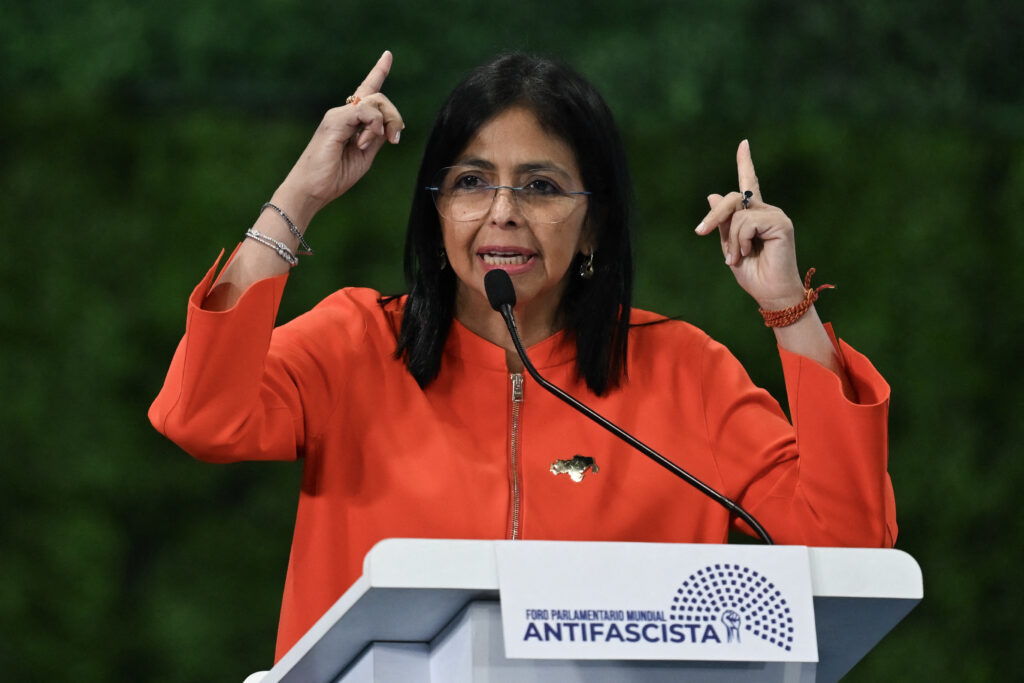
Venezuela’s vice president, Delcy Rodríguez, has taken over as acting leader in the wake of a U.S. raid that deposed President Nicolás Maduro over the weekend.
Rodríguez, 56, is a veteran politician, lawyer and diplomat who has played a key role in overhauling Venezuela’s economic policy, developing close ties with the business community.
Venezuela’s Supreme Court ordered her late Saturday to assume the presidency in Maduro’s absence, a position she would hold on an interim basis. On Sunday, Defense Minister Vladimir Padrino López also recognized Rodríguez as acting president, saying in televised remarks that the nation’s forces must be unified in “the mission of confronting imperial aggression.”
Rodríguez’s first public comments came Saturday when, in an address to the nation, she denounced the U.S. operation to take Maduro and said he is the country’s only president.
But in a Sunday night statement, Rodríguez offered a more conciliatory message, calling for “peaceful coexistence.”
“President Donald Trump, our peoples and our region deserve peace and dialogue, not war,” Rodríguez said. “This has always been President Nicolás Maduro’s message, and it is the message of all of Venezuela right now.”
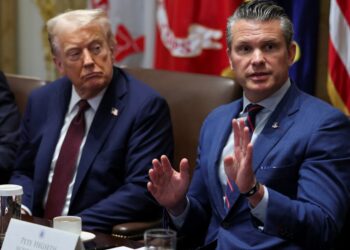
Earlier, President Donald Trump suggested Rodríguez was willing to work with the United States, which he said would “run” Venezuela. But on Sunday, he threatened the vice president in an interview with the Atlantic, saying that “if she doesn’t do what’s right, she is going to pay a very big price, probably bigger than Maduro.”
Here’s what we know about the interim Venezuelan leader.
Who is Delcy Rodríguez?
Rodríguez is a Caracas native and was born in the Venezuelan capital in 1969.
She was 7 years old when her father, leftist political leader and guerrilla fighter Jorge Antonio Rodríguez, was killed while under interrogation by counterintelligence agents for his alleged role in the abduction of an American executive in Caracas.
His death left an indelible mark on Rodríguez and her brother, Jorge Rodríguez Gómez, 60, who is president of Venezuela’s National Assembly, according to a 2020 profile in Vanity Fair España.
After growing up in a deeply socialist family and hearing tales about their father, the siblings embarked on lifelong political careers, embedding themselves in the country’s leftist politics and serving in key roles under Venezuela’s former firebrand president and socialist icon, Hugo Chávez, and his handpicked successor, Maduro.
Rodríguez, who often wears black-rimmed glasses and bright-colored fabrics, was educated in Caracas, Paris and London, studying law at the Central University of Venezuela, where she later worked as professor. She started her professional career as a labor lawyer and joined the Chávez administration in 2003.
What political role has Rodríguez played in government?
Rodríguez’s political résumé stretches back over two decades, during which she held positions that led her to the upper echelons of power.
She started in the office of the general coordinator for the vice president in 2003, moving then to the Ministry of Energy and Mines, where she served as director of international affairs.
Later, she became minister of presidential affairs under Chávez in 2006.
She was a fierce defender of Chávez’s Bolivarian Revolution — named after 19th-century Venezuelan revolutionary Simón Bolívar — which envisioned social and political reforms that would lift millions out of poverty and build a Latin America free of U.S. influence.
“She has defended Venezuelan sovereignty, peace and independence like a tiger,” Maduro said of Rodríguez in 2017.
But even as Chávez sought to fund social welfare programs, he let the country’s strategic petroleum reserves dwindle and made authoritarian moves that stifled the press and gutted the nation’s stable of experts.
After Chavez died in 2013, Maduro elevated Rodríguez to minister of popular power for communication and information — and appointed her as his top diplomat and foreign minister the next year.
When the price of oil plummeted in 2014, it set off economic chaos in Venezuela, characterized by severe food shortages, runaway inflation and an exodus from the country.
On the heels of that collapse, in 2018, Rodríguez became Maduro’s vice president (while serving later as finance minister and minister of oil). A few months afterward, the U.S. placed sanctions on Rodríguez, her brother and other members of Maduro’s inner circle, accusing them of corruption and human rights abuses.
“The revolution is our revenge for the death of our father and his executioners,” Rodríguez said in an interview that year with Venezuelan journalist José Vicente Rangel.
What’s next for Rodríguez?
With her broad portfolio, Rodríguez sought to implement economic reforms while maintaining state control over key sectors and continuing to prioritize social spending.
She has been viewed generally as more pragmatic and willing to oversee a limited opening of Venezuela’s economy than hard-line government officials, including the defense and interior ministers.
Trump said Saturday that Rodríguez had spoken to Secretary of State Marco Rubio. “She said, ‘We’ll do whatever you need,’” he added. “I think she was quite gracious,” Trump said. “But she really doesn’t have a choice.”
In some of her first actions as acting president, Rodríguez announced the creation of two commissions in a statement published by Communications Minister Freddy Ñáñez. The first is a high-level panel dedicated to the release of Maduro and his wife, Cilia Flores. The second will focus on guaranteeing and consolidating “food sovereignty and supply projects” in Venezuela, the statement said.
Rodríguez also visited people who were injured in the U.S. attacks that deposed Maduro, according to the statement, referring to them as “brave and heroic young people who stood up to defend our sovereignty and the integrity of our President, Nicolás Maduro Moros.”
Rodríguez and her brother are seen as modernizers who want a semi-open country and economy and warmer relations with the broader world, Tulane University sociologist David Smilde said.
The siblings, however, “don’t have guns,” said Phil Gunson, a senior analyst for the Andes region with the International Crisis Group. And even with Delcy Rodríguez as interim president, the interior and defense ministers could still hold most of the power, given their control of the military and security forces.
“If it comes to a fight, they’re left hanging because they don’t have anyone to back them,” Gunson said. “What I suspect is going to happen is, she will occupy the presidency, but the powers will be the defense and interior ministers, and that’s not good.”
The post Who is Venezuela’s acting leader, Delcy Rodríguez? appeared first on Washington Post.