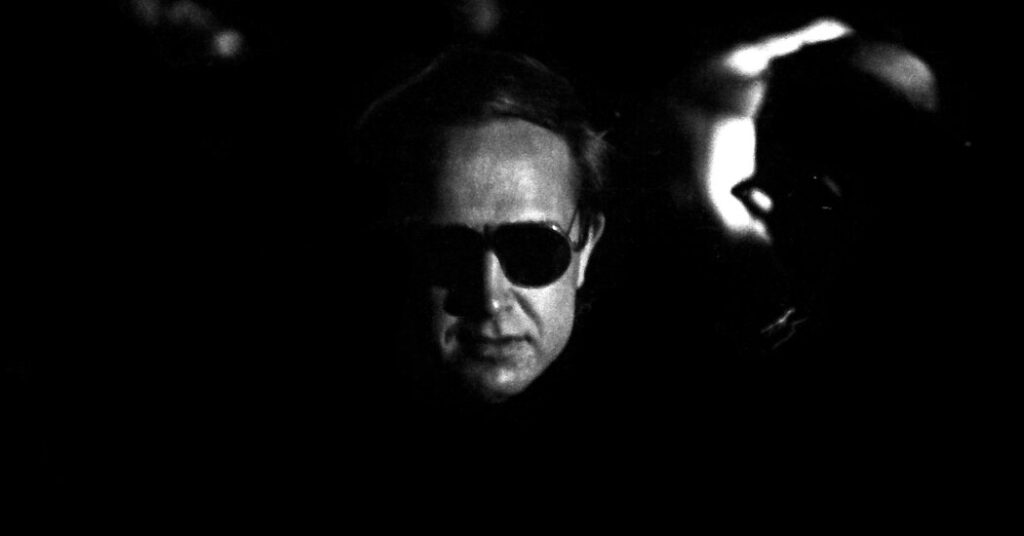
Robert Heide, who began his career as a playwright and ended it granting interviews to historians and becoming part of countless anecdotes in books and articles about the cultural life of downtown Manhattan, died on Dec. 17. He was 91.
His death, at a Manhattan nursing home, was caused by complications of dementia, his spouse, John Gilman, said.
If Mr. Heide (pronounced HI-dee) was known for one thing in particular, it was his play “The Bed” (1965). It was striking for its time in depicting a homosexual relationship. It was one of the major works of the earliest phase of Off Off Broadway theater, and it was restaged and filmed by Andy Warhol as part of his 1966 movie “Chelsea Girls.”
Yet Mr. Heide was ultimately notable not mainly for any one of his plays, film scripts, books or essays so much as his memories of his time as a young star of downtown Manhattan’s bohemia and his improbable survival as a downtown bohemian himself.
For more than 60 years, he lived in the same rent-controlled Christopher Street apartment. Mr. Gilman, who later moved in, said their rent was not much more than the cost of a single expensive dinner in today’s West Village.
All the freedom — to write, to collect and to gallivant — made Mr. Heide a storyteller on many subjects.
He regaled historians with tales of the Stonewall Riot, which he witnessed, and encounters with Bob Dylan, Edie Sedgwick and Jimi Hendrix. He spoke authoritatively about Andy Warhol’s inner life, unseen behind his mystique.
Above all, he spoke about playwrights — Edward Albee, Sam Shepard, Terrence McNally and Lanford Wilson — who, like Mr. Heide, had emerged out of an artistic circle far away from Broadway, centered originally at a Greenwich Village coffeehouse called Caffe Cino.
In his book “Off-Off-Broadway Explosion: How Provocative Playwrights of the 1960s Ignited a New American Theater” (2003), David Allison Crespy called Mr. Heide “one of the most articulate raconteurs of Cino history.”
Mr. Heide said that family money had enabled Mr. Albee to hire multiple Broadway press agents for his one-act play “The Zoo Story” (1959), catapulting him to renown. He recalled Mr. Shepard’s “internal, surly anger,” which he tried not to show and instead “transmitted” into his writing.
And Mr. Heide spoke evocatively about their shared milieu. There was the revelation he experienced when the actor Warren Finnerty got him to drink a glass filled with “pure mescaline.” There was his friendship with the playwright H.M. Koutoukas, which began when the two of them ran into each other around Greenwich Village — and found that they were each toting around a copy of Sartre’s “Being and Nothingness.”
Mr. Heide saw the Sartre play “No Exit” at Caffe Cino — with exactly three actors onstage and three spectators in the audience. He recalled to Mr. Crespy that the cafe was illegally hooked up to the city’s electrical grid, so that the lighting went on and off with the street lamps.
After a mixed run of a couple plays at the Cherry Lane Theater, Mr. Heide found the Cino to be a more congenial home for his experimental work.
“The Bed” consisted of two handsome young men in white boxers sitting on a bed about the size of Cino’s small theater and discussing their feelings of aimlessness. The script was less than 15 pages, but the play lasted for more than half an hour because of many extended pauses. The same upbeat rock song, Dave Clark Five’s “Anyway You Want It,” played twice all the way through, with the actors onstage incongruously silent.
The Village Voice wrote wonderingly that the play “achieves its most alive moments in complete stasis.” Life magazine sent a photographer to capture Mr. Heide and the Cino’s other leading playwrights.
In “Playing Underground: A Critical History of the 1960s Off-Off-Broadway Movement” (2004), Stephen Bottoms wrote that “‘The Bed’ provides the missing link between Beckettian absurdism (two men filling in empty time) and the New York avant-garde’s fascination with the detailed observation of banality.”
Warhol restaged the play and intercut scenes of it into “Chelsea Girls.” He and Mr. Heide became friends and collaborators. Mr. Heidi wrote the script of “Lupe,” the final film of Warhol’s that Edie Sedgwick appeared in, and Mr. Heidi acted in the Warhol films “Batman Dracula” and “Camp.”
The two men were each the gay sons of blue-collar immigrant fathers. Warhol told Mr. Heide that his famous Campbell’s soup paintings came from his memories of the simple lunches served by his mother.
Robert William Heitke was born on May 9, 1934, in Irvington, N.J. His father, Ludwig, was a tool and die maker for the Singer sewing machine company. His mother, Olga (Straefle) Heitke, took Bob on his earliest trips to New York City.
After graduating from college at Northwestern University, where he studied theater, Bob took classes for two years with the renowned acting coach Stella Adler. He change his name with the goal of seeming less foreign.
The first gay bar Mr. Heide went to was Lenny’s Hideaway on 10th Street, where he befriended Mr. Albee.
Mr. Gilman acted in one of Mr. Heide’s Cino plays. They became a couple soon after meeting, in 1965, and stayed together for the rest of Mr. Heide’s life. Mr. Gilman is his only immediate survivor.
On weekends, tourists from New Jersey often descended on the West Village. Mr. Heide and Mr. Gilman, conversely, left the Village and drove to New Jersey. It became their main hunting ground for antiques.
They amassed an idiosyncratic series of collections, all related to American pop culture. Photographs of their holdings, with accompanying essays, became the basis for more than a dozen books that the two men co-wrote on subjects like “Disneyana” and “cowboy collectibles,” which they pursued, The New York Times wrote in 1990, “with the fervor of a thirsty horse seeking water.”
They developed specialties in such unknown fields as Mickey Mouse sandbox toys — there were pails, shovels and sifters — as well as the packaging design of tooth powders (“pour powder in palm of hand not on brush”).
In “Dime-Store Dream Parade: Popular Culture, 1925-1955” (1979), they explained their cutoff date as the moment when “planned obsolescence” brought about a sharp decline in the quality and craftsmanship of consumer products.
They abided by their historical theory so thoroughly that even their car, a pink Plymouth Belvedere convertible, came from 1954.
Alex Traub is a reporter for The Times who writes obituaries.
The post Robert Heide, Daring Playwright and Warhol Collaborator, Dies at 91 appeared first on New York Times.