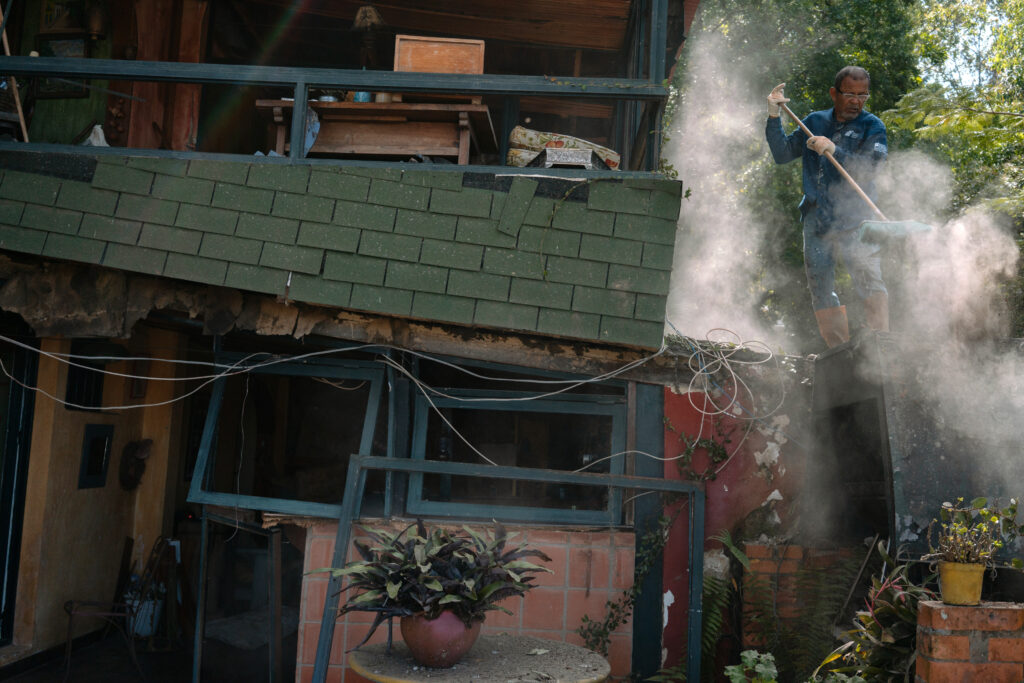
CARACAS — In the wooded neighborhood of La Boyera, at the feet of a mountain known as “the volcano,” Elena Berti was sleeping deeply early Saturday when everything began shaking so violently that the head of her bed frame toppled down on her.
Berti, 78, recalled rising from her bed, rosary beads in hand, and looking outside at a scene that seem incomprehensible: The woods beyond her back patio were on fire.
In its assault on the Venezuelan capital of Caracas, the U.S. military said it strategically bombed several radar installations and radio transmission towers to blind government forces as it closed in on President Nicolás Maduro. It also appeared to strike this residential neighborhood, seen as an oasis in this chaotic city, leaving residents bewildered and afraid.
“I never imagined something like this could happen inside my home,” Berti said. “I don’t have anything to do with politics or the military.”
“This is anguish,” she continued, sighing: “It’s always something living here.”
The Pentagon and The White House did not immediately respond to a request for comment on the strike in La Boyera.
In recent years, as Venezuela went bankrupt, millions fled the country, inflation soared and Maduro strengthened his authoritarian grip on power — claiming victory after the 2024 presidential election despite tallies showing he lost — life in the capital has been marked by hardship.
Now, in the aftermath of the U.S. strikes and the capture of Maduro, Venezuelans are struggling to understand what just happened, and what might come next.
The earthquake has apparently come and gone: Maduro is in jail in New York, awaiting trial on narco-terrorism charges, and his vice president Delcy Rodríguez has taken over, vowing continuity. But everyone seems to be bracing for aftershocks.
“There’s so much confusion,” said commercial salesman Ronald Figuera, 44, who lives less than a mile from where Maduro was apprehended on a Venezuelan military base in southern Caracas. “It was so fast. We don’t know anything about anything.”
His dread and uncertainty is shared by many across the Western Hemisphere, where government officials and political analysts alike were taken aback by the sight of Maduro — until Friday, Venezuela’s most powerful man — as a blindfolded detainee in American custody.
For years, Washington has made it clear that it viewed the Latin American strongman as illegitimate and wanted him gone. But the stated rationale for his removal has changed over time.
In 2019, when the first Trump administration backed then-National Assembly President Juan Guaído’s bid to replace Maduro as head of state, it was ostensibly about the preservation of democracy. Maduro had been declared the victor of the May 2018 presidential election, but the flawed vote was rejected by the Venezuelan opposition and much of the international community. Ultimately, Guaidó fled the country and the United States began building a legal case.
In March 2020, U.S. federal prosecutors in the Southern District of Florida filed charges against Maduro, accusing him and other government figures of heading a large drug-trafficking network, the Cartel de los Soles, “to flood the United States with cocaine.” Maduro’s alleged role in the drug trade was invoked by the Trump administration last year as it began launching deadly strikesagainst suspected drug-trafficking speedboats off the Venezuelan coast, and was cited by U.S. officials this weekend as the primary justification for his abduction by American Special Forces.
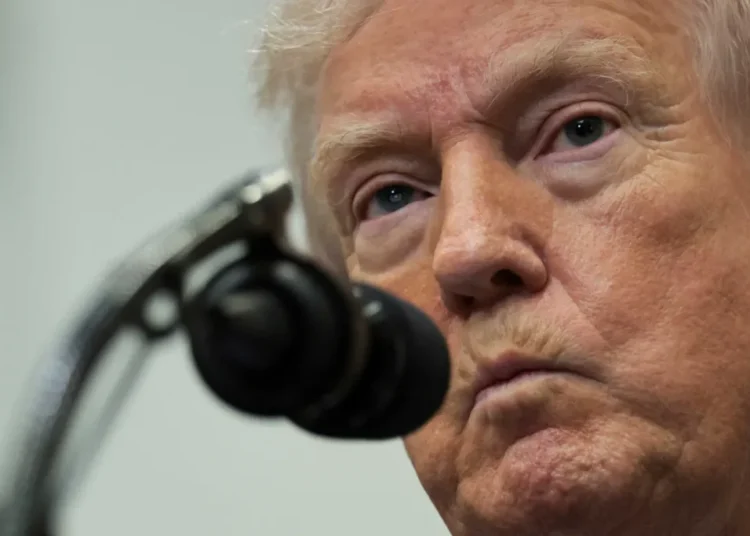
But in Trump’s remarks to the nation Saturday, he repeatedly brought up another factor: Venezuela’s oil. American energy companies, Trump said, are poised to go in, invest billions of dollars and assume control of the nation’s vast reserves.
“They stole our oil,” Trump charged, apparently referring to the nationalization of Venezuela’s oil industry in the 1970s and later efforts to tighten state control. “We built that whole industry there. And they just took it over like we were nothing … So we did something about it.”
Describing the successful military operation Saturday, Defense Secretary Pete Hegseth introduced another overarching reason. Trump, he said, was “deadly serious about reestablishing American deterrent and dominance in the Western hemisphere.”
In November, the White House published what it called a “Trump Corollary” to the Monroe Doctrine — a historic document asserting America’s hemispheric dominance — that promised to “restore American preeminence in the Western Hemisphere.”
Carolina Jiménez Sandoval, the Venezuelan president of the Washington Office on Latin America, said she could only make sense of Saturday’s stunning events in the context of this new document.
“The idea that you can take the most powerful man in the country and then see him surrendered to U.S. troops sends a very powerful message across Latin America that the U.S. is willing to go through with its threats,” she said. “They’re not saying they’re going to work through alliances; they’re saying they’re going to impose their will through any means, including military power.”
Trump, she noted, didn’t mention Venezuelan democracy once in his speech Saturday and the White House hasn’t signaled that it wishes to replace Maduro with either Edmundo González Urrutia, the apparent winner of the 2024 election, or María Corina Machado, winner of the Nobel Peace Prize and leader of the country’s opposition movement.
“The lack of a clear objective is what has so many of concerned,” she said.
Renata Segura, director of the Latin America and the Caribbean program at the International Crisis Group, said she was particularly worried about what could befall Venezuela if various factions begin vying for power. Dozens of men carrying rifles were seen rumbling through Caracas on motorcycles Sunday, members of a pro-government gang known as a colectivo.
“It’s very clear they have not really thought through what could happen next after removing Maduro,” Segura said. “And that’s very disturbing.”
By midday Sunday, people in the capital were beginning to head out to the shops again. They lined up to buy food, water. More businesses were open than on Saturday, though owners were careful not to allow too many people inside. Others went to church to pray — for peace, stability and, perhaps, for answers.
“It’s still the same people in power,” Figuera said. “Everyone here is waiting to see what happens next.”
A police officer, who spoke to The Washington Post on the condition of anonymity because he was a member of the state security forces, said as soon as heard the first bombs he knew Maduro’s time in power had come to a close.
But he’d felt few moments of certainty since. How long would Rodríguez hold on as president? He had no idea.
“She has no real power,” he said. It was the Americans, the “gringos,” he said, who were now in control.
“If anyone does anything against the gringos,” he said, “they will face the same fate as Maduro.”
McCoy reported from Mexico City. Helena Carpio in Caracas contributed to this report.
The post Confusion reigns in Caracas after Maduro’s capture by U.S. forces appeared first on Washington Post.