The dream of returning had grown distant for millions of Venezuelans who had fled their government’s crushing of dissent and an economy in free fall.
“If I speak from my heart, I had utterly lost hope,” said Jorge Colmenares, 50, who left seven years ago. For him, selling caramel candy at red lights on the streets of a Colombian border city was a step up from living out of cardboard boxes on the streets of his own homeland with his wife and young children.
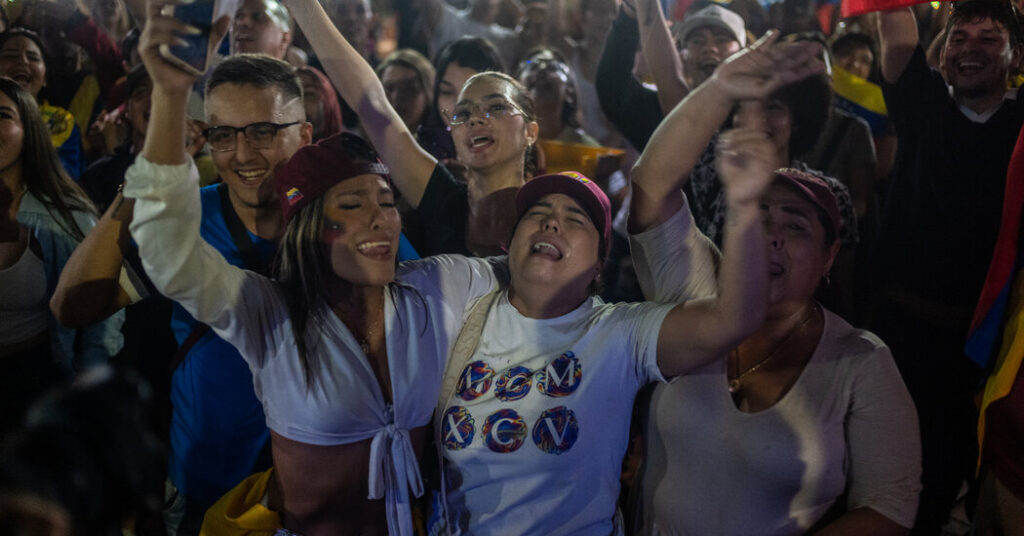
But even if he knew the road to returning remained uncertain after an American attack deposed Venezuela’s autocratic leader, Nicolás Maduro — whom he called “the head of the gang of our torturers” — Mr. Colmenares wept Saturday night. So did many other Venezuelans in exile. Their tears were brought on both by hope that going home might be close at hand and by the pain from the years of privation and tragedy that had befallen them.
“When I think of my land, the beaches,” Mr. Colmenares said, before he broke down in sobs as he spoke in Cúcuta, along Colombia’s border with Venezuela. “My parents who died and I couldn’t see them, my brothers and my son who crossed the Darién.”
In recent years, hundreds of thousands of Venezuelans have crossed the Darién Gap, a treacherous, roadless zone between Colombia and Panama, on their way north to Central America and the United States. One of Mr. Colmenares’s sons is in detention in the United States, he said.
Three million Venezuelans have settled in Colombia over the past decade. Nearly five million more have scattered across South America.
Since the U.S. attack on Saturday, few have returned. The border crossing in Cúcuta, which accounts for 70 percent of traffic between the two countries, was quiet over the weekend, except for the presence of three armored vehicles belonging to the Colombian military.
The United Nations and the Colombian government said the flow of people in both directions remained normal, and reflected mostly the daily back-and-forth of commerce between cities on either side of the border.
On Sunday morning, it was mostly Venezuelans crossing into Colombia. Some were on Venezuelan-made Bera motorcycles emblazoned with decals saying “socialista.” Others were in ancient Chevrolet Caprices, sipping coffee out of plastic cups in between gear shifts.
The night before, hundreds of jubilant Venezuelans had gathered on a central promenade in Cúcuta to light fireworks, give speeches and sing their national anthem
Eduardo Espinel, a Venezuelan who opened a restaurant in Cúcuta and organized the gathering, told the crowd that he could not believe the day would come when Mr. Maduro was behind bars. He then thanked President Trump and led a chant: “It’s happening, it’s happening.”
When asked what exactly was happening, however, he acknowledged that he and everyone around him remained in a wait-and-see mode, and that Mr. Maduro’s closest associates seemed to have been left in control by Mr. Trump. But it is the nature of Venezuelans, he said, to be optimistic, to be boisterous, and to be emotional. He clasped the crucifix necklace he was wearing under his tightfitting white shirt.
“Look, we thought this day was impossible, that no one would ever get rid of these guys, that this was our eternity,” Mr. Espinel said. “How could we not celebrate?”
Mr. Espinel, like many of those gathered at the promenade, said they had fled persecution by the Maduro government. Mr. Espinel said he was never affiliated with any opposition party and had not tried to run for office, but was simply a community organizer.
One mansaid that while he wasn’t sure what would come next for his home country, he was satisfied that Mr. Maduro, now that he is in custody, would likely experience some of the fear he had imposed on many Venezuelans.
Like other Venezuelans interviewed for this article, the man refused to give his name, citing fear for the safety of relatives still back home.
The man said he had lived in San Cristobál, the Venezuelan city right across the border from Cúcuta, and was a small-business owner who had been threatened with extortion by the government.
Many in the euphoric crowd were willing to put aside what they regarded as nakedly colonial rhetoric coming from Washington about their country’s resources.
Mr. Colmenares was elated, too. He danced under the fireworks to the sound of men playing tamboras with his 8-year-old daughter, Karen, who waved a Venezuelan flag that was larger than she was. His wife, Raiza Yudith Echeverría, sold hot dogs dressed with mayonnaise and crispy potato sticks from a cart to the revelers.
For him, the lesson was about resilience, not revenge.
“We made it this far,” Mr. Colmenares said. “Many didn’t. They died in the streets. In the forests. Before they could return home.”
Max Bearak is a reporter for The Times based in Bogotá, Colombia.
The post Venezuelans in Colombia Rejoice, but Are Not Ready to Rush Back Home appeared first on New York Times.