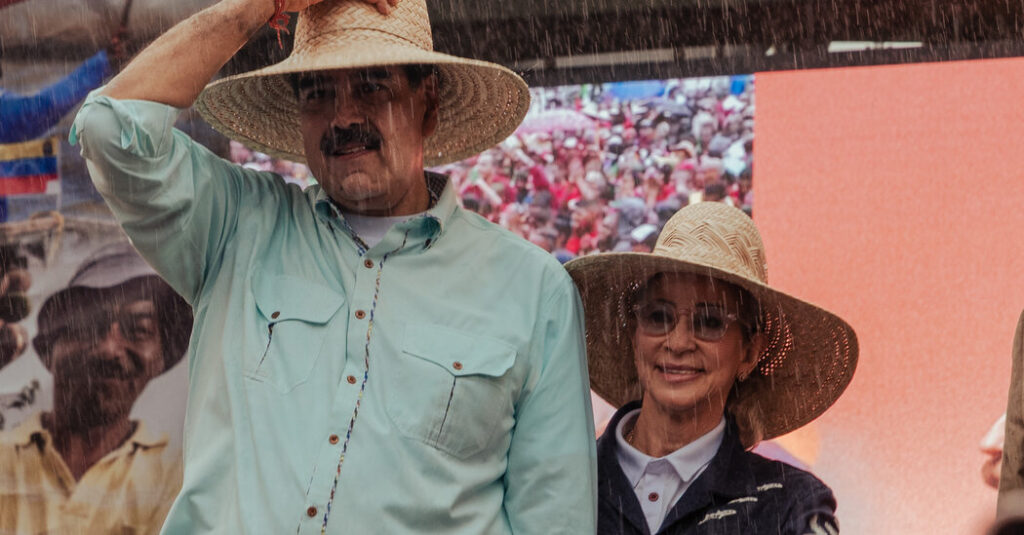
When news broke that the United States had captured and indicted Venezuela’s longtime authoritarian president, Nicolás Maduro, another name appeared alongside his that left some observers puzzled: his wife’s, Cilia Flores.
Far more than a first lady, Ms. Flores is one of Venezuela’s most powerful political figures. She built extraordinary influence over decades while largely operating from the shadows. Ms. Flores shaped a judicial system in which nearly every major decision ran through her and embedded state institutions with relatives and loyalists, according to journalists, analysts and former officials. At the same time, they noted, her family amassed vast, unexplained wealth.
A lawyer from a lower middle class background, Ms. Flores began her political rise in the 1990s, becoming close to Hugo Chávez — the former president who was Mr. Maduro’s mentor and predecessor — while he was imprisoned after a failed coup attempt in 1992. She steadily climbed the ranks of Chávez’s socialist movement, known as chavismo, becoming a central figure in Venezuela’s legislature.
Ms. Flores and Mr. Maduro have been partners since at least the late 1990s, when both were lawmakers. They married in 2013, the year he became president. After Mr. Chávez’s death, she was widely seen as critical to consolidating and sustaining Mr. Maduro’s hold on power, bringing a loyal political base and deep institutional influence.
Within chavismo, she commands both respect and fear, said Roberto Deniz, a Venezuelan investigative journalist who has reported extensively on the Flores family.
“She is a fundamental figure in corruption in Venezuela — absolutely fundamental — and especially in the structure of power,” said Zair Mundaray, who worked a senior prosecutor under both Mr. Chávez and Mr. Maduro. “Many people consider her far more astute and shrewd than Maduro himself.”
In an interview published in the Spanish newspaper La Vanguardia in 2013, Ms. Flores called herself a “combatant” and defended hiring relatives.
“My family got in based on their own merits,” she said. “I am proud of them, and I will defend their work as many times as necessary.”
Though she stopped holding formal government posts after 2013, Ms. Flores retained immense behind-the-scenes authority. She is often described as a key architect of Mr. Maduro’s political survival.
“Within chavismo itself, they know the real power that Cilia Flores has, more so than perhaps the general public,” Mr. Deniz said.
Ms. Flores is also widely believed to wield decisive influence over Venezuela’s justice system. Many judges and senior officials are thought to be loyal to her or have been placed through her networks. The judiciary is considered thoroughly politicized, having failed to issue a single ruling against the state in more than two decades.
“It is a completely politicized, flawed, corrupt judicial system, and Cilia Flores bears a great deal of responsibility for what the Venezuelan judicial system has become,” Mr. Deniz said.
Investigative journalists have documented extensive corruption involving the Maduro-Flores family, including misuse of public funds and business links with sanctioned foreign businessmen. One investigation showed the family effectively taking over an entire street of luxury homes in Caracas, the country’s capital.
A federal indictment unsealed on Saturday charged Ms. Flores, along with her husband and son, with collaborating with drug traffickers.
“She has been basically co-governing the country since he came to power, and in many ways is the strategy or power behind the throne,” said Risa Grais-Targow, the Latin America director for Eurasia Group, a political risk consultancy. “She’s been key to his staying power, but also now his downfall as well.”
Genevieve Glatsky is a reporter for The Times, based in Bogotá, Colombia.
The post Who Is Cilia Flores, the Power Broker Captured Alongside Maduro? appeared first on New York Times.