While he was out of office, President Trump mused about what would have happened if the United States had taken control of Venezuela.
“We would have gotten all that oil,” he said in a speech at the North Carolina Republican Convention in 2023. “It would have been right next door.”
On Saturday, Mr. Trump made it clear that he now intends to follow through.
In the last year, as the Trump administration built up pressure against Nicolás Maduro, the Venezuelan leader, the president and his top aides said that the aggressive U.S. actions were necessary to curb drugs and migration from that country. But on Saturday, as Mr. Trump discussed the predawn attack on Venezuela that led to the capture of its leader, it was evident that the president’s longtime fixation on oil was a driving factor in his decision to greenlight the mission.
“We’re going to be taking out a tremendous amount of wealth out of the ground,” Mr. Trump told reporters as he celebrated the seizure of Mr. Maduro, promising that American companies would be able to tap more of Venezuela’s vast oil reserves.
The money made, he said, would go not only to the people of Venezuela, but also to American oil companies and “to the United States of America in the form of reimbursement for the damages caused us by that country.”
There was little immediate clarity as to how the White House envisions the United States profiting from Venezuela’s oil. Analysts warn that large increases to the country’s oil production could take years and tens of billions of dollars in spending. But Mr. Trump indicated that the country’s oil wealth was a key factor not only in his decision to attack, but also in pledging that the United States would “run” Venezuela for the foreseeable future.
“It won’t cost us anything because the money coming out of the ground is very substantial,” Mr. Trump said, adding that “we’re going to get reimbursed for everything that we spend.”
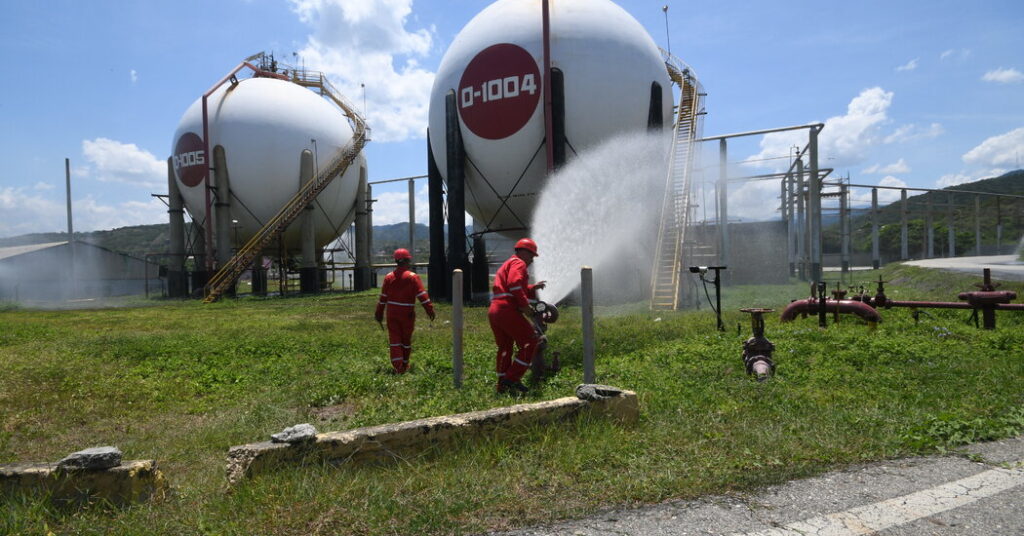
Venezuela has about 17 percent of the world’s known oil reserves, or more than 300 billion barrels, more than any other country. But its production is only about 1 percent of the world total.
Before Venezuela nationalized its oil industry in 1976, American companies like Exxon, Mobil and Gulf Oil were major players. The country reopened its oil industry to foreign drillers in the 1990s, but Hugo Chávez, Mr. Maduro’s predecessor, began another phase of nationalization in 2007. U.S. oil giants like Exxon Mobil and ConocoPhillips claimed they were owed billions of dollars in compensation because their operations were seized.
That history feeds the Trump administration’s contention that Venezuela stole oil from the United States — an argument that the White House increasingly made in the weeks leading up to Saturday’s attack. Stephen Miller, the senior Trump adviser central to the president’s immigration crackdown, posted on social media last month that “American sweat, ingenuity and toil created the oil industry in Venezuela.”
“If you remember, they took all of our energy rights; they took all of our oil from not that long ago,” Mr. Trump said last month. “And we want it back.”
Laying claim to other countries’ oil has long been a fixture in Mr. Trump’s rhetoric.
“I’ve been saying it for years. Take the oil,” he told The New York Times in 2016, when asked how his strategy to fight the Islamic State in the Middle East would differ from President Barack Obama’s approach.
As the Trump administration increased its pressure on Mr. Maduro during the last year, oil was not initially central to its public rationale. Instead, the White House focused on claims that Mr. Maduro had directed drug trafficking and gang members who migrated to the United States — some of which have been disputed by Mr. Trump’s own intelligence agencies. When Mr. Trump said in March that he would impose tariffs on countries that buy Venezuelan oil, he said he was doing it because, he claimed, Venezuela had “purposefully and deceitfully” sent “murderers and people of a very violent nature” to the United States.
But behind the scenes, as The Times reported last month, the future of Venezuela’s oil was central to Mr. Trump’s deliberations as early as last spring. The White House saw the pressure campaign against Venezuela as a way to combine three separate policy goals: crippling Mr. Maduro, using military force against drug cartels and securing access to Venezuela’s oil reserves for U.S. companies.
Chevron has in recent years been the only U.S. oil company operating in Venezuela, thanks to permission from the governments of both countries to produce and export oil there. Chevron’s activities played into the White House deliberations, as the company lobbied the White House for an extension of the Biden-era license that allowed it to expand its operations in Venezuela, as The Times previously reported.
However, on Saturday, Chevron was circumspect, even after Mr. Trump said that U.S. companies would soon spend “billions of dollars” on Venezuela’s oil infrastructure.
The company initially sent reporters a statement saying it was “prepared to work constructively with the U.S. government during this period, leveraging our experience and presence to strengthen U.S. energy security.” It later said the statement was incorrect and issued a new one that removed mention of the U.S. government.
“Chevron remains focused on the safety and well-being of our employees, as well as the integrity of our assets,” the company said. “We continue to operate in full compliance with all relevant laws and regulations.”
Ivan Penn contributed reporting from Los Angeles.
Anton Troianovski writes about American foreign policy and national security for The Times from Washington. He was previously a foreign correspondent based in Moscow and Berlin.
The post Trump Long Wanted to ‘Take the Oil.’ He Says He’ll Do It in Venezuela. appeared first on New York Times.