Sparklers shooting foot-long flames. A ceiling covered in flammable foam. A crowded basement with a narrow staircase exit that became a choke point.
These are some of the avoidable hazards that fire experts, witnesses and a New York Times analysis of visual evidence suggest turned a festive bar in a Swiss Alpine resort into a death trap as fire tore through a New Year’s celebration, causing a stampede and killing at least 40 people.
Investigators have not yet provided a comprehensive account of what caused the fire at Le Constellation around 1:30 a.m. on Thursday, which Switzerland’s president called one of the worst disasters in the country’s history. But the available evidence suggests the tragedy involved some of the same safety lapses that caused other lethal blazes in crowded venues, according to fire safety experts, including a 2003 blaze in Rhode Island that killed roughly 100 people and a 2013 fire in Brazil that killed more than 200 people.
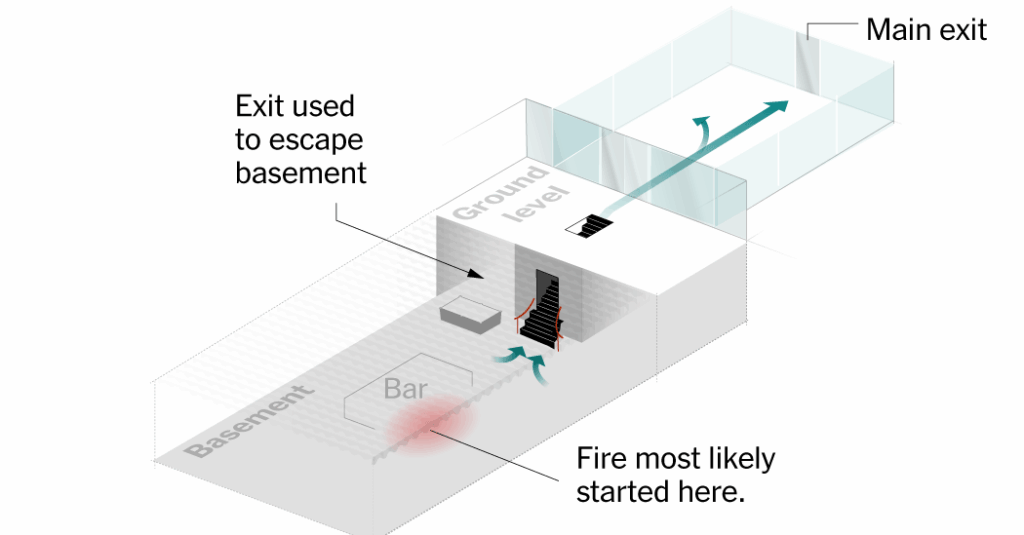
The Swiss fire most likely began after sparklers — finger-size fireworks, carried that night by some of the waiters, that send up a fountain of sparks — set flame to the ceiling, according to Beatrice Pilloud, the regional chief prosecutor. As fire quickly engulfed the bar, partygoers congregating near the dance floor recounted struggling to escape the basement through a narrow staircase exit that quickly became clogged. Though officials and neighbors said there was a second door for emergencies, several witnesses said they saw only the staircase exit and, after reaching the ground floor, some broke through windows to escape.
Richard Meier, a fire and explosion investigation expert based in Palmetto, Fla., said the evidence pointed to an “avoidable tragedy,” adding, “It is a lesson that we should have learned decades ago, but we keep repeating.”
The police on Saturday announced that they were opening an investigation into the two managers of the bar, on suspicion of negligent homicide, negligent bodily harm and causing a fire by negligence. According to the canton’s public business records, the two owners of the bar are a French couple named Jacques and Jessica Moretti, who opened Le Constellation in 2015.
The Morettis did not respond to requests for comment. In brief interviews with the Swiss media, they said they were fully cooperating with investigators and denied any wrongdoing.
“We can neither sleep nor eat; we are all in a terrible state,” Mr. Moretti told 20minutes.ch, a local news site.
The sparklers
As Noa Bersier, 20, a marketing coordinator, played billiards at the bar early on New Year’s Day, he noticed waiters hurrying to and fro, carrying wine bottles fixed with sparklers to various tables. It was these, according to the regional chief prosecutor, that likely caused the fire, sending sparks shooting toward the ceiling.
Pyrotechnics like sparklers are legal to purchase in Switzerland, but fire protection specialists have long warned against their indoor use. Photographs from the night of the fire show them being used particularly dangerously, with partygoers hoisting them aloft, close to the ceiling.
Mr. Bersier said he could not tell whether the sparklers set the blaze, but he noticed the ceiling had burst into flames shortly after waiters brought them out.
“It was as though all the ceiling had been soaked with something and instantly caught fire,” he said in a phone interview from the hospital bed where he is recovering from severe burns.
Steven Badger, an American lawyer who has worked extensively on cases involving indoor fires, said there was a well-documented history of risk posed by the use of sparklers indoors. “It’s shameful we continue to have mass casualty losses from this exact scenario we’ve seen over and over again,” Mr. Badger said.
The flammable ceiling
To explain how the initial flame spread so aggressively, experts point to the foam insulation material that appeared to cover parts of the ceiling. The foam, typically made of a synthetic material called open-cell polyurethane, is traditionally used for soundproofing and is highly combustible.
“We don’t allow this material to be visible in a room in Switzerland. It must be covered,” said Olivier Burnier, who directs a fire-safety engineering firm in Switzerland. Mr. Burnier said that footage of the fire suggested that parts of the bar’s setup did not comply with local fire safety regulations.
Those regulations mandate that combustible materials may only be used if they do not lead to an “unacceptable increase” in risk, based on factors like occupancy and building layout. Materials that have a “critical” reaction to fire cannot be used inside buildings unless they are fully covered, the regulations say.
Footage of the bar appeared to show that the material covered much of the ceiling, and a regular who visited the bar earlier in the week told The Times that the foam had come unstuck in some places and was hanging loose by several inches.
Samir Melly was drinking at Le Constellation two days before the disaster, he said, when a friend who works in construction suddenly became fixated on the foam-covered ceiling, which he said appeared to be hanging loose.
“He was so focused on the ceiling because he was looking at it from the perspective of a construction worker,” Mr. Melly said. After the fire, Mr. Melly reported his friend’s concerns to the police, who summoned him on Friday to give testimony as part of the investigation.
Arnaud Trouvé, a professor at the University of Maryland’s Department of Fire Protection Engineering, said the foam should be the “first target” of inquiry because of its potential to drastically spread blazes. Similar material has long been a culprit in deadly mass blazes at nightclubs and music venues, including those in Rhode Island and in Brazil.
Mr. Meier said, “I can’t think of any worse material that could be placed on the ceiling of a public space,” adding, “In addition to burning, the material would melt, and burning droplets would further ignite materials below.”
The exits
Survivors have questioned whether the bar had sufficient exits, with several describing getting caught in a crush on the narrow staircase to the ground floor as people desperately fled the fire. Others described smashing windows to escape, while bystanders outside said they had forced open glass doors to allow people to flee.
The authorities said the building had an emergency exit but did not specify whether it was on the basement level, where most people would presumably congregate. Swiss fire safety codes hold that rooms that accommodate over 100 people are required to have two “vertical evacuation routes” — like staircases — if escape routes leading directly to the open air are insufficient.
Davide D’Agostino, 56, the owner of an architecture firm located in the same building as the bar, said there was definitely an emergency exit because it came up in discussions with members of the building’s board when the Morettis took ownership. That emergency door, he said in an interview, was near the bathroom and opened onto stairs leading up to the building behind.
That has raised questions about whether patrons had been made sufficiently aware of alternative escape routes, and if those exits were clearly marked.
Nestor Fischer, 17, who was outside the bar when the fire began, described how he and others struggled to force open a glass door on the side of the bar to help others escape.
“We tried to break it with a stool,” he said in an interview. “We tried hitting the window, but it wouldn’t open.” At some point, the door ripped off and his friends helped guide people out with the flashlights on their phones.
The building inspections
It was unclear to what extent the building had been subject to required inspections. The Crans-Montana municipality, which is in charge of regular building inspections, had not reported any fire safety issues to the Valais canton, the equivalent of a Swiss state, a senior canton official said at a news conference on Friday. But the official, Stéphane Ganzer, said he could not say how frequently the municipality had carried out those inspections.
Mr. Moretti, one of the bar’s owners, told the Tribune de Genève that the bar had been inspected by local authorities three times in 10 years and that “everything was done according to the standards.” But local law in the region calls for yearly fire safety inspections in buildings that are open to the public or present special risks.
“This type of accident with Swiss regulation is not possible,” said Mr. Burnier, the Swiss fire expert. “But we have one because we have a problem now in the application of the law.”
The municipality office overseeing public security declined to comment, referring questions to the police, who also declined to comment.
Ségolène Le Stradic is a reporter and researcher covering France.
The post An ‘Avoidable Tragedy’: The Hazards That Led to the Swiss Fire Disaster appeared first on New York Times.