CAMPOLEONE, Italy — Inside their recording studio on a recent morning, Matteo Salvatori and Emiliano Santoro’s smartphones lit up. Fresh reports were pouring in from their “deputies” — a legion of online followers — of another violent crime against the sanctity of Italian cooking.
The Eastern European suspects in question were repeat offenders; their chosen weapons, TikTok and a frying pan. Previous food felonies included a clip in which the two blonde women heated bologna, eggs and yogurt with raw penne and a mountain of salt before declaring the ensuing abomination a “carbonara.”
This time the women had crossed a line as red as ragù.
“They’re making …” said Santoro, his face contorting in mounting horror.
“They’re making …” said Salvatori, hands gesticulating.
The Italians shrieked in unison:
“Pizza soup!”
Later, Santoro and Salvatori — who have built comic careers as Italy’s global pasta police — made a de facto citizen’s arrest by calling out the women in a YouTube skit that ended with their infamous tagline.
“Not approved!”
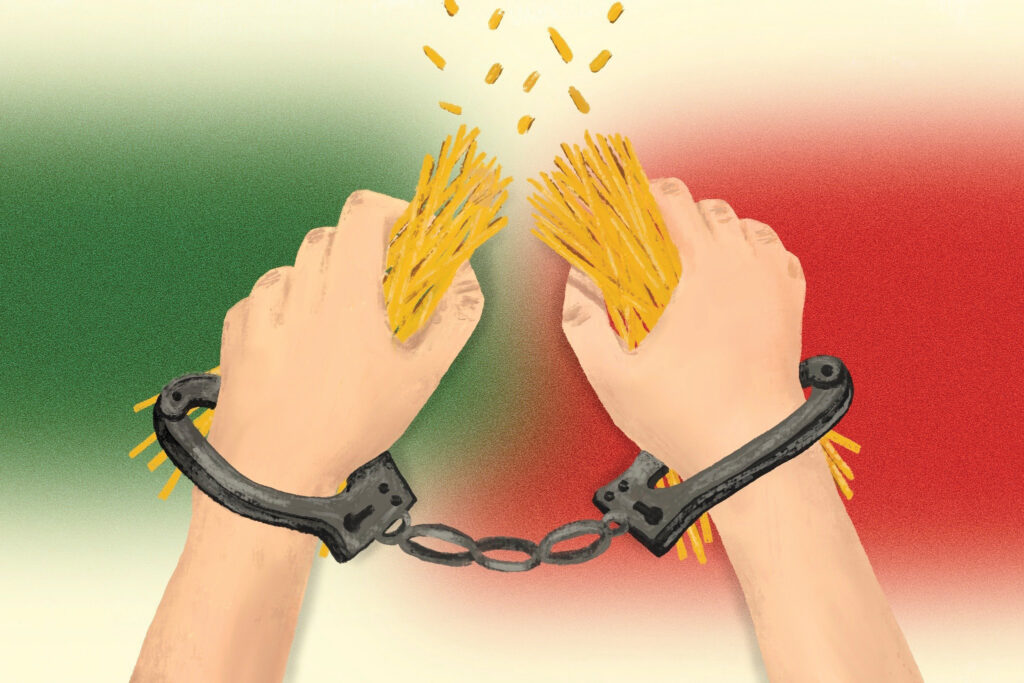
To nearly 30 million followers, the duo known as Lionfield — translation of their hometown south of Rome — serve up gastronomic reprimands with heaping helpings of tongue in cheek. But in Italy, reclaiming its globally appropriated food culture is no laughing matter but rather, a national call to arms.
A host of online kitchen Carabinieri has joined government officials and celebrity chefs in a culinary crusade to stop foreign perversion of la cucina italiana — a campaign so serious the government is proffering a new law to jail peddlers of counterfeit parmesan or masquerading mozzarella for up to four years.
Italians for decades have griped over the Frankenstein monsters created from the parts of their cooking — look at (or avert your gaze from) pineapple pizza. But in the years-long push to have “Italian cooking” broadly recognized by UNESCO — which succeeded in December, in what national officials have called a “first” — pride of cuisine has reached a fevered pitch in il bel paese, touching off a heated debate over Italian food purity and the politicization of cooking.
Italy’s UNESCO designation also instantly stirred a pot of contrarians, who poked at Italy for succumbing to the first and worst of deadly sins: pride.
Blasting the “myth” of Italian food “primacy,” Giles Coren, restaurant critic for the Times of London, dismissed Italy’s celebrated cuisine as “rubbish,” lampooning its indoctrinated supporters as having the palates of “spoilt toddlers.”
“‘It’s the light on the hills, darling,’ they gushed. ‘And the shadows cast by the cypresses.’ Like the sun doesn’t shine anywhere else and nowhere but Italy has trees,” Coren wrote. “And then it was the tomatoes. They didn’t stop going on about the tomatoes, which — spoiler alert — are the same as all other tomatoes.”
Aghast, Chiara Amati, a food writer for Corriere della Sera, Italy’s largest daily, responded with a takedown of her own, labeling Coren’s piece “poisonous, bordering on a diplomatic incident.” She kicked him where it hurts: his prowess as a critic.
“He doesn’t build a reasoning: he accumulates invectives and gags,” Amati opined.
If the retort sounded personal, it’s no surprise. Just a few years after Domino’s pizza left Italy with its tail between its proverbial legs — but as Starbucks is making worrying inroads — the government of Prime Minister Giorgia Meloni is injecting a dose of nationalism into food culture.
Meloni heralded the UNESCO designation by lighting up the Colosseum in the tricolors of the Italian flag, and issuing a video message that ended with a cry of “Long live Italian cuisine! Long live Italy!” At an annual meeting of the right wing in Rome, Meloni bragged of her government’s success in celebrating Italian food, crowing that left-wing politicians “have been gnashing their teeth” and “eating in kebab shops all week.”
Francesco Lollobrigida, Italy’s agriculture minister, who was a force behind the UNESCO bid, has moved to defend Italian food from impostors and posers. Under his watch, tricolor labels are being stamped on Italian domestic wines. In November, he called for an official investigation after finding a particularly offensive jar of canned carbonara for sale at a food market inside the European Parliament building in Brussels.
Food is big business in Italy — generating $820 billion a year. Infuriated by the rise of Russian parmesan and Chinese pecorino, a new law set to be voted on in early 2026 would double the maximum jail time to four years from two for falsely declaring the country of origin of foods sold in Italy. Fines could more than double to 50,000 euros ($58,700).
“We’re proud of our food model, but also aware that in order to guarantee its economic value, its quality, safety, and the protection of production regulations, we must be extremely vigilant,” Lollobrigida said in interview with The Washington Post.
Alberto Grandi, professor of food history at the University of Parma and an Italian food contrarian, described the recent outburst of Italian food pride as deeply unnerving — as well as undeserved.
His book — “Italian Cooking Does Not Exist” — claims that Italian cuisine as it is known today owes much of its grandeur to the reimportation of recipes created by Italian immigrants who found abundance in the New World, or from serendipitous foreign influences — like the American soldiers who brought bacon and powdered eggs to Italy during World War II, inspiring Carbonara.
Pre-World War II “pizza,” Grandi argued in an interview with The Post, was largely “garlic and pork fat on bread” sold on Neapolitan streets. “The descriptions we have of these vendors’ wares are terrible,” he said. Samuel “Morse, the inventor of the Morse code, says it looked like ‘a piece of bread pulled from the sewer.’”
Pizzerias, he notes, only sprung up across Italy after the economic boom of the 1950s and 60s, well after they had become established in the United States. His heresies have earned him threats and tongue lashings from Italian agriculture groups and right-wing politicians, who call him a tiramisu turncoat, a trattoria traitor.
He remains unbowed.
“We hear stern warnings against ‘globalist contamination’ from politicians who grew up eating industrial panettone and Kraft slices in school sandwiches,” Grandi wrote in a recent op-ed in the Guardian. “We are told that Italian cuisine must remain pure, fixed and inviolable — as if purity had anything to do with our past. ”
Revisionist history or not, Italians are rallying to defend their cuisine. Purists are quick to point out that dishes like veal parmesan, garlic bread, Alfredo sauce and spaghetti and meatballs are pungent North American fare invented by Italian immigrants — not to be found on the menu of any self-respecting restaurant in Italy today.
‘It’s American cuisine, not Italian,” said Massimo Bottura, the renowned Italian chef who helped push the UNESCO bid. Bottura admitted to trolling the saucy creations of his former disciple, Stefano Secchi, now based in New York City, who earned a single Michelin star for his restaurant, Rezdôra.
“I was looking at his Instagram and busting his balls, saying ‘too much sauce,’ ‘too much of this,’ ‘too much of that,’” said Bottura, whose restaurant, Osteria Francescana in Modena, holds three Michelin stars. “You know, don’t put the culatello on top of the gnocco fritto because it’s gonna be too salty.’ He said, ‘Listen, here it’s New York. And Italian cuisine is different. It’s Italian American cuisine.’ I said, ‘You’re right.’”
After its waves of immigrants left decades ago, Bottura said, “Italy evolved and transformed in a different way.” Correctly cooked pasta, he said, can be poetry; the right balsamic vinegar, sublime. The whole of the Italian cooking tradition — the selection of ingredients, the transformation of food into love — transcendent beyond mere sustenance.
Italian cooking, he said, “is an invitation to look at food as a cultural language.”
The Italianate atrocities being railed against now range from sweet corn pizza in Japan to chicken alfredo at the Olive Garden. Just as often, the complaints are about a lack of a respect — the sacrilegious breaking of spaghetti before putting it in a pot, or — mamma mia! — sipping cappuccino (a breakfast drink in its native habitat) after noon.
On YouTube, Santoro and Salvatori’s largest following is outside Italy — with audiences who eat up the Italian purists. Musicians who studied in United States before returning to Italy, they began filming humorous short clips during the pandemic, and after marveling at the creations served as “Italian food” in America.
They’re not necessarily bad, the Lionfield duo and other Italians say. Just label them what they are — Italian-American, not Italian.
One of their early hits: a segment in which Santoro, as Captain Italia, dons an Italian flag as a cape to save a pizza from a descending pineapple slice.
“Now, it’s normal to think about Italians complaining about … the Italian fusion you find outside of Italy,” Santoro said. “But at that time, five years ago, it was not that common. We were, like, among the first ones to do it publicly. And I think for people it was like … these guys are Italians, and they’re talking about the breaking of spaghetti. Now, well, it’s a meme.”
These days, they do not stand alone. Angelo Coassin, an Italian chef with 1.8 million TikTok followers, shot a clip of his ultimate nightmare: Dining on pineapple pizza. Another Italian food defender — Michele Lettera, with nearly 900,000 followers — posted a video of an instant carbonara recipe from the United States with a voice-over declaring “defend Spaghetti from American torture.”
Nicolas Calia, a Sicilian marketeer, trolled the cheesy, saucy fare at the San Gennaro Festival in Manhattan’s Little Italy on Instagram with head-scratching bewilderment in 2024. Calia also staged a viral 2023 protest at Rome’s Trevi Fountain, holding up homemade signs to tourists declaring, “stop putting cream on your carbonara!!!” and “adding chicken to the pasta is a crime in Italy!!!”
Yet surely his outrage is as manufactured as Velveeta Macaroni and Cheese?
“I’m telling you it’s real, 100 percent, because we see it, and we really feel the pain,” said Calia, who now lives in New York, where he said he is privy to daily indignities against Italian food. For example, he said: “One day, I saw a lady drinking cappuccino with porcini risotto. But … how? How can they do it? Any Italian who sees this, they will make a face. Because it hurts. It really hurts.”
Stefano Pitrelli in Rome contributed to this report.
The post Bologna in the carbonara? Call Italy’s pasta police! appeared first on Washington Post.