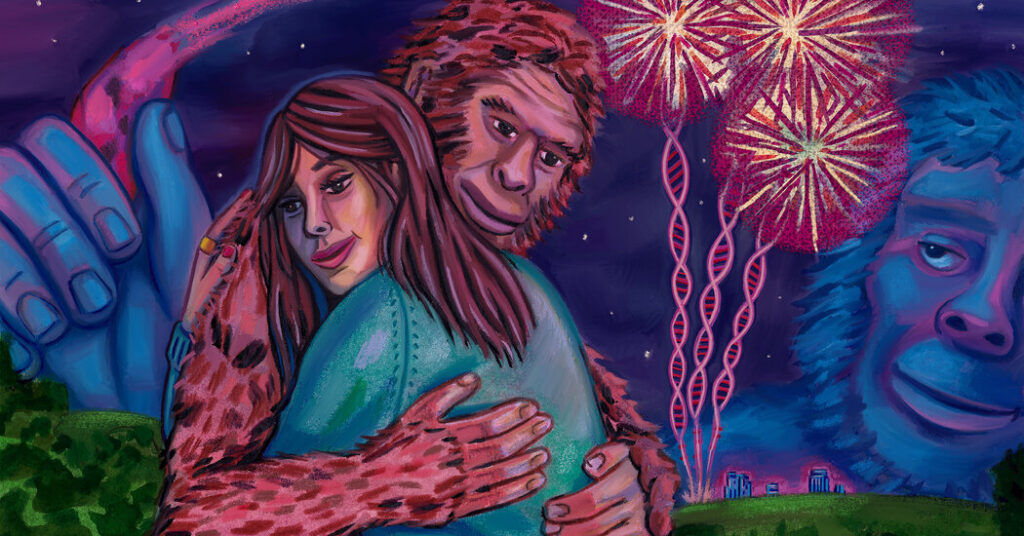
Neanderthals, who flourished across Eurasia for hundreds of thousands of years before vanishing around 40,000 years ago, had a notable return to the scientific spotlight in 2025.
More than a dozen high-profile scientific studies explored all sorts of aspects of their existence, from their love lives (they probably kissed Homo sapiens) to potential flaws in their red blood cells that may have hastened their decline.
Barely three decades ago, these ancient hominids were still being widely depicted as knuckle-dragging brutes that were too dimwitted for moral or religious concepts, probably lacking language and behaviorally less advanced than modern humans. The picture changed considerably in 2010 after the Max Planck Institute published the complete Neanderthal genome, which revealed that people of European or Asian descent possess as much as 4 percent Neanderthal DNA, indicating extensive, past interbreeding between the two hominid groups.
Joao Zilhão, an archaeologist at the University of Lisbon, noted, with a trace of sarcasm, that the push to classify Neanderthals as a separate species frequently arises from a reluctance, especially among geneticists, to fully accept them as a geographically distinct, but interbreeding, branch of humanity.
“There are lots and lots of geneticists, many more than there are archaeologists,” he said. “Doing research on this or that molecule is much less time-intensive than excavating an archaeological site and studying what was found there.”
Since the mid-1990s, Dr. Zilhão has argued that there was no significant cognitive or cultural gap between Neanderthals and modern humans. His fieldwork in Spain indicates that Neanderthals independently fashioned cave art and jewelry, such as decorated seashells, between 65,000 and 115,000 years ago, tens of thousands of years before similar finds linked to Homo sapiens in Africa or their arrival in Europe. Dr. Zilhão proposes that the shared capacity for symbolic thought points to a history of gene flow and cultural diffusion between the two groups, rather than Homo sapiens being uniquely sophisticated.
The Times asked Dr. Zilhão to share his perspective on the year’s most newsworthy Neanderthal-related projects.
The parent trap
In 1931, archaeologists discovered the 140,000-year-old skeletal remains of a child, most likely a girl between the ages of 3 and 5, at the Skhul Cave on Mount Carmel in Israel. A new study in the journal L’Anthropologie found that the child may have been a hybrid, with one parent a Homo sapiens and the other Neanderthal. This would push back the date for when these groups mixed by some 90,000 years and indicate that they interacted earlier and more deeply than thought.
Under the direction of Israel Hershkovitz from Tel Aviv University and Anne Dambricourt-Malassé of the French National Center for Scientific Research, paleoanthropologists digitally reconstructed the skull and jaw of the child using CT scans and 3-D mapping technology. Comparing these models with those of other Neanderthal and early Homo sapiens children, they discovered a compelling fusion of features: The part of the skull housing the brain resembled that of a modern human, while the jaw and inner ear structures were similar to those found in Neanderthals. The findings suggest that the unique combination of traits points to a long-term intermingling in the Middle East, not just isolated encounters.
This evidence challenges the notion that Neanderthals were rapidly replaced by modern humans, and that human evolution was solely defined by conflict. Instead, the two hominid groups appear to have been intimately connected, such that local Neanderthal populations were gradually absorbed into larger Homo sapiens groups, Dr. Hershkovitz argues. This supports the paleodeme theory, which views both groups as part of one fluid evolutionary lineage.
Dr. Hershkovitz contends that lumping all early humans into one species group hides important details about why some traits stuck around while others vanished, and why mixed individuals, like the Skhul hybrid, appeared when they did. Sticking to a single-species model might seem less complicated, he added, but it risks simplifying the fossil record too much, losing the real story of evolution, and making it harder to understand how different human groups interacted and changed over time.
Despite the physical evidence, the classification of the Skhul child remains contentious. To Dr. Zilhão, the extent of interbreeding suggests that Neanderthals and Homo sapiens should be considered one species. Dr. Hershkovitz, however, contends that persistent physical differences between the groups, spanning time and geography, justify having separate categories. While both experts agree that DNA analysis could clarify the child’s genealogy, Dr. Zilhão noted that the fossil’s age and location make recovering such data unlikely.
A truer Paleo diet
Neanderthals were far from simple scavengers, several findings this year revealed.
A study in Science Direct detailed how Neanderthals in modern-day Serbia were elite hunters, executing daring, commando-style ambushes and dramatic cliff drives to corner wild goats in treacherous terrain. Fifty thousand to 70,000 years ago, in what is now Israel, neighboring Neanderthal groups practiced distinct, culturally transmitted methods for butchering animals, according to research published in Frontiers in Environmental Archaeology. And in a paper in Science Advances, scientists working a site in Germany found that Neanderthals were extracting marrow fat from bones 125,000 years ago, long before early Homo sapiens were doing anything similar.
“Of course they did,” Dr. Zilhão said. “Why not?”
The Neanderthal diet was long thought to have been heavy on large game, a conclusion drawn from analyzing nitrogen isotopes in their bone collagen. But a study published in Science Advances suggests that the same data could also point to a more varied, omnivorous diet that included insects.
Melanie Beasley, who is a biological anthropologist at Purdue University in Indiana and the study’s lead author, proposed that maggots, which convert lean protein into fat, offered a nutrition-rich, abundant, easily procurable food source when times were tough. She likened munching on fly larvae to eating candy corn (and advised against dwelling on the comparison).
Dr. Zilhão said that Neanderthals were likely to have had a flexible diet and adapted their eating habits to the food options found throughout their extensive range, which stretched from Gibraltar to Siberia. The notion of Neanderthals as exclusively hyper-carnivores, he added, was “a dumb, nonsensical proposition.”
The brightest crayon
Archaeologists, led by Francesco d’Errico at the University of Bordeaux in France, analyzed 16 ocher fragments found across Neanderthal sites in Crimea and mainland Ukraine, dating as far back as 100,000 years ago. The study, detailed in Science Advances, highlighted three items that showed clear evidence of having been intentionally shaped and used for drawing. One remarkable discovery was a two-inch yellow “crayon” from roughly 42,000 years ago, which microscopic analysis showed had been repeatedly sharpened, indicating that it was likely a valued tool. The implement had clearly been modified through grinding and scraping.
Dr. d’Errico argued that the crayon must be attributed to Neanderthals rather than modern humans: It was found in a site known to have been occupied by Neanderthals, and preceded the era when Homo sapiens were widely accepted to have arrived in that area. Researchers called the artifact a crayon, he said, based on its function and specific wear patterns, which strongly confirmed its use for marking a surface, possibly skin or rock. Tiny signs of friction and applied pressure, not just the object’s shape alone, suggested it had been used as an artistic tool.
“Further proof that Neanderthals engaged in the symbolic use of colorants,” said Dr. Zilhão, who has frequently collaborated with Dr. d’Enrico.
Kissing cousins
The genetic and physiological evidence indicate that Neanderthals and Homo sapiens interbred. Now, research led by Matilda Brindle, an evolutionary biologist at the University of Oxford, suggests that these encounters also likely involved kissing.
The study, published in Evolution and Human Behavior, found that both groups shared specific oral bacteria that diverged long after their evolutionary split, indicating what Dr. Brindle called ”prolonged engagement and saliva swapping.”
She and her colleagues maintain that smooching is not a contemporary cultural development but a deeply rooted primate trait that originated between 21.5 million and 16.9 million years ago. The researchers began by examining the ritual across different ape species. They defined the act prosaically, if not clinically, as “nonaggressive, mouth-to-mouth contact” independent of feeding. “Unfortunately, there are no fossils of gorillas locking lips,” Dr. Brindle said.
The team observed platonic kissing (for affection and reconciliation) in chimpanzees and orangutans and sexual kissing (for arousal) in bonobos. “We watched loads of video footage of apes having a snog,” Dr. Brindle said. “There was quite a lot about bonobo tonguing going on, and that wasn’t even the worst of it.”
The team then used Bayesian modeling to reconstruct the evolutionary history of kissing. Their hypothesis: Despite the potential risk of spreading pathogens, kissing endured as an evolutionary advantage because it enabled individuals to strengthen social ties and subconsciously assess a potential partner’s health. “We’ve all been there,” Dr. Brindle said. “You kiss someone and suddenly realize, ‘Oh, actually, this isn’t going to work.’ It’s a try-before-you-buy situation.”
Canoodling between hominids shouldn’t come as a shock, Dr. Zilhão said, given how widespread the behavior is across species. “Monkeys do it, giraffes do it, polar bears do it and — surprise, surprise — Neanderthals did it, too. Amazing. Who would have thought?”
The post The Year in Neanderthals appeared first on New York Times.