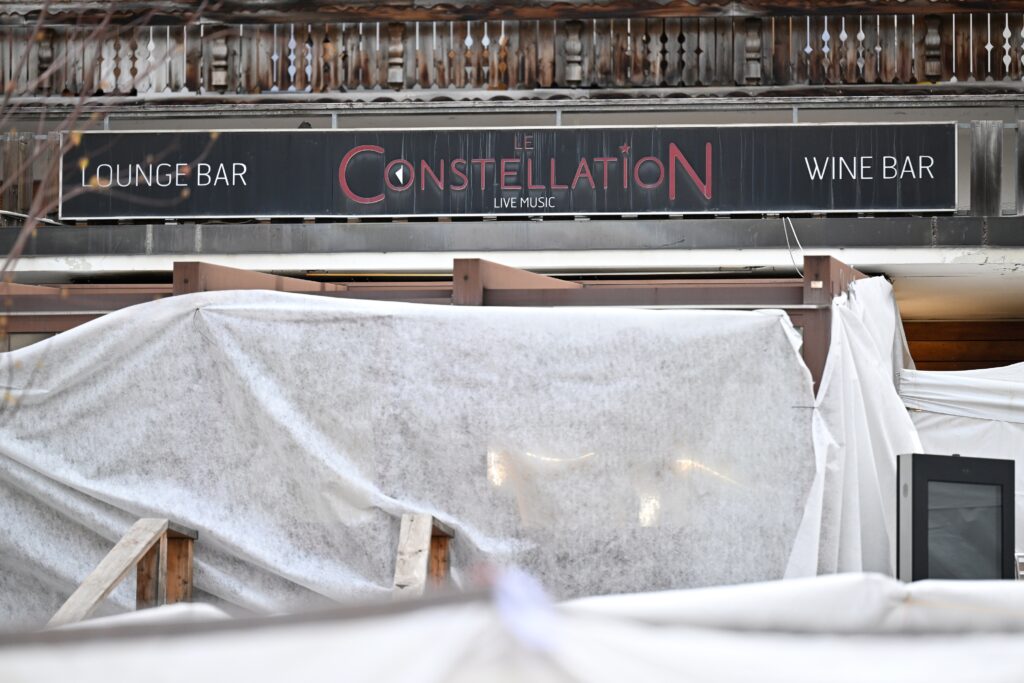
The New Year’s Day inferno that ripped through a crowded bar in southern Switzerland, killing at least 40 people and injuring 119, spread so rapidly because of what is known as a flashover, local authorities have said — the near-simultaneous ignition of everything in a room.
So fast and deadly is the phenomenon, where temperatures can soar up to 1,000 degrees Fahrenheit in seconds, that even firefighters in full protective gear are unlikely to survive such an event, experts say.
A flashover is a stage of fire growth that occurs when all combustible items reach their ignition temperatures and burst into flames, according to the National Fire Protection Association (NFPA). When a fire ignites in a room, it will grow and spread, consuming all combustible material in its path. But as the flames grow, its hot gases are trapped by the ceiling and forced downward onto unburned fuel, said Milosh Puchovsky, a professor in the Fire Protection Engineering Department at Worcester Polytechnic Institute in Massachusetts.
Swiss authorities said a flashover is what happened at the Constellation, the bar in the Crans-Montana mountain resort where many young revelers were celebrating the new year when the fire erupted early Thursday morning. Sparklers placed on top of bottles of champagne appear to have been the source of the New Year’s Day fire, and the flames spread quickly after the sparklers came close to the ceiling, Beatrice Pilloud, the attorney general of the Swiss canton of Valais, told reporters during a news conference Friday.
According to the NFPA, there are three signs a flashover is about to occur: The presence of thick, black smoke with tightly packed curls; smoke that pushes out of the doorway or window opening; and smoke that has accumulated as low as the doorknob.
“The practical sign is that thin objects on the floor (a sheet of paper) start igniting and soon every combustible material/object starts burning,” Arnaud Trouvé, the chair of the Department of Fire Protection Engineering at the University of Maryland, said in an email.
“Evacuation can only occur under pre-flashover conditions,” Trouvé said. “When a flashover occurs, people left inside the fire room are likely to perish because of the heat, the toxicity of the smoke, and/or the opacity of the smoke that prevents occupants from finding an exit.”
Fire experts have identified several factors that make buildings more susceptible to flashovers, including ceiling height and the presence of combustible material on the ceiling and walls, such as acoustic soundproofing foam. “If you have a lower ceiling height, there’s less space for the hot gases to accumulate and it’s a shorter period of time for the hot gases to heat up all the rest of the combustible in the room,” said Brian Meacham, a fire safety engineering professor at Lund University in Sweden.
“If you don’t have a combustible ceiling, you’re waiting for the hot gases to build up. Once you have that combustible material under the ceiling, it becomes part of a fire right away,” he continued. A room with a noncombustible ceiling might reach flashover within 4 to 10 minutes, whereas a room with a combustible ceiling might reach flashover within seconds, depending on the dimensions of the space, he said.
An automatic fire sprinkler system is the most effective way to stop a fire from growing and reaching flashover, fire experts said.
“If you have a sprinkler system, the sprinkler will activate very early in the fire when the temperatures are much lower and there’s much less smoke produced,” Meacham said. “That can control the fire so that you’re never producing as much hot gases and high temperature, and it’ll wet the fuel in the room.”
Sprinklers are a key element of a robust “fire and life safety ecosystem,” said Christian Dubay, vice president and chief engineer at the NFPA.
“Part of that ecosystem is one, ensuring proper exits, ensuring proper construction. But the most important thing is, first, ensuring the fire itself doesn’t occur,” he said, calling sparklers and pyrotechnics an ignition source.
Individuals should locate exits once they enter a space, pay attention to safety systems like fire alarms and sprinklers, and leave an area at the first sign of trouble, Lorraine Carli, vice president of outreach and advocacy at the NFPA, wrote in a blog post on Friday.
Similar flashovers occurred during the deadly 1985 inferno at Bradford City stadium in northern England that claimed 56 lives, and the 2003 Station nightclub fire in Rhode Island that killed 100 people. In 2013, more than 240 people died after flames tore through a packed nightclub in southern Brazil.
“Almost every year, somewhere in the world, there’s a major-life-loss fire in a nightclub because of this combination of often combustible sound insulation, very tightly packed, not enough egress space and not having sprinklered facilities,” Meacham said.
“In the U.S., most jurisdictions were required to sprinkler nightclubs after the 2003 Station nightclub fire, but that is not the case in every country,” he said. “It’s a known problem, and it’s really sad that we have to see this over and over again when we know there’s very simple ways to mitigate the problem and take big steps to preventing these types of losses.”
Frances Vinall in Melbourne, Australia, and Victoria Bisset in London contributed to this report.
The post A flashover made the Swiss blaze so deadly, authorities say. What is it? appeared first on Washington Post.