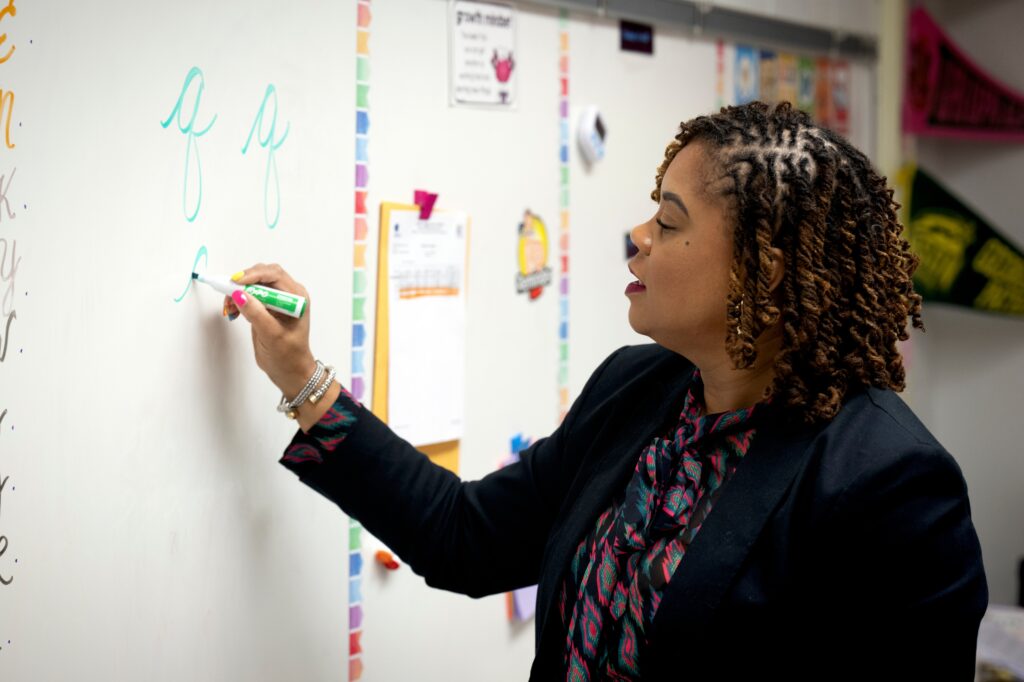
The group of preteens uncapped their markers and began practicing how to capitalize two new letters: “B” and “Q.”
The lesson felt like a return to the basics. Only this time, the middle-schoolers were learning to write, many for the first time, in cursive.
Sherisse Kenerson, a multilingual teacher at Holmes Middle School in Alexandria, Virginia, leads a club of sixth- through eighth-graders who want to know the art of looping and curving their letters together.
The attention her small club has attracted surprised Kenerson. Local news stories, thousands of social media comments. Teachers from as far as Oklahoma asking how they could bring something similar to their classrooms.
If boomers and Gen X are puzzled by the fact that many youngsters are not required to endure the same painstaking labor of mastering cursive that they were, they might be even more surprised — perhaps, even delighted — to hear that some are learning the craft entirely for fun.
“I see why we’re not teaching cursive to a degree. All of our literature now is in print. The computers, typing, texting — it’s print, it’s not cursive,” Kenerson said. “So a lot of people probably felt like we don’t need that anymore. That’s outdated. But science wise and mentally, we do.”
In the early 2000s, as technology picked up, cursive was declared all but dead. By 2006, only 15 percent of SAT essays were written in cursive. The Common Core standards released in 2010 did not include cursive as a required curriculum, leading to states around the country to drop the requirement.
But in the years since, there has been a steady effort to preserve the art by historians and educators like Kenerson. Clubs, camps and optional classes like hers have popped up around the country. In recent years, states from California to Pennsylvania have passed legislation to mandate the teaching of cursive in school and further cement handwriting skills.
The resurgence comes as a rise in screens and artificial intelligence motivates conversations about the role of technology in education. Research suggests handwriting is a key tool for learning and memory. It activates brain activity like motor, sensory and cognitive processing better than typing does.
“Even in the age of technology, I think that handwriting is here to stay,” said Shawn Datchuk, a professor of special education at the University of Iowa who has written about the benefits of handwriting for teaching literacy. “Simply put, it is the most portable, cheapest way for students to engage in writing.”
Datchuk said he suspects research about the cognitive benefits of handwriting, paired with the affordability of teaching it, are key drivers behind the resurgence. But another factor could be how personal and emotionally resonant cursive is, especially for older generations.
“If I have to send my mom a birthday card, I hand write it. If I just send a text message, there’ll be hell to pay for that,” Datchuk said. “And I think it’s because our handwriting strokes, whether it’s print or cursive, develop across our lives. So it really becomes kind of a thumbprint or fingerprint of our entire development.”
That’s the appeal to Kenerson, who launched the cursive club four years ago when her students couldn’t read a word she had written in flowing script on the whiteboard.
In her after-school program, she reminds students that cursive is personal. It’s their own handwriting and can have its own flair.
Halle O’Brien, 12, had never learned cursive before the club. Her grandfather, who was set on helping her improve her handwriting, had tried to teach it to her, but she found it too hard, she said.
But something about cursive club just clicked. She finds herself writing in the script for class assignments. It’s easier for her than printing. It’s quicker than typing.
“People who know cursive can read and can write it so smoothly without needing to concentrate on the letters,” Halle said.
Halle has a friend who learned cursive while enrolled in private school, but she couldn’t think of anyone else she knows who writes in cursive. As she thought about it, she didn’t believe her grandfather did either, even though he was the one who pushed her to learn the skill.
Halle sees practical value in her new skills beyond bragging rights to her friends. She recalled a history field trip where none of the students could read the Declaration of Independence.
“I tried to read it, but I had no idea how to do it,” Halle said. “I actually heard some people doing cursive clubs so that they could learn how to read the Declaration.”
The need for cursive readers led the National Archives to put out a call for volunteers to help transcribe historical documents and artifacts. The skill is so increasingly rare that Suzanne Isaacs, a community manager with the National Archives Catalog in Washington, D.C., told USA Today last year that it was a “superpower.”
Datchuk said there are also links between writing in cursive and better spelling skills. You have to know how to spell a word entirely before writing it in cursive, he said.
That was evident in Kenerson’s classroom. Before writing the word “spectacular” in cursive, Sarah Stephens, 11, carefully spelled it out in print at the top of her paper. Then, with the text as her guide, she slowly looped the word together in script.
The sixth-grader came into the club ahead of some of her peers. She first learned cursive in second grade while enrolled in private school. There, she said, students were expected to write completely in cursive by fourth grade. The school even held an annual cursive competition.
Even with her expertise, Sarah found delight in the biweekly club meetings. She gets to spend time with friends and loves Kenerson, who isn’t otherwise her teacher. She boasted that cursive club was even more fun than the anime club.
“It’s just fun to just do it again, because it’s just fun to kind of do the swirls,” Sarah said. “I like doing the letter ‘S.’”
For all of the benefits she sees in cursive, Kenerson guesses that students are drawn to the club for the same reason she was eager to learn cursive as a child: It made her finally feel grown up.
“It makes them feel mature,” Kenerson said. “I think it empowers them, because they know that everyone cannot write it.”
Including, she said, even some of the teachers.
The post Meet the middle-schoolers keeping cursive alive, one swoop at a time appeared first on Washington Post.