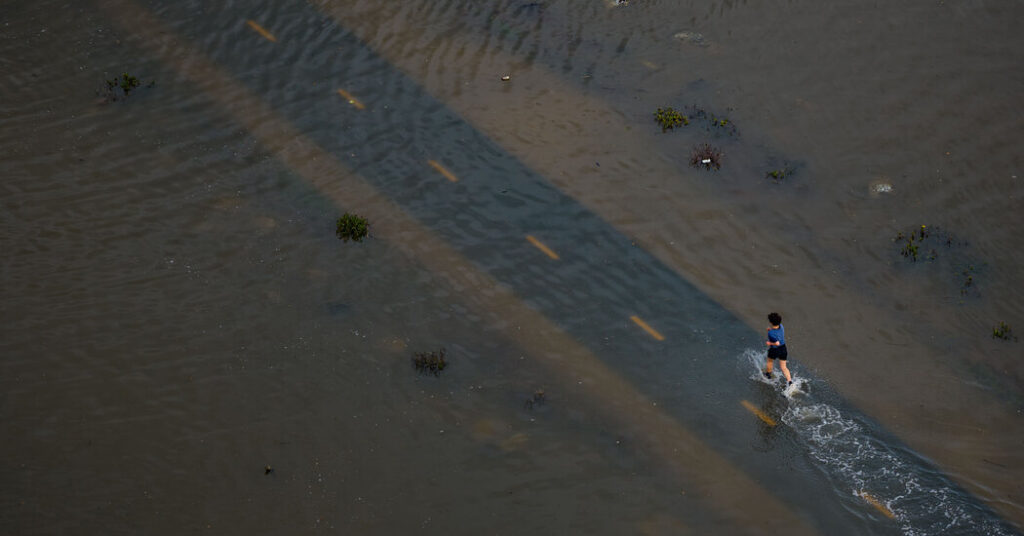
Parts of the San Francisco Bay Area were inundated with floodwaters heightened by exceptionally high tides on Friday as yet another storm began to smack California, bringing more wind and rain to a region where a steady flow of storms since mid-December has soaked the landscape.
The storm is expected to bring heavy rain and winds throughout the state this weekend. In addition to flooding in coastal areas, forecasters were especially concerned about the risk of landslides in Southern California as yet more rain falls in areas that are still saturated from other recent storms.
High tides make flooding worse in Northern California
The timing of the storm coincides with exceptionally high tides called king tides, which occur when the moon, sun and Earth align and create a stronger gravitational pull on the oceans. Coastal flood warnings were issued for portions of Northern California, including the San Francisco Bay shoreline, which is expected to see its highest tide since 1998 on Saturday morning.
Forecasters warned Saturday’s high tide could be as much as two and a half feet above normal.
In Marin County where low-lying areas are particularly vulnerable to high tides, flooding inundated some businesses on Friday.
Melissa Schwartz, who works at The Junction Beer Garden in Mill Valley, just north of San Francisco, said that the restaurant had prepared by lining the building with sandbags.
King tides are always noted in employees’ work calendars because of the risk they present to the creekside business, she said; it flooded during one event a few years ago.
On Friday afternoon, county workers were sandbagging the creek to prepare for more flooding tomorrow, she said.
The business was open on Friday, though customers coming from San Francisco having trouble reaching the restaurant because a nearby freeway off-ramp had been closed because of standing water, she said.
Laine Hendricks, a spokeswoman with Marin County, said the flooding was less severe than expected because it had stopped raining by the time Friday morning’s king tides hit. Over the past few days, the county had also been clearing drains of debris and testing pump equipment to prepare for floods, she said.
“Thankfully, the rain tapered off overnight,” she said in an email. “It’s not as bad as it could have been.”
Mary Press, who works at a veterinary hospital in Corte Madera, said clients were having a difficult time accessing the clinic because a nearby highway off-ramp was blocked off because of standing water. A gym across the street had closed early because of flooding.
The clinic is near a creek that feeds into the San Francisco Bay. “We get floods on a regular basis,” Ms. Press said. “It’s been going on for years.”
In rural Humboldt County near the Oregon border, local officials urged people to avoid an area around Eureka, where high tides were also causing flooding.
Forecasters warned heavy rain would continue through the weekend in the Bay Area. San Francisco could see wind gusts of up to 50 miles per hour on Saturday, and the city is likely to record 1.5 inches of rain through Monday morning.
San Francisco has already recorded 9.64 inches of rain since Oct. 1. That’s a little more than an inch above the normal amount for this time of year, but not nearly as drastic an overshoot as in Southern California, where four times the usual amount of rain has fallen.
More rain coming to a waterlogged Southern California
California receives most of its annual rainfall in the winter, but it has been an especially wet few months in Southern California. Since Oct. 1, Los Angeles has recorded nearly 13 inches of precipitation, more than three times the four inches it would typically see this time of year. At least another inch is expected from this weekend’s storm.
That has led to widespread flooding, as cities struggle to manage the precipitation from one storm before the next hits.
This next system is poised to push into Central and Southern California on Saturday, bringing a risk of flooding, rockslides and mudslides. Winds could knock over trees in soil made more unstable by the saturation of recent storms. Downtown Los Angeles is predicted to receive up to an inch of rain, but up to six inches could fall in the coastal mountains of Southern California.
While many of this season’s storms have hit an area between Santa Barbara and Los Angeles Counties, Mr. Wofford said that this one would likely be more focused to the north, including San Luis Obispo County.
Rain on Thursday in San Diego was so significant that roads in some neighborhoods flooded quickly enough that water poured into businesses and homes, and parked cars began floating away. As rain pelted the region, teams rescued people who were stranded in their cars by rapidly rising floodwaters.
In Los Angeles, the annual Rose Parade was soggy for the first time in years. On the morning of New Year’s Day, spectators crouched under umbrellas and wore ponchos as they watched colorful floats, mariachi bands and dancers go by.
About one in 10 New Year’s Day holidays in the Los Angeles area see some rain, but it is typically less than half an inch. Before this year, the last time it had rained more than an inch here on New Year’s Day was in 1934, according to the Weather Service.
For some, the rain on the parade, which was established in 1890 to showcase L.A.’s famously mild weather, felt like a bad omen — yet another sign of how the city is being reshaped by extreme weather. In early January of last year, the city had recorded only 0.16 inches of rain since October, and the dry weather had fueled some of the most catastrophic fires in the city’s history.
“Not only did the gods create fire last year they’re actually raining on our literal parade,” said Fernando Guerra, a professor at Loyola Marymount University.
Amy Graff is a Times reporter covering weather, wildfires and earthquakes.
The post California’s Latest Storm Brings Flooding to San Francisco Bay Area appeared first on New York Times.