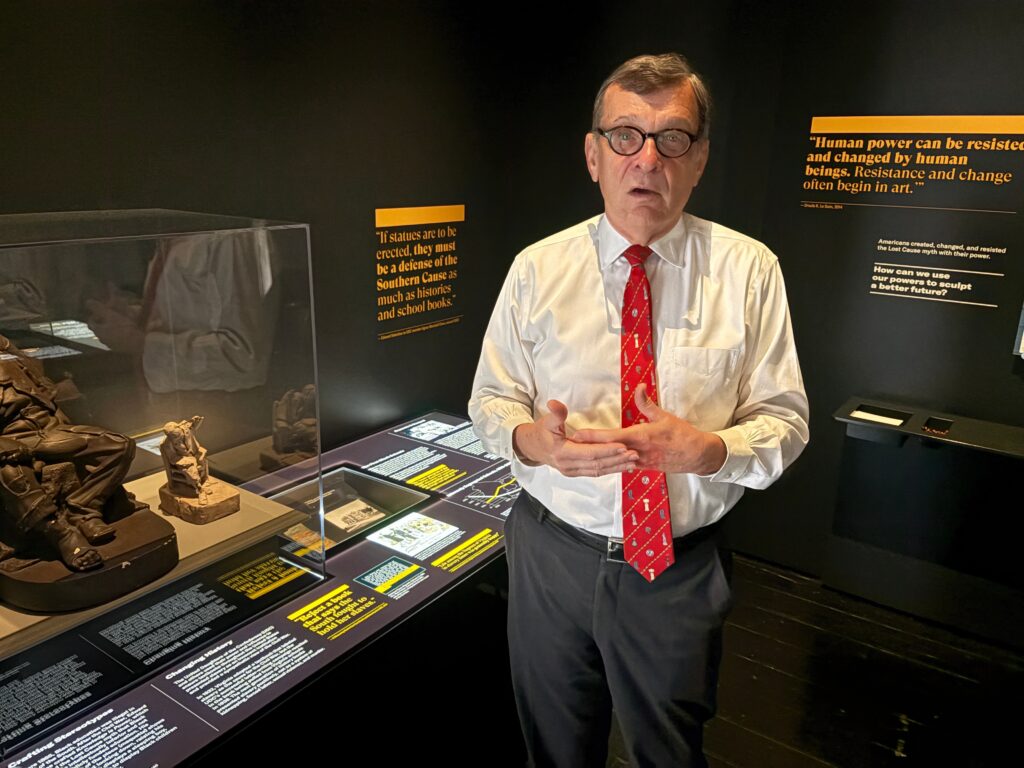
RICHMOND — In a cavernous gallery of the Valentine museum filled with marble busts and giant images of maps, Bill Martin gestured at a humble 1950s school history textbook in a display case.
“This is where it gets personal for me,” Martin said one day last August.
That book taught generations of young Virginia fourth-graders — including Martin — that slavery was benign and enslaved people were happy. Now, as the director of a history museum, he had featured it in an exhibit that exploded the lies of the Southern “Lost Cause” mythology.
Martin has been one of the most beloved and influential figures in the movement to retell the storyof Richmond — and, by extension, Virginia and the nation — in a more honest and clear-eyed fashion.
Over the weekend, Martin, 71, was struck by a vehicle and killed while crossing a street near the Valentine in downtown Richmond.
His sudden loss has brought an outpouring of grief and shock from a wide swath of the community, ranging from historians to activists to politicians.
“He stood in the gap for so many — helping to connect some of the very most complicated corners of the city through arts, culture, and history,” Sesha Joi Moon, co-leader of the JXN Project’s effort to commemorate a historic Black neighborhood, said in a written statement. Moon has been nominated as state director of diversity by Gov.-elect Abigail Spanberger (D).
“No one was more dedicated to fostering a deep understanding of Virginia’s complicated history than Bill Martin,” Sen. Tim Kaine (D-Virginia) posted on X this week.
A bespectacled White man from rural Culpeper County with a soft Southern accent and a wit as sharp as his penchant for neckties, William J. “Bill” Martin was an unlikely agent of reform in the former capital of the Confederacy.
He graduated from Virginia Tech and had worked at museums in Georgia and Florida before landing in Petersburg, Virginia, in 1987 to run that city’s museums and tourism effort. Martin joined the Valentine, which is dedicated to Richmond history, in 1994, just in time to see it nearly sink from depleted finances and low attendance.
Over time, Martin became known as the “dean” of Richmond’s many museums, a one-man welcoming committee for new directors and a clearinghouse for collaborative efforts.
He was a congenial force for change as the city wrestled with its complicated history. As recently as 2020, giant statues of Confederate leaders still loomed over busy intersections and enthusiasts waving the rebel battle flag regularly greeted traffic outside the national headquarters of the United Daughters of the Confederacy.
Martin led a long process to reorganize the Valentine, using community input to focus its collections and slowly homing in on a story he felt it was uniquely positioned to tell: The origins of the Lost Cause, the romanticized view of the South that took hold in the years after the Civil War. After all, one of the primary creators of the images that fueled the myth was sculptor Edward Valentine, first president of the museum that bears his family’s name and the artist behind some of the iconic statues of Confederate leaders.
When Martin’s changes to the museum’s message provoked hate mail and even death threats, he was known to invite his critics to lunch, as recounted last year by Richmond’s StyleWeekly magazine in naming him Richmonder of the Year for 2024. “You can’t do history and sit on the sidelines,” Martin told the magazine.
That philosophy was put into action in 2020 when Richmond’s streets erupted in racial justice protests over the killing of George Floyd by Minnesota police. One night in early June, Martin stayed alone at the Valentine in case there was rioting or vandalism. Police broke up demonstrations with chemical sprays and trapped protesters in a warren of downtown blocks, arresting them by the dozens.
As he described in an interview with The Post that year, Martin heard voices whispering outside a museum window and found several young protesters hiding in the bushes. He hustled them inside, helped wash the chemical spray out of their eyes with milk and kept watch until it was safe for them to leave without being arrested. The next morning, he gathered rubber bullets and signs from the streets to display in the museum.
Only a few days later, protesters dragged down a statue of Confederate president Jefferson Davis from stately Monument Avenue. That touched off a series of events that saw city and state officials eventually remove almost all Confederate monuments from public spaces in the city.
Martin had quietly been angling to get Davis into the Valentine for several years, at least since the deadly Unite the Right rally in Charlottesville in 2017 began turning the tide of public opinion against the monuments. The Davis figure was an Edward Valentine creation — the former Confederate had posed for his likeness in the carriage house studio that now sits on the grounds of the museum.
While the rest of Richmond’s statues went into storage, the Davis — dented and spattered with paint — went on display at the Valentine. The museum convened community meetings to discuss how to remake the sculpture studio to better tell the story of what Valentine’s body of work had created.
On Aug. 19 of this year, reporters descended on the Valentine to see the Davis statue removed from the museum to be loaned to a gallery in Los Angeles. Martin was there, of course, and pulled a few reporters aside individually to show them something he considered more profound: the remade sculpture studio, located across a courtyard from the main gallery.
Where floor-to-ceiling shelves once held hundreds of pieces of Valentine’s work — studies of hands, heads, other body parts — now a black screen covered the far wall. A multimedia display would occasionally illuminate sculptures behind the screen, bringing them out of darkness to tell the story of how the South constructed a new narrative for itself after the Civil War.
Or, as Martin put it, “How does fiction become accepted truth?”
He emphasized that the answer to that question came not with lecturing or preaching but with facts. Around the room, quotes highlighted in orange signified primary sources — figures from the postwar era stating, clearly and in their own words, that they were devising a massive publicity campaign to burnish Southern honor.
“All that is left of the South is the ‘war of ideas,’ ” author Edward Pollard wrote in his 1866 book “The Lost Cause,” which was published in Richmond.
“If statues should be erected, they must be defensive of the Southern cause, as much as histories and school books,” sculptor Valentine wrote in a letter around 1900. He was a chief image-maker of the movement, creating everything from the noble statue of Gen. Robert E. Lee that until recentlyrepresented Virginia in the U.S. Capitol to caricatures of happy, simpleminded Black people.
With an animated map, Martin demonstrated how grand monuments proliferated across Richmond — not in the immediate aftermath of the Civil War, but in the 20th century during the repression of Jim Crow, when the statues made the same intimidating point as the Ku Klux Klan Christmas parade that’s also depicted in the gallery. Similar tales played out across the South.
“Richmond is the only place” to tell that story, Martin said, “because you have every part of the history here.”
Martin spent more than 30 years investing in that belief. On Saturday, Dec. 27, he stopped by the Valentine to check in — as he often did on weekends, staffers said. He left around 2 p.m. and was just two blocks away, crossing Broad Street, when he was struck by a vehicle. Martin died the next day in a hospital.
Police have released little information about the incident, other than to say the driver remained at the scene and that the investigation is ongoing.
Martin’s leadership “helped shape the museum into the place it is today, and his impact will be felt for generations to come,” Meg Hughes, who will serve as acting director while the Valentine’s board seeks a replacement for Martin, said in a written statement to museum members. “We remain committed to serving our community and honoring the legacy that he leaves behind.”
The post He exposed myth of the South’s ‘Lost Cause.’ His death shook Richmond. appeared first on Washington Post.