I’ll give Andre Gaines’ new, weird adaptation of “The Dutchman” this much: the first big movie of any given year is usually a horror film, but it’s rarely a supernatural riff on a classic, controversial 1960s play about racial tensions and double consciousness. That distinction appears to belong exclusively to “The Dutchman.” (Unless the haunted swimming pool movie “Night Swim” was a lot deeper than I gave it credit for.)
Amiri Baraka’s “Dutchman” is a tightly coiled theatrical panic attack centered on Clay, a Black man riding the New York City subway, and Lula, the white woman who singles him out. Lula attempts to seduce Clay while psychoanalyzing him through sharp, stereotype-laden observations that are, to his surprise, often uncomfortably accurate. For a time, the dynamic holds, but Lula ultimately pushes Clay past his breaking point, leading to a public outburst, a furious political tirade and an act of shocking violence.
Gaines’ “The Dutchman” assumes you already know a lot about Baraka’s controversial, award-winning play. So much so that, early in the movie, Anthony Harvey’s 1966 film adaptation plays on a TV, revealing the horrifying climax in detail. “The Dutchman” treats its source material the same way “Wes Craven’s New Nightmare” treats the original “Nightmare on Elm Street” or the 2015 “Goosebumps” movie treats the works of R.L. Stine. We’re riffing off the audience’s presumed familiarity, not introducing this material to a new audience for the first time.
So if you’re confused while watching “The Dutchman,” dear reader, try to consider it a compliment. Writer-director Gaines thinks we’re all very well-read. Or at least he hopes so. His new take on “Dutchman” doesn’t work unless you’ve already done your homework. Then again, if you’ve already done your homework, you’ll probably notice several other reasons why it doesn’t work.
André Holland plays Clay, whose wife Kaya (Zazie Beetz) recently cheated on him. They’re in therapy now, with Dr. Amiri (Stephen McKinley Henderson), but Clay is resistant to self-reflection. Dr. Amiri asks him to hang back after their first session, and mentions that he has a book which Clay might find helpful. If you guessed that it’s the script for Baraka’s “Dutchman,” and if you clocked that Dr. Amiri’s name is “Dr. Amiri,” you’re ahead of the game.
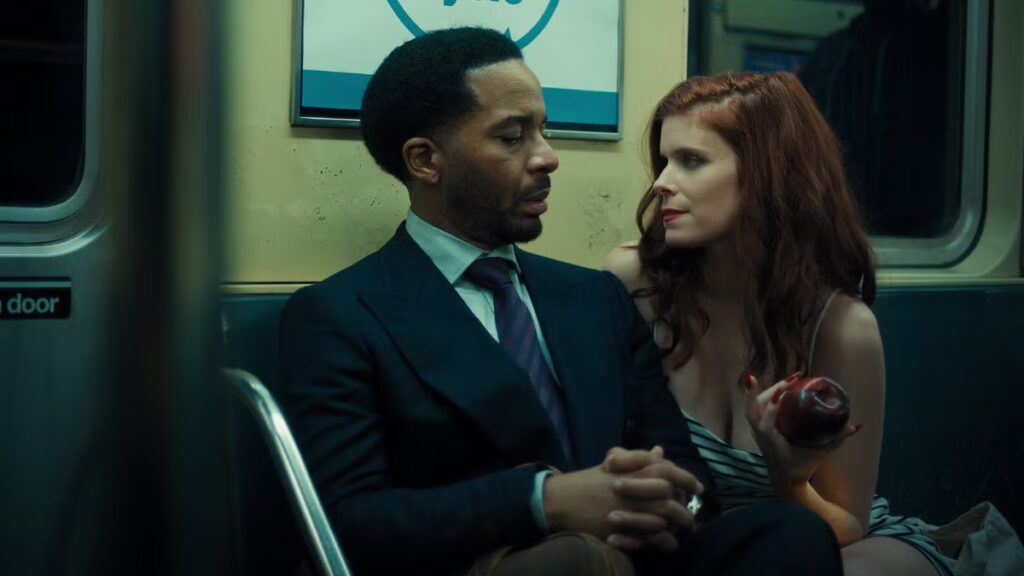
Then again, “The Dutchman” is hardly playing coy. Pretty soon Clay is on a subway, unintentionally reenacting the play with his very own Lula (Kate Mara). She’s playful. Seductive. Insightful in an insulting, racist way. Clay is seduced in spite of himself. But this new Lula refuses to stay on the subway and follows him to the party the play only references in passing, bringing her trainwreck personality and — after the threat of blackmail — ominous danger into Clay’s personal life, which upsets his politician friend Warren (Aldis Hodge) and, as one might imagine, his wife.
All the while, “The Dutchman” reminds you that we’re in a new, mutant strain of Baraka’s play. Clay watches the previous film version play out in an electronics store window. Dr. Amiri returns, in different roles, and speaks to Lula as if they were an angel and devil fighting over Clay’s immortal soul. By the time “The Dutchman” lays it all on the line, it’s clear that Gaines envisions Baraka’s play as an endless cycle — which makes sense, given the original play’s ending — that has been imported into the real world by the power of imagination. So now Lula is essentially Freddy Krueger, if Freddy Krueger exclusively targeted Black men who lack confidence in their identity, and it’s up to Clay to — as the film’s heavy-handed production design practically shouts at us — “break the cycle.”
On one hand this is an interesting idea. On the other hand it’s not a subtle one, and “Dutchman” wasn’t particularly understated to begin with. So Gaines’ film is, more than anything, whether you like it or not, incredibly blunt. It’s one thing for Baraka to write an allegorical, confrontational tale about racial conflict. It’s another to say that Baraka’s imagination literally willed a hobgoblin into existence that’s been haunting the New York City subway for over 60 years, while the author impersonates randos just to keep tabs on her. Even if you don’t take Gaines’ “The Dutchman” literally, this imagined reality is the one we have to work with until the credits roll, and it plays out like a well-intentioned, highfalutin theater school final project that deserves an “A” for effort and a “C” for execution.
Whether you’re dazzled by Gaines’ moxie or underwhelmed by the actual production, at least we can agree he assembled a solid cast. Holland continues his winning streak, playing Clay with the complexity the stage play demands, which almost compensates for the arch incredulousness with which he’s forced to react to “The Dutchman’s” new revelations. Mara is an unexpected choice to play Lula, but she gives off fewer red flags than Shirley Knight in the 1966 adaptation, which makes it easier to believe — at first — that Clay would take such a risk. But Mara is asked to play Lula as a concept, much more than a person, so after a while the fakery is unmistakable, and it makes her job much, much harder.
It’s easy to appreciate the ambition of Gaines’ new take on “The Dutchman,” but the original tale is fighting back, and it’s got the upper hand. Baraka’s play was already upsettingly dreamlike, and even though Gaines has a vision for where this is all headed, and has much more hope for his characters and the world they inhabit than the original author, adding more dream logic to the pile doesn’t make it deeper. It just makes a bit of a mess.
The post ‘The Dutchman’ Review: Amiri Baraka’s Controversial Play Gets Lost in Film Nightmare appeared first on TheWrap.