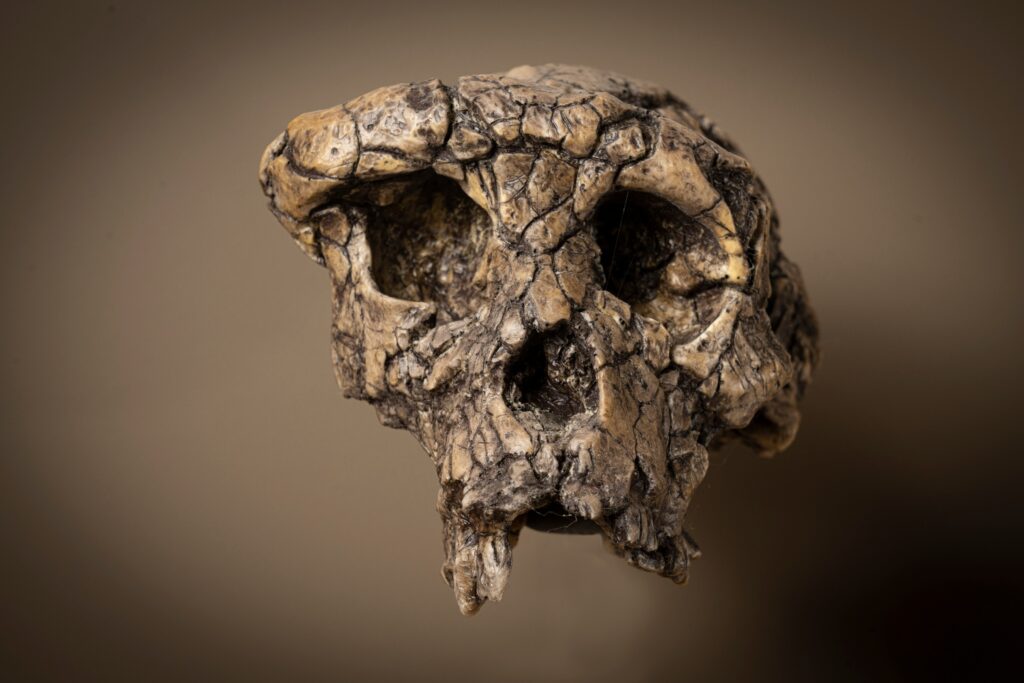
More than two decades ago, scientists digging in Central Africa unearthed the 7-million-year-old remains of what may be one of the earliest known human ancestors.
Only a few fossils were recovered from the desert in northern Chad: a skull, a leg bone, a couple of arm bones. Ever since the discovery, scientists have been trying to put together those puzzle pieces to answer a question that gets to the heart of what it means to be human.
Did this ancient ape-man, dubbed Sahelanthropus tchadensis, mostly stride on two feet, like modern humans do? Or did the creature primarily crawl on all fours, like most of the animal kingdom?
A new analysis of these primordial bones offers evidence that Sahelanthropus was our first known ancestor to regularly walk on two feet, a sign that bipedalism evolved early in our lineage and constitutes an evolutionary hallmark of our kind. The interpretation, if it holds, would push back the date at which early hominins stood tall by about a million years.
But the new study is unlikely to settle the long-simmering debate over whether Sahelanthropus walked on two or four feet. And it underscores just how little scientists still know about human evolution, with only a handful of fossilized bones of early hominids ever unearthed after decades of digging.
“I’m fairly convinced that this thing was a biped,” said Scott Williams, a New York University evolutionary morphologist who led the new study, published in Science Advances on Friday. But, he added, “I’d be foolish to think that it would settle it.”
A team led by French paleoanthropologist Michel Brunet discovered the fossils in the early 2000s in Chad’s Djurab Desert. The cranium seemed to belong to an adult male with a chimpanzee-size brain but a humanlike face. The placement of the opening at the base of the skull, through which the spinal cord passed, suggested a more upright posture. The individual was nicknamed Toumai, which means “hope of life.”
Standing up was a key moment in our ancestors’ evolution. It freed the forelimbs to develop into hands and encouraged the growth of bigger brains to use those hands to make and wield tools.
But other scientists questioned that early interpretation of the skull opening. And an initial analysis of the leg bone showed it was shaped like those of chimpanzees and bonobos, suggesting something that ambled on all fours.
For the latest study, researchers performed a detailed analysis of the limb bones. In the femur, they found a natural twisting, similar to that in humans, which points the feet forward and aids in walking. The team also found a bump in the leg bone — again, similar to our own — where the femur is attached to the butt muscles, which is key for standing and running.
But the feature that “really sold the case for bipedalism,” according to Williams, was the presence of a something called the femoral tubercle. This is the place where a ligament tethering the pelvis to the femur is attached. The ligament is the strongest in the human body, and is key to preventing the torso from toppling backward when we stand up.
“It’s a subtle feature,” Williams said, “so it wasn’t recognized by the other groups.”
Williams recalled holding a 3D-printed model of the Sahelanthropus bone in one hand and a human femur in the other, and noticing the similar tubercles. Before finding them, “we were all sort of on the fence about Sahelanthropus, and whether we thought it was a biped.”
Franck Guy and Guillaume Daver, researchers at France’s University of Poitiers who have previously argued Sahelanthropus was bipedal, were pleased the independent team led by Williams backed up their findings.
The new study “not only confirms our initial interpretations of the adaptations and locomotion of the earliest hominin Sahelanthropus, but also puts forward new arguments supporting its terrestrial habitual bipedalism,” they said in a statement.
But Roberto Macchiarelli, a paleoanthropologist who has argued the fossils did not come from a biped, said the femur has been too warped and damaged by time to show the twisting and tubercle that would prove Sahelanthropus regularly walked on two legs.
“Body proportions in Sahelanthropus are 100 percent apelike, certainly not ape-hominin ‘intermediate,’” Macchiarelli said in an email. “Compared to most scientific disciplines and research,” he added, “paleoanthropology is deeply affected by competition and politics.”
Macchiarelli also noted the researchers relied on a cast, not the original specimen, for their analysis of the femur. Williams said he confirmed the presence of the femoral tubercle on the actual fossil with French researchers.
Guy and Daver agreed the new paper will not settle the controversy. “Indeed, closing the debate would require the discovery of new remains,” they said.
To that end, their team plans to return to the desert in Chad this year to hunt for more fossils.
The post When did humanity take its first step? Scientists say they now know. appeared first on Washington Post.