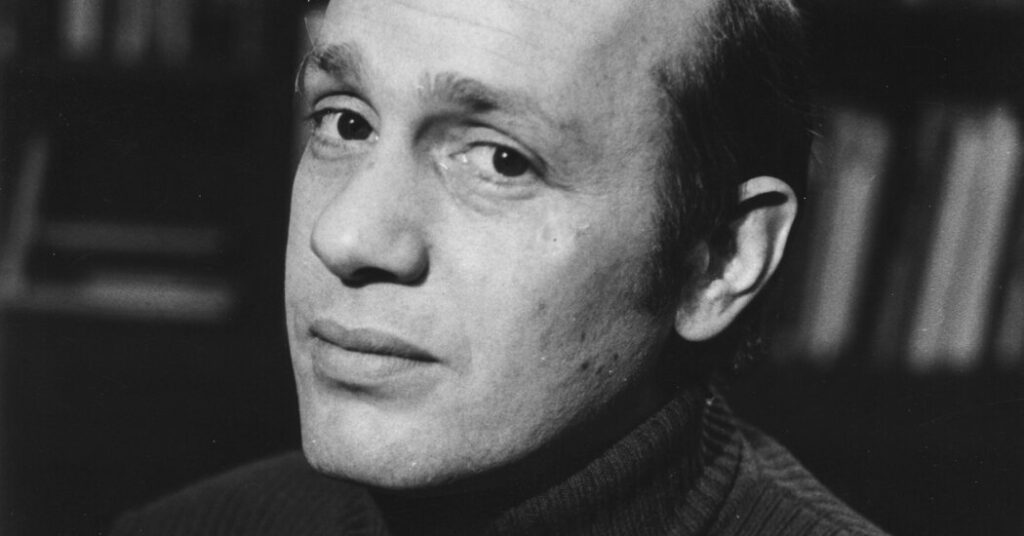
Richard Pollak, the founding editor of More magazine, an irreverent monthly journalism review that during the 1970s critiqued the media’s coverage of contentious subjects like the Vietnam War, President Richard M. Nixon and the oil industry, died on Dec. 27 in Stockholm. He was 91.
Mr. Pollak’s wife, Diane Walsh, confirmed his death, in hospice care. They had moved to Sweden from Portland, Maine, in May, to live near his daughter and grandchildren.
More was the brainchild of J. Anthony Lukas, who met Mr. Pollak when they were both young reporters at The Baltimore Sun. Mr. Lukas, who won a Pulitzer Prize in 1968, had become a staff writer at The New York Times Magazine by the time he recruited Mr. Pollak to run the start-up publication in late 1970.
“What this town needs is a good journalism review, and you’re just the man to edit it,” Mr. Lukas told Mr. Pollak, Ms. Walsh said in an interview.
With funding from William Woodward III, a banking scion who was also a journalist, More’s first issue debuted in 1971, during flush times for newspapers and television networks, decades before the internet. Its name was rendered on the cover as [More] in homage to generations of reporters who typed that at the bottom of a page to indicate that additional material was to follow.
“The founders of (More) saw the mainstream American press as stagnant, conservative and unwilling to examine themselves at a time when the country was convulsing with social movements and the public was losing confidence in institutions,” Kevin Lerner wrote in Columbia Journalism Review in 2018.
Brit Hume, now the chief political analyst at Fox News, who was the magazine’s Washington editor, said in an interview that Mr. Pollak “was a very smart and decent guy who was trying to encourage more enterprise reporting and a more skeptical look at the powers that be.”
Articles included Mr. Lukas’s skewering of James Reston, a major figure at The New York Times — the paper was a frequent target — for his perceived failures as an opinion columnist. The historian Taylor Branch wrote a scathing assessment of journalists who were eager to focus on the Watergate scandal after having been indifferent to the Nixon administration’s secret bombing of Cambodia during the Vietnam War.
The magazine also critiqued the press’s kid-glove treatment of David Rockefeller and the bank he ran, Chase Manhattan. It exposed how a phone call from Spiro Agnew, the disgraced former vice president, to the publisher of The Baltimore Sun had killed an article about government-funded improvements to Mr. Agnew’s home. (More published the spiked article.)
In the magazine’s first issue, Mr. Pollak vowed to publish corrections in a regular spot and challenged The Times to follow suit. He believed that this helped prod The Times to start printing its own daily corrections in a dedicated section in 1972.
Mr. Pollak “was a genius at putting his finger on the media zeitgeist,” Robert Friedman, one of his successors as More’s editor, wrote in an email. “But he preferred to stay behind the scenes.”
He “was always trying to strike a balance between seriousness and not taking himself too seriously,” Mr. Lerner said in an interview. “So More ended up being somewhere between The New York Review of Books and Spy magazine, with that tongue-in-cheek tone.”
Richard Pollak was born on April 5, 1934, in Chicago, to Robert Pollak, a stockbroker who also wrote music and drama criticism for The Chicago Sun-Times, and Janet (Spitzer) Pollak, an indexer for the Great Books program, a course of study in classic Western literary and philosophical texts.
After earning a bachelor’s degree in English from Amherst College in 1957, Mr. Pollak served in the Army as a writer for the American Forces Press Service.
Starting in 1959, he spent five years as a reporter for The Sun, covering politics, followed by three years as an associate editor at Newsweek, where he focused mainly on its reporting on the press. After a year as an editor at The Honolulu Star-Bulletin, he vetted candidates for grants at the Ford Foundation before joining More.
“I think there are some enlightened people who are going to grin and bear it,” Mr. Pollak said at a news conference to promote the first issue. “Just because we’re critical of the press doesn’t mean that we think there’s no good in it.”
Financial losses eventually pushed More to the brink. It was sold in 1976 to Michael Kramer, an editor at New York magazine, and again a year later to James Adler, the founder and president of the Congressional Information Service. Mr. Adler closed the publication in 1978.
Mr. Pollak, who had left the magazine after Mr. Kramer’s acquisition, returned once Mr. Adler bought it, for a stint as associate editor under Mr. Friedman. In the 1980s, Mr. Pollak served as literary editor and later executive editor of The Nation, and began to focus on writing books.
“The Creation of Dr. B: A Biography of Bruno Bettelheim” (1997) offered a devastating perspective on the renowned but polarizing psychoanalyst who directed the Orthogenic School in Chicago, a therapeutic day school for children who were described at the time as emotionally disturbed.
Mr. Pollak’s 11-year-old brother, Stephen, had been a student at the school for five years in 1948, when he died while on vacation with the family in Michigan. (He fell to his death in a barn, through an open chute camouflaged by hay.)
When Mr. Pollak approached Bettelheim in 1969 to learn more about his brother, the doctor, who was known for linking children’s emotional problems to their mothers’ behavior, responded with blunt hostility, insulted Mr. Pollak’s parents and suggested that Stephen had died by suicide.
The interaction inspired the 1997 biography, in which Mr. Pollak described Bettelheim as a liar who had invented degrees he had never earned, had embellished his research for a groundbreaking paper about the childlike behavior of concentration camp inmates and had probably exaggerated his own experiences as a prisoner at Buchenwald during World War II.
“As Mr. Pollak portrays him,” Christopher Lehmann-Haupt wrote in his review of the book in The Times, “the keys to Bettelheim’s success seem to have been his facility with psychoanalytic insights, his ability to tyrannize his students and subordinates, and his gifts as a storyteller.”
Mr. Pollak’s self-published book “After the Barn: A Brother’s Memoir” (2013) was an attempt to reckon with the family’s tragic loss.
His first marriage, to Merle Winer, ended in divorce. He married Ms. Walsh, a concert pianist, in 1982.
In addition to her, Mr. Pollak is survived by a daughter from his previous marriage, Amanda Pollak, and three grandchildren.
In the midst of More’s seven-year run, Mr. Pollak edited “Stop the Presses, I Want to Get Off: Inside Stories of the News Business From the Pages of More” (1975), a collection of about two dozen articles from the magazine.
“The magazine’s mission,” he wrote in the introduction, was to “embarrass the nation’s media managers whenever they deserve it — and thus (with luck) to nudge change.”
Richard Sandomir, an obituaries reporter, has been writing for The Times for more than three decades.
The post Richard Pollak, 91, Dies; Edited Magazine That Criticized the Media appeared first on New York Times.