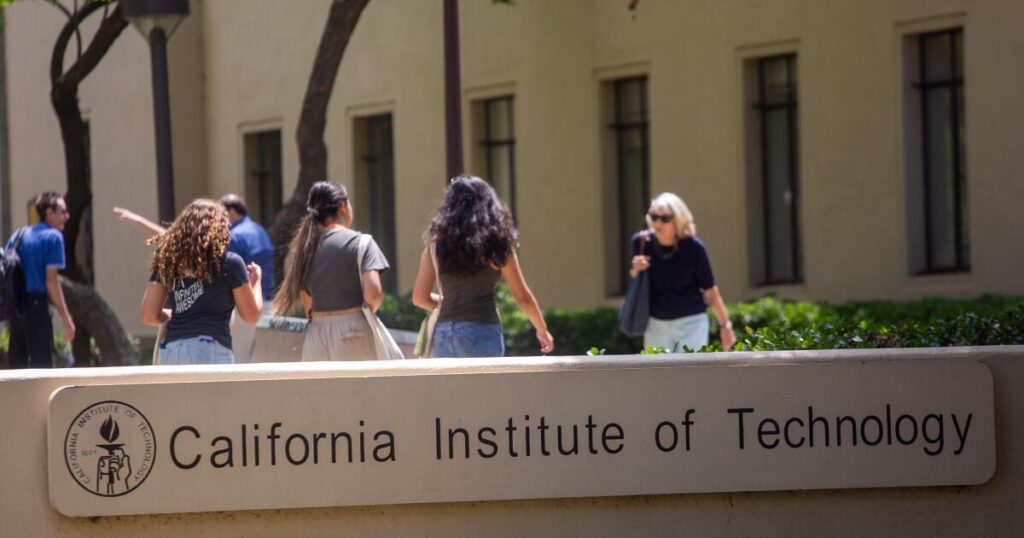
When prospective Caltech students applied in the fall for early admission, some faced a new, technologically advanced step in the selection process at one of the nation’s most prestigious universities.
High schoolers who submitted research projects appeared on video and were interviewed by an artificial intelligence-powered voice that peppered them with questions about their papers and experiments, akin to a dissertation defense. The video-recorded exchanges were then reviewed by humans — faculty and admissions officers — who also evaluated test scores, transcripts, personal statements.
Students applying to college know they can’t — or at least shouldn’t — use AI to write their college admission essays. So it might come as a surprise that some schools are using artificial intelligence to read them and are incorporating AI into their own admissions process to conduct interviews and detect fake applications attempting to steal financial aid money.
In some cases, colleges are quietly slipping AI into their evaluation work, while others are touting the technology’s potential to speed up their review of applications, cut processing times and perform some tasks better than humans.
“We wanted to bring the student voice back into applications,” said Ashley M. Pallie, the dean of undergraduate admissions at Caltech, where VIVA, an AI-assisted technology developed by a company called InitialView, helped screen roughly 10% of recent early applicants.
“It might seem strange to use AI to get more of a human voice, but I think of it as a way to bring more authenticity into the fold,” said Pallie, who said the university is planning to expand its use of AI in admissions in 2026.
Colleges stress that they are not relying on AI to make admissions decisions but using it instead to review components of applications, from research projects to transcripts, as well as to eliminate data entry tasks.
“Can you claim this research intellectually? Is there a level of joy around your project? That passion is important to us,” Pallie said about Caltech’s AI interview bot.
A growing trend
Virginia Tech debuted an AI-powered essay reader in the fall. The college expects it will be able to inform students of admissions decisions a month sooner than usual, in late January, because of the tool’s help sorting tens of thousands of applications.
“Humans get tired; some days are better than others. The AI does not get tired. It doesn’t get grumpy. It doesn’t have a bad day. The AI is consistent,” says Juan Espinoza, vice provost for enrollment management at Virginia Tech.
The prevalence of AI usage is difficult to gauge because it is so new, said Ruby Bhattacharya, chair of the admission practices committee at the National Assn. for College Admission Counseling. NACAC updated its ethics guide in the fall to add a section on artificial intelligence. It urges colleges to ensure the way they use it “aligns with our shared values of transparency, integrity, fairness and respect for student dignity.”
Some of California’s most popular campuses, including the UCs and USC, do not use AI to cull applicants, and use only human readers and admissions staff.
“I don’t think it’s as black and white as saying using AI in college admissions is either good or bad in any kind of blanket way,” said Gary Clark, UCLA’s associate vice chancellor of enrollment management. “It has a role to play, and that role may evolve in the future but, for us in terms of the reviewing of applications and the selection process, we’ve kept that pretty tight and focused on a human process.”
Some schools face blowback
The University of North Carolina at Chapel Hill faced a barrage of negative feedback from applicants, parents and students after its student newspaper, the Daily Tar Heel, reportedin January that the school was using AI to evaluate the grammar and writing style of applicants’ essays.
The university declined to comment and pointed to its admissions website, which it updated after the criticism. “UNC uses AI programs to provide data points about students’ common application essay and their school transcripts,” the website says. Every application “is evaluated comprehensively by extensively trained human application evaluators.”
At Virginia Tech, Espinoza said several colleges interested in the new technology but wary of backlash have contacted him. “The feedback from a lot of colleagues is, ‘You roll this out, we’re watching you, and we’ll see how everyone’s reacting,’” he said.
He stressed the AI reader his school spent three years developing is being used only to confirm human readers’ essay scores.
Until the fall, each of the four short-answer essays Virginia Tech applicants submit was read and scored by two people. Under the new system, one of those readers is the AI model, which has been trained on past applicant essays and the rubric for scoring, Espinoza said.
A second person will step in if the AI and human reader disagree by more than two points on a 12-point scoring scale.
Like many colleges, Virginia Tech has seen a huge increase in applications since making SATs optional. Last year, it received a record 57,622 applications for its 7,000-member freshman class. Even with 200 essay readers, the school has struggled to keep up and found itself notifying students later and later.
The AI tool can scan about 250,000 essays in under an hour, compared with a human reader who averages two minutes per essay. Based on last year’s application pool, “we’re saving at least 8,000 hours,” Espinoza said.
Georgia Tech is rolling out an AI tool to review the college transcripts of transfer students, replacing the need for staff to enter each course manually into a database.
“It’s one more layer of delay and stress and inevitable errors. AI is going to kill that, which I’m so excited about,” said Richard Clark, the school’s executive director of strategic student access. The school hopes to soon expand the service to all high school transcripts.
Georgia Tech also is testing out AI tools for other uses, including one that would identify low-income students who are eligible for federal Pell Grants but may not have realized it.
Community colleges use AI to combat fraud
In California, where community colleges have faced an onslaught of fake applications that steal federal and state aid dollars, administrators are using AI to tackle fraud.
The problem has ballooned since the COVID-19 pandemic, when online studies became more popular. Last year, the state’s community colleges had 1.2 million fake applicants, leading to roughly $8.4 million and more than $2.7 million in stolen federal and state aid, respectively.
Leaders at Golden West College in Huntington Beach used to manually screen for fake students. They looked for unusual course combinations, such as policing, dance and art, as signs of potential fraud. In recent years, overburdened staff spent spending 20 to 30 hours a week looking for fakes, said President Meridith Randall.
“But that was untenable,” Randall said.
Today, the same fakes can be flagged using AI developed by a company called N2N Services, said Claudia Lee, Golden West College’s vice president of student services.
“The AI uses algorithms in place based on the information we provide it to look for the patterns, the trends, in the data that could point to fraud,” Lee said.
Faculty provide a final check by reporting nonresponsive or no-show students. Similar efforts are being made statewide through the California Community Colleges chancellor’s office. AI can also assess metadata to detect potential fraud, including IP addresses, an applicant’s proximity to the college based on the IP, and if multiple applications are coming from the same computer.
“We’re an open access system, so we always have to balance the ease of application and enrollment for legitimate students with protecting the resources, class seats, and financial aid dollars for those that really need it,” said Jory Hadsell, who works in the chancellor’s office.
Not all, including UCs, are buying into trend
Some of the most popular and prestigious colleges in California have so far eschewed AI in admission evaluations.
USC, which received 83,500 applications in the last undergraduate admissions cycle, has dozens of full-time readers who work tens of thousands of hours to pore over grades, essays and other application elements.
At UCLA, the most applied-to campus in the nation with more than 145,000 first-year applicants, a team of more than 300 readers handles the workload. Each student is evaluated twice by two people, typically high school counselors and retired high school counselors who are specially trained.
“The human process on our side, I think, needs to mirror the human process on the other side,” said Clark, the UCLA admissions director.
In addition to grades, he said, “we’re looking at what they share in their personal insight question responses and things that they’ve accomplished or dedicated their time towards outside of class. Especially those qualitative things, I think, really require human evaluation.”
The human-centered approach is equally important at UC Merced, which has seen the fastest-growing applicant pool across the system — a year-to-year nearly 45% increase of first-year applications in 2024 to more than 51,000.
“Having a human reader review the application can provide some contextual experience to what that student is, has opportunities to do, and what they’re experiencing on the school level in a way that I don’t think is could be easily generalized by using some of the information out there with AI,” said UC Merced director of admissions Dustin Noji.
Noji noted that although human readers are not without “flaws,” there are also concerns about technology. “There’s still bias in some of the things that the large language models are using to do the reviews,” he said.
Humans, too, can step in in ways machines may not be able to yet, he said.
“If we need to reach out to an applicant that may be missing something in the application but may be close to being admissible, I don’t know that I feel comfortable giving that advising piece over to a machine at this point.”
Gecker writes for the Associated Press.
The post AI is scoring college essays and conducting interviews, a new layer in admissions stress appeared first on Los Angeles Times.