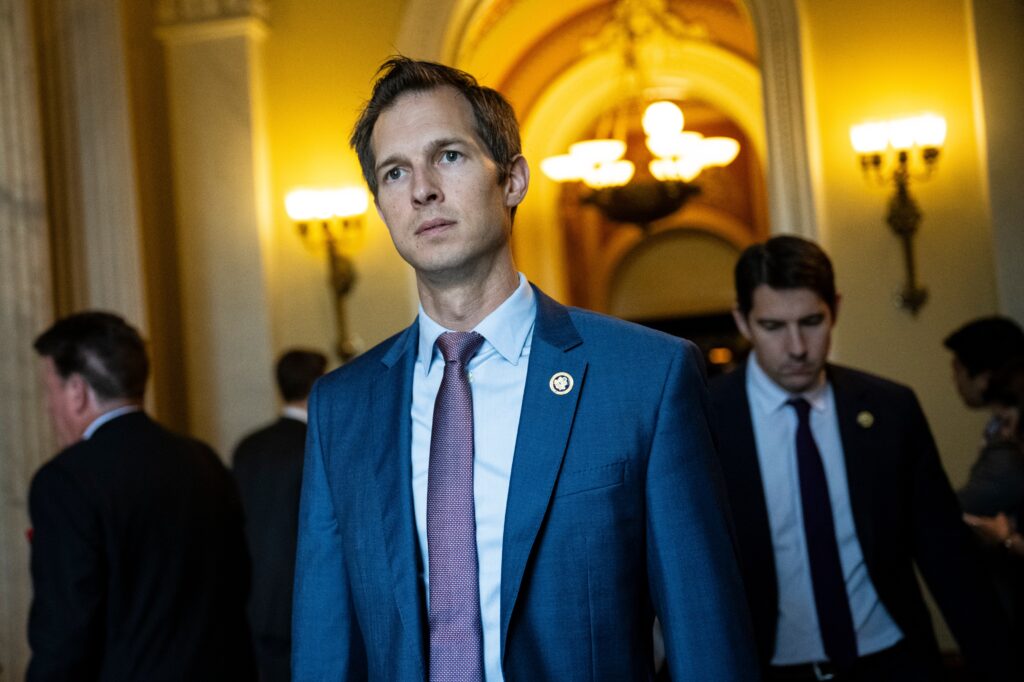
The Democratic Party’s future — if it wants one; the evidence is mixed — should be based on candidates who understand that U.S. politics, when healthy, takes place between the 40-yard lines, contesting the center of the field. People such as the 37-year-old Marine (he served in Afghanistan, and is in the Corps’ Individual Ready Reserve) who now is a Whiggish (his description) congressman.
A substantial portion of his Massachusetts district, including some Boston suburbs, typifies what now is his party’s affluent, educated base — people who have flourished in the knowledge economy that globalization fostered. Another large portion of his district resembles what used to be his party’s base: blue-collar manufacturers.
The district’s largest city, Fall River, in 1880 was the nation’s foremost textile manufacturing powerhouse, with more than half a million spindles. In 2024, for the first time in a century (in 1924, it voted for Massachusetts’s former governor, who was then president, Calvin Coolidge), the battered city voted for the Republican presidential candidate.
In 2020, during the pandemic, when Jake Auchincloss won his first congressional term, he was dismayed by Democratic-run cities that ignored public-health experts and kept schools closed: “There was a condescending attitude to parents who were rightfully frustrated watching kids atrophy at home,” he told the Wall Street Journal in August. This oblique, but clear enough, criticism of teachers unions indicates his desire to push against the boundaries of acceptable speech within his party.
By calling himself, in passing, “Whiggish,” Auchincloss implies intellectual kinship with those British who favored parliamentary power capable of trimming the king’s sails. And with 19th-century Americans who favored congressional supremacy: Whiggish politics implies less president-centric politics.
Auchincloss, who writes on Substack that he thinks many voters regard his party as “weak, woke and whiny,” wants a more “muscular” vocabulary about “upholding social order.” He has a Marine’s way of discussing guns, a way probably grating to some in his party: “I slept, ate, trained, and patrolled with an assault weapon for four years. I cleaned it before I ate or slept every night. Selling AR-15s at Walmart to teenagers is not just dangerous, it also undermines the military ethic … and degrades warrior craftsmanship.”
When was the last time a Democrat said anything so interesting about this issue? He is equally distinctive when discussing a subject that today disturbs the tranquility (elusive as it might be) of every American family with children in or approaching adolescence: smartphones and social media.
Twenty years ago, the technology that torments today’s parents did not exist: The iPhone arrived in 2007. Now, Auchincloss has written, “Kids in America spend less time outdoors than federal inmates.” Social media corporations are “attention fracking.” They have “monetized children’s attention,” making many adults, too, “angrier, lonelier, and sadder.”
The companies are more than just enabling, they are encouraging “hyperventilating meanness” and “endless scrolling,” a society where everything “is instant, easy and alone.” Auchincloss wrote in the New York Times in September: “The Consumer Product Safety Commission insists that pharmaceutical companies put medications in child-safe bottles. It should be the same for apps that deliver digital dopamine.”
In the years since the smartphone’s debut, parents have grappled with the unique dangers it poses for children — dangers far more sinister than comic books (yes, really), television and other cultural panics of the post-1945 era.
Rahm Emanuel — former Chicago mayor, likely 2028 presidential candidate — recently posted online,“It’s either going to be adults or the algorithms that raise our kids.” So, “no child under the age of 16 should have access to social media” — TikTok, Instagram, Snapchat and others — because they are “too addictive, too alluring” for parents to push against, given the power of the companies pushing the apps.
Auchincloss proposes a 50 percent tax on the companies’ advertising revenue over $2.5 billion to help finance “1,000 new trade schools across the country.” This is a timely proposal: While the Trump administration is deporting workers, Ford Motor’s CEO Jim Farley laments that the nation has “over a million openings in critical jobs, emergency services, trucking, factory workers, plumbers, electricians and tradesmen.”
Auchincloss’s (and Emanuel’s) proposals involve thorny philosophical, constitutional, legal and practical problems. But leave aside the wisdom or feasibility of his desired policies. He is exemplary because he talks about topics that resonate with centrist voters, using sometimes surprising language (see above: guns) to persuade the probably 80 percent of Americans who are not communicants in the Church of Progressivism.
“The country is in crisis,” Auchincloss says, “and Democrats are in the doldrums.” But politics is mostly talk, at which some Democrats are getting better.
The post Behold, a Democrat who doesn’t preach from the Church of Progressivism appeared first on Washington Post.