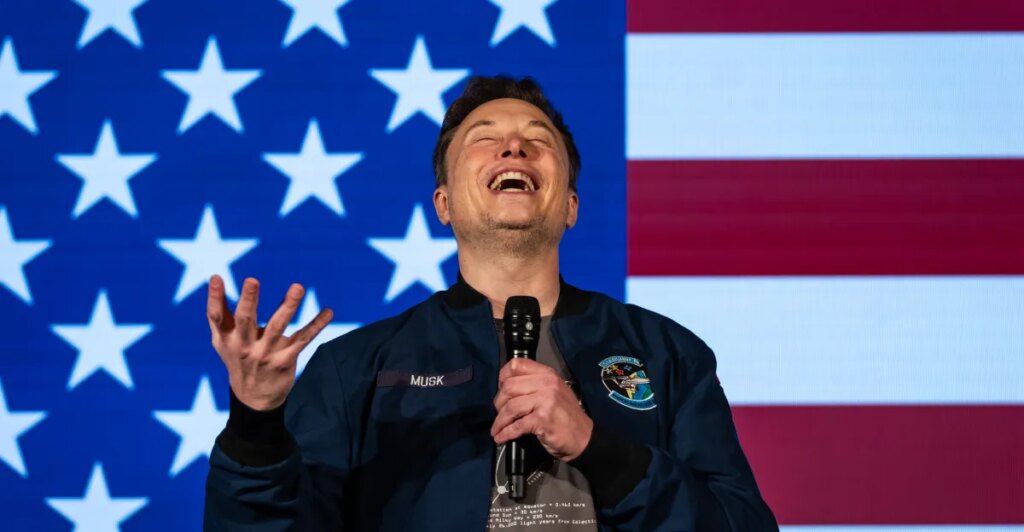
Since Elon Musk bought Twitter in 2022, it has often seemed that he transformed a platform that favored progressives into one that bolstered the right instead.
And in the years after that purchase, the right’s political fortunes improved dramatically. The woke era came to a close, conservatives gained the upper hand in the culture war, and President Donald Trump returned to power while Democrats and leftists became disillusioned and dispirited. A mood of right-wing triumph pervaded the platform Musk renamed X.
Key takeaways
- Elon Musk’s changes at X (such as rolling back content moderation policies and creator payouts), plus progressives’ departure, have turned it into a platform where the right mainly argues with the extreme right.
- Now, even right-wingers like Christopher Rufo are perturbed by how popular bigotry and conspiracy theories are becoming on X, as feuds and controversies erupt there and shake the GOP.
- Meanwhile, the Trump administration remains obsessed with pandering to the online right, putting them out of touch with ordinary voters and endangering the multiracial MAGA 2.0 coalition.
But in recent months, X has lost its ability to unite the right. Instead, it’s increasingly the place where Trump supporters turn on each other.
Intense and bitter public feuds have broken out over such topics as Israel, antisemitism, bigotry against Indian Americans, and whether people whose ancestors came to the US more recently should be considered less authentically American. Conspiracy theories are running rampant, with many targeting the Trump administration itself.
Importantly, much of this is happening because of X. That is: the changes to the platform’s policies and culture that have been made under Musk’s ownership have altered the norms of what it’s acceptable for right-wingers to say, and have incentivized a race to the bottom for engagement. It turns out that once guardrails against bigotry and misinformation are removed, there’s a huge audience-side “demand” on the right for both.
“On the right, the public mind is now shaped by the X algorithm,” right-wing activist and X power-user Christopher Rufo recently wrote, arguing that X has usurped the role formerly held by Fox News. But, he went on, “the platform’s algorithm seems increasingly hijacked by bad actors who peddle baseless conspiracies” for “clicks, dollars, and shares.”
Meanwhile, as X grows more extreme and disconnected from reality, top Trump officials remain obsessed with pandering to its user base — focused on throwing red meat to the online right, rather than trying to win back the ordinary voters who have soured on the president.
In all this lies the seeds for the potential destruction of the MAGA 2.0 coalition. Controversies over antisemitism are shaking right-wing institutions like the Heritage Foundation. Overt bigotry and an obsession with online nonsense seem ill-suited to retaining the loyalty of the voters of color who backed Trump for the first time in 2024.
And in a way, this is a familiar story. Just a few years ago, when progressives were the most influential Twitter users, it was Democrats who often mistook retweets for reality and got out of touch with ordinary voters. Now it’s the right’s turn in the barrel.
Why Twitter/X is so important and powerful
Twitter was, and X remains, the closest thing we have to a “public square” where people of varying ideological persuasions from different walks of life come together and say what’s on their minds.
Many of our country’s elites are still on the platform, which helps shape their views of what ideas are in vogue and correct — and how to make sense of the world. Amid an increasingly atomized media and content environment, it’s still the place where various writers and streamers and podcasters come together and talk directly to each other, rather than just to their own audiences.
Crucial to the platform’s power is the pile-on, in which large numbers of users come together to say that someone or something is bad. The pile-on is enjoyable to its participants, who derive meaning and belonging from coming together against a common enemy. Potential targets of the pile-on — corporations, media figures, politicians, other institutions — fear it, and shape their behavior to try to avoid it.
Yet the platform is also, in a sense, a trap. The saying goes that “Twitter isn’t real life” — though that sentiment has seemed somewhat quaint as real life and Twitter have come to resemble one another. But there remains a core truth to it: the platform’s heaviest users tend to be deeply politically engaged and ideological, while the many Americans who follow politics less closely or have more mainstream views are far less represented and vocal.
The problem is that political actors and coalition participants seeking to gauge what people think of something use X and other feedback mechanisms that are dominated by the most super-engaged slice of their base. For many, the day-to-day work of their job essentially becomes pandering to their super-engaged supporters. (After all, if they’re mad at you, they’re surely going to let you know it, and you’ll likely try to make the problem go away.)
How Musk changed Twitter
Twitter was crucial in driving and amplifying the emboldened social justice activism of the 2010s and early 2020s. Musk then bought it to try and combat that activism, and he changed how the platform worked in a few important ways:
- He rolled back content moderation policies against hate speech and misinformation, restoring many previously banned accounts (such as that of the antisemite Nick Fuentes)
- He started letting anyone buy the “blue check” verified status previously given to journalists and other prominent figures
- He used creator payouts to incentivize people to create viral content
Finally and crucially, Musk also sparked an exodus. Many of the vocal progressives who had long set Twitter’s dominant tone and culture quit using the platform in protest of his behavior.
The combination of these changes transformed X from a platform where right-wingers talked alongside progressives to a platform where the relatively more “reasonable” right-wingers talked alongside kooks and virulent bigots.
On Twitter, if you said something too bigoted, you could be banned. On X, that won’t happen — and indeed, creator payouts may give you an incentive to say even more bigoted things, if an audience likes it.
Tucker Carlson was fired from Fox and moved his show to X, and has since hosted increasingly extreme characters, culminating in his interview of Fuentes this fall, an interview that kick-started a controversy that eventually led to many resignations from the most important conservative think tank, the Project 2025-authoring Heritage Foundation.
All this helped change right-wing norms and standards on what is acceptable to say publicly, to the dawning horror of some in the movement. After being bombarded with anti-Indian attacks in October, conservative commentator Dinesh D’Souza — not exactly the most politically correct guy around — wrote: “In a career spanning 40 years, I have never encountered this type of rhetoric. The Right never used to talk like this. So who on our side has legitimized this type of vile degradation?”
Rufo, for his part, is not exactly uniformly opposed to racially charged conspiracy theories: He happily spread the accusation that Haitian immigrants were eating pets in Ohio last year. But he’s been perturbed by three ideological trends he saw gaining steam among parts of the right: racialism, antisemitism, and conspiracism. These trends have only worsened as the year continued — for instance, in the conspiracy theories over the murder of Charlie Kirk.
Lately, Rufo has pointed the finger at X’s algorithm as a main culprit, complaining that “Musk’s decision to pay content creators has further detached reach from quality” and urged him to make changes on the platform.
Longtime conservative blogger Razib Khan expressed similar concerns, recently writing that he’s “starting to worry reading X and seeing the impact of youtube influencers that we’re going to lose because our arguments are starting to sound very stupid.” This shift, he added, represents “a major decrease in IQ.”
The Trump administration’s X obsession – and the attempt to reunite the online right
X has grown more extreme amid a remarkable context: The second Trump administration is the most online in US history, with many current top officials positively obsessed with how they are viewed among the online right, and turning to X first to assess that.
Indeed, Trump administration policy seems to be driven in part by Trump’s own personalistic whims, in part by White House adviser Stephen Miller’s anti-immigrant fanaticism, and in part by various officials’ independent attempts to try and impress online right influencers.
The examples are legion. The continuing saga over the “Epstein files” began as Attorney General Pam Bondi’s botched attempt to pander to right-wing influencers. Top FBI officials Kash Patel and Dan Bongino are chronically online and obsessed with criticism from right-wing influencers over their supposed failures to reveal deep-state conspiracies. FCC chair Brendan Carr’s threats against Jimmy Kimmel were made as tough talk to impress a right-wing streamer. And Vice President JD Vance is the most online of all, driven to defend the honor of racist shitposters so long as they’re on his side.
This continued obsession with pleasing the fringiest figures on the right does not seem to have been very successful at making Trump popular — his approval rating is mired at about 42 percent, with 54 percent disapproving of his job performance. Yet his administration has plowed ahead with its base-pleasing strategy regardless, either mistaking X for ordinary voter sentiment, or thinking X is more important to their future career prospects than ordinary voters are.
Rabbit holes, conspiracy theories, and bigotry are spreading on X with no end in sight, and alienating the less extreme people who are exposed to it. But right-wingers’ hope is that they can restore their frayed unity by redirecting their energy to targets they can all agree on.
And they’ve had some success on that in recent days, in right-wing outrage about fraud allegedly committed by Somali immigrants against Minnesota’s welfare programs. It was in fact Rufo who helped focus the right’s attention on this long-public scandal, and a young conservative YouTube influencer who helped it go mega-viral in recent days.
On this topic, they could all agree on who the bad guys were: African immigrants, Democratic Gov. Tim Walz, and the media. It was like old times. Can it last?
The post Elon Musk created a monster that’s tearing the right apart appeared first on Vox.