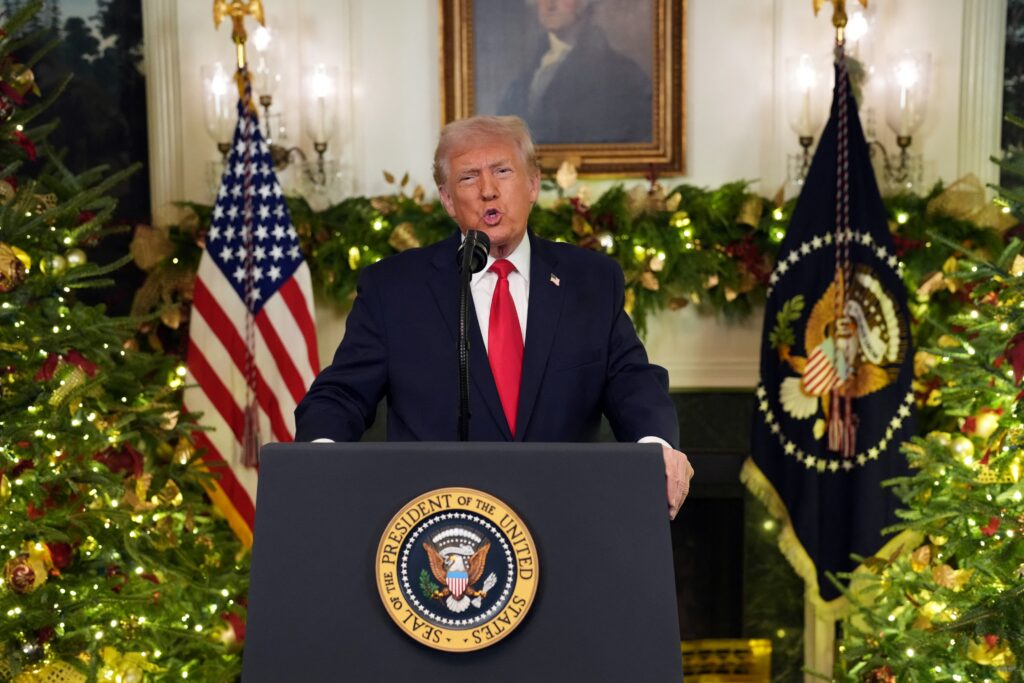
President Donald Trump and White House leaders say that American workers are winning because of his immigration crackdown. But the data doesn’t back that up.
Since the summer, Trump officials have been trumpeting the idea that job creation is booming for U.S.-born workers. Trump said so, too, during a prime-time address last month aimed at assuaging Americans’ concerns about the economy.
“In the year before my election, all net creation of jobs was going to foreign migrants. Since I took office, 100 percent of all net job creation has gone to American-born citizens,” Trump declared. “One hundred percent.”
Trump administration officials also said recently that more than 2.5 million U.S.-born workers gained jobs in 2025 as 1 million immigrants left the workforce.
But economists on both sides of the political aisle say they have seen no evidence that American-born workers are getting jobs by the millions or moving en masse into positions abandoned by deported immigrants.
In fact, data shows that U.S.-born workers are doing moderately worse under Trump than they were under President Joe Biden because the labor market has weakened — partly due to a sharp slowdown in immigration.
“The unemployment rate has been rising for both native-born and foreign-born adults,” said Jed Kolko, a senior fellow at the Peterson Institute for International Economics and a former Commerce Department economist.
Taylor Rogers, a White House spokeswoman, said in a statement to The Washington Post that “mindless nitpicking doesn’t change the simple fact that President Trump has done more for American workers than any president in history by cracking down on visa program abuses, successfully negotiating new trade deals, securing our border, and carrying out the largest mass deportation of illegal aliens.”
Those policies ensure “American-born workers can finally benefit from our new economic resurgence,” Rogers said.
Here’s what to know about how U.S.-born workers are faring under Trump’s immigration crackdown.
Fewer immigrants are in the workforce
Immigrants are leaving the U.S. labor market, economists agree.
The Trump administration prioritized deportations in 2025, with immigration officials deporting about 579,000 people, according to a Dec. 7 social media post by Trump border czar Tom Homan.
Meanwhile, admissions under refugee and other humanitarian programs have been slashed, and illegal border crossings declined sharply last year. And the Trump administration has moved to strip legal status from more than 1 million immigrants with temporary protections.
After years of labor market growth fueled by immigration, 2025 could mark a turning point, with more immigrants leaving the United States than arriving. That could result in a net drop in migration for the first time in at least 50 years, economists say.
But economists don’t know yet how many fewer immigrants there were in 2025 compared to 2024, and they say they won’t have good estimates for a while.
What is clear is the share of immigrants with jobs has fallen since hitting longtime highs earlier in the Biden era. But there has been little change compared with a year ago, at the end of Biden’s term.
U.S.-born employment is not surging
The Trump administration said in December that 2.57 million U.S.-born citizens had obtained jobs last year, while about 1 million immigrants lost work. And officials have repeatedly said some variation of that since August.
These claims are based on Bureau of Labor Statistics data derived from the U.S. Census showing large gains in employment for native-born workers and falling employment for immigrants.
What @POTUS is doing for our workforce is nothing short of HISTORIC. While other Presidents allowed foreign workers to flood the job market, President Trump is working to ensure ALL jobs created go to our workers:
NATIVE-BORN EMPLOYMENT is UP 2.5 MILLION
FOREIGN-BORN… pic.twitter.com/1FWssj8Zb6
— U.S. Department of Labor (@USDOL) November 22, 2025
But economists warn against using counts of native-born workers derived from census population estimates — or comparing those numbers with figures from previous years. Doing so would be “a multiple-count data felony,” Jed Kolko wrote in August.
That’s because the census data was hemmed in by a population estimate set by the Census Bureau last January, before any new immigration policy had gone into effect.
Basically, the number of foreign-born and native-born workers in Bureau of Labor Statistics data have to add up to a total based on the U.S. Census population estimate that is set at the beginning of the year, according to several economists consulted by The Post.
When the monthly responses from foreign-born households drop, which has been happening, then the math takes over: The native-born population totals automatically increase, so responses in the monthly household survey reflect the population controls. That’s why it looked like the United States had so many more native-born workers in 2025.
Any drop in foreign-born workers artificially boosts the number of native-born workers reported each month. And currently, fewer immigrants are responding to these surveys. (More on that below.)
“The main thing [the Trump administration] has been saying is that 2 million people left the country and 2 million native-born workers have joined the labor force as a result,” said Stan Veuger, a senior fellow in economic policy studies at the American Enterprise Institute, a conservative think tank. “That’s the incorrect analysis of the [government data] that has been plaguing us all year.”
As an extreme illustration, Kolko has said that if the entire foreign-born population vanished, this dataset would show the population of native-born residents skyrocketing by tens of millions of people.
Trump’s prime-time speech assertion last month that “100 percent of all net job creation has gone to American-born citizens” also relies on misuse of the same dataset, according to Kolko.
“Their claim is based on looking at the change of the level in employment for native and foreign-born workers,” Kolko said. “And you cannot use that dataset to look at those levels.”
Immigrants are disappearing from the data
There are a few reasons fewer immigrants are responding to the Current Population Survey. First, the number of immigrants in the United States likely did go down last year because of deportations, a closed border and immigration restrictions.
Immigrants who are still here could also be reluctant to respond to government surveys for fear of becoming targets of heightened immigration enforcement. Or they could be responding inaccurately to surveys because of the same fears, several economists said.
“If there’s a sudden drop in immigration, or if fewer foreign-born residents respond to the survey, then, by design, the number of native-born workers would almost certainly go up,” Kolko said. “The way the calculation is set up, it’s not like you can lower the population of foreign-born workers without raising the population of native-born.”
Unemployment rate for U.S.-born is on the rise
So how are U.S.-born workers doing?
Economists say the best real-time measure of how U.S.-born workers and immigrants are doing in the labor market is the unemployment rate. And that rate climbed for native-born workers last year as job creation slowed, while changing little compared to a year ago for foreign-born workers.
The unemployment rate for native-born Americans is 4.3 percent, up from 3.9 percent last November, which economists say is the strongest indication that the labor market has worsened for U.S.-born workers, though it’s still strong compared to recent decades.
“We know that it’s just been harder for native-born workers to find work because more of them are unemployed,” Veuger said.
Meanwhile, job growth for all workers in the United States has slowed significantly in recent months and the unemployment rate has climbed to the highest level in four years.
“The labor market is not in a better place than it was a year ago,” said Dean Baker, senior economist at the Center for Economic and Policy Research. “It is harder to find a job.”
U.S.-born are not rushing into jobs left by immigrants
There is little evidence that millions of U.S.-born workers rushed into jobs typically worked by immigrants in 2025, as Trump officials have suggested, several economists told The Post.
Trump economic adviser Kevin Hassett said on CBS’s “Face the Nation” last month: “When foreign-born workers depart, then it creates jobs for people who are native-born.”
There are likely cases of U.S.-born workers stepping up for jobs previously worked by immigrants. But the rising unemployment rate for native-born workers indicates that native-born Americans are not moving in large numbers into those jobs.
“We don’t know what’s happening definitively, but the fact that the native-born unemployment rate is rising — and over the past year has risen faster than the foreign- born unemployment rate — suggests that it is not simply that native-born workers are taking the jobs of foreign-born workers,” Kolko said.
Immigration restrictions and deportations also could be pushing U.S. citizens out of work. Research on the construction industry has shown that the deportation of immigrants working in lower-skilled positions, such as roofers and laborers, can lead to the disappearance of work for native-born construction workers, especially those in higher-skilled jobs, such as electricians and plumbers.
“A lot of immigrants take low-wage, generally less-skilled jobs in construction on projects that wouldn’t otherwise go forward,” said Baker, the economist at the Center for Economic and Policy Research. “You have native-born workers in higher-skilled jobs, but when the immigrants aren’t there, they aren’t able to do it.”
The post Trump says the job market is booming for U.S.-born. The data doesn’t show it. appeared first on Washington Post.