Whether Mayor Zohran Mamdani has the skills and good fortune to succeed in the so-called second-hardest job in America no one can yet say.
But at age 34, he is already a historic figure, beginning with his biography: Born in Uganda to Indian parents and raised in the rarefied atmosphere of Columbia University (where his father is a prominent professor), he identifies as Muslim, was a state assemblyman from Queens, is a member of the Democratic Party and the Democratic Socialists of America and is married to an animator and illustrator, Rama Duwaji, whose work has appeared in The New Yorker.
His résumé looks like a composite picture of urban America in the 21st century — and of the broad coalition Mr. Mamdani built when he swept to victory in November. His “strong showing across the city among most racial and ethnic groups and most income levels,” The Times reported, included impressive performances in precincts where the median registered voter’s age was 45 or younger. It was an electoral map that overlaps with President Trump’s winning coalition in 2024.
Indeed, of all the statistics being processed and fussed over in post-mortems of Mr. Mamdani’s victory, the most telling may be the number of Mamdani voters who previously supported Mr. Trump — some 60,000, according to data tabulated by CBS News. The parallels with Mr. Trump’s victory were not lost on the president’s ally Steve Bannon. “Modern politics now is about engaging low-propensity voters,” he told Politico in an interview. Mr. Mamdani’s ability to attract them, Mr. Bannon said, means Mr. Mamdani “is a serious guy” whose victory points to something new on the left. “This is kind of the Trump model.”
That model begins with an understanding that positions that only recently seemed extreme or fringe have gained wider acceptance. In a recent book, “Lost in Ideology,” the political philosopher Jason Blakely wrote of “liquid ideologies” that spill across the boundaries of left and right and sometimes can “combine in unexpected ways.”
One striking example is the growing consensus of opposition to Israel’s conduct of the war in Gaza. Many in both parties were unprepared for this, given the longstanding bipartisan support for Israel. But just as antiwar protests during the Vietnam era gave rise to an emerging generation of politicians, left and right, who began to question the Cold War campaign against world Communism, so have campus-based protests, such as those Mr. Mamdani was involved in at Bowdoin, challenged America’s longstanding commitments in the Middle East.
The break with the past could not be sharper, especially in New York, with its large Jewish population, which is a dominant constituency in the city’s politics. For many years, New York mayors were expected to assert their solidarity with Israel, and each mostly did — until Mr. Mamdani, who was overtly critical of Israel’s actions.
In an analysis published in The Free Press, the scholar Zineb Riboua argued that Mr. Mamdani is in the vanguard of a new political cohort on the left that has adapted “the lexicon of third world liberation” to American politics, “transforming decolonization into a scaffold for moral and political identity.”
Mr. Mamdani’s position on Israel led to a strong backlash, in particular when he declined for months to disavow the slogan “globalize the intifada,” which many say amounts to a call for violence against Jews around the world. (He later said that he would not use such language.)
The surprise — for startled observers of Mr. Mamdani’s large victory — is how many New Yorkers agreed with his stance on Israel or at least seemed untroubled by it.
The Gaza debate is one component of a larger lesson of the Trump years — one that still eludes many observers and commentators, who tend to assess voters on specific policy matters rather than looking more closely at how voters think. In an essay in the latest issue of Harper’s Magazine, Mr. Blakely argued that “ideologies are holistic phenomena: large-scale narratives that not only guide action but are embodied in many of our social rituals and ways of organizing.”
Mr. Mamdani’s campaign was a master class in 21st-century organizing. There were his witty YouTube videos in which he quizzed street vendors about permit costs (showing viewers how those costs are passed to consumers), his visits to mosques and synagogues, a nighttime rally in the Forest Hills Stadium in which he invited audience members to turn on their cellphone flashlights if they had knocked on doors to get out the vote (to show how useful old-style campaigning still is).
And there was the moment in his victory speech when he burst through the fourth wall and taunted his anticipated chief antagonist. “Donald Trump, since I know you’re watching, I have four words for you: Turn the volume up.”
In saying this, Mr. Mamdani was telling the president to listen up, but he was also giving courage to his supporters. With his victory, he wanted his Muslim constituents to “know that they belong — not just in the five boroughs of this city but in the halls of power.”
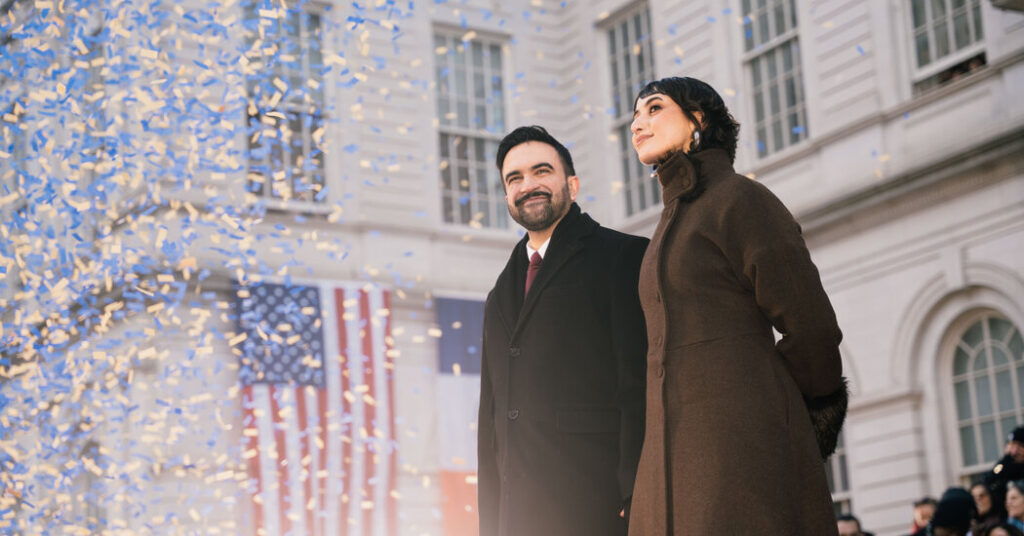
Mr. Mamdani made no effort to conceal his ideological allegiances during the campaign. At the rally in Forest Hills, with early voting underway, he was joined onstage by two of his mentors, Senator Bernie Sanders and Representative Alexandria Ocasio-Cortez, leading progressive voices. At his inauguration on Thursday, Ms. Ocasio-Cortez introduced Mr. Mamdani, and Mr. Sanders administered the ceremonial oath of office.
The partnership of these three politicians has led some to suggest that Mr. Mamdani is strictly a local or regional phenomenon. The promises of universal child care, freezes on rent and “fast, fare-free buses” may sound radical outside New York. But the proposals matter less than the spirit in which they are made and the sentiments they rest on. Or as Mr. Blakely remarked in his book, “We have forgotten that politics is cultural.”
Mr. Mamdani understands this very well. His biography on the State Assembly website mentioned his “detours in film, rap and writing” in addition to his career as an organizer.
To make sense of his rise we do well to set aside data-tested political science and look instead to the lessons of art. One useful primer for is the novel “Netherland,” Joseph O’Neill’s bittersweet ode to New York in the aftermath of Sept. 11. Mr. O’Neill, like Mr. Mamdani, is a cosmopolitan New Yorker who seems hand tooled for our century. His background is Irish and Turkish, and he grew up in the Netherlands. He practiced law in England before moving to New York and becoming a leading fiction writer.
The book is mainly set in New York, with much of the action taking place in remote working-class districts outside Manhattan. The narrator, a displaced Dutchman and avid cricket player, travels the city to compete on fields like Walker Park’s on Staten Island, where cricket matches have been played since 1872. His teammates come from South Asia and the Caribbean. The team’s main booster, a Trinidadian, insists that cricket is “the first modern team sport in America” and “a bona fide American pastime.”
At almost the same time “Netherland” was published, Mr. Mamdani, then a student at the Bronx High School of Science who had grown up with the game in Uganda, had the idea with a friend to form a school cricket team. Any and all were welcome. “Brown ain’t no requirement to play this game,” the teenage Mr. Mamdani posted on Facebook — words that might easily have found their way into the bantering exchanges in “Netherland.” That early organizing effort was cited in Mr. Mamdani’s biography on the State Assembly website, saying it “taught him how coming together with a few like-minded individuals can transform rhetoric into reality.”
Some wonder how Mr. Mamdani was able to overcome the distrust of so many voters who disagreed with him on the Middle East and other divisive issues and bring them together.
There, too, “Netherland” offers a clue. The world opened up by his new cricket connections enables the narrator meets all sorts of “strictly local characters — lawyers and Realtors and painters and roofers and fishmongers and rabbis and secretaries and expediters.” This looks like Mr. Mamdani’s New York, down to the rabbis who might not have endorsed him but supported him.
All these characters are drawn to a larger idea or hope of what New York — and America — may one day become. At one point the narrator of “Netherland” attends an annual gala of cricket clubs in the region. “I made my entry just in time to hear a voice announce, ‘Please stand for the national hymn,’ and every person rose for a recording of ‘The Star-Spangled Banner.’”
Not anthem, but “hymn”: patriotism joined with higher belief. Here, then, is the deeper meaning of Mayor Mamdani’s election. At a moment when so many seem to have lost faith in the American future and speak nostalgically of making the country great again, newcomers — immigrants, including New York City’s new mayor — continue to embrace the American dream.
Sam Tanenhaus is the author of “Buckley: The Life and the Revolution That Changed America” and “Whittaker Chambers: A Biography.” He is a former editor and writer at large at The New York Times.
The Times is committed to publishing a diversity of letters to the editor. We’d like to hear what you think about this or any of our articles. Here are some tips. And here’s our email: [email protected].
Follow the New York Times Opinion section on Facebook, Instagram, TikTok, Bluesky, WhatsApp and Threads.
The post Mamdani Represents 21st-Century America appeared first on New York Times.