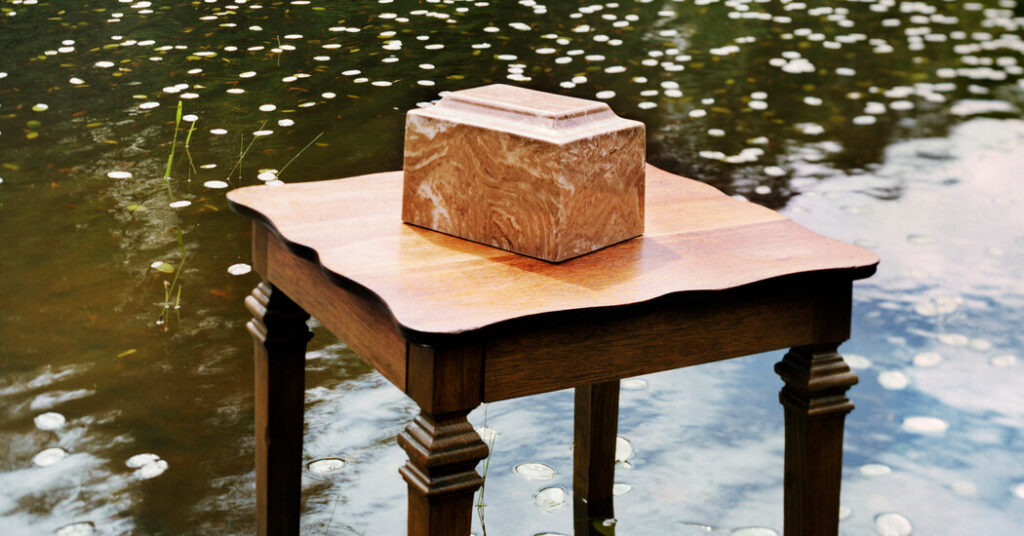
For the past three years, my dad’s ashes have lived in a FedEx box on the top shelf of my closet, in the very cheapest of graves. One Halloween, I nearly knocked it over reaching for a wig.
I’m an Episcopal priest and theologian who’s spent more than 15 years studying the intersection of trauma and theology. I’ve lost count of the people I’ve watched die. I’ve scattered ashes everywhere from cemeteries to lakes. Every year, I participate in the Ash Wednesday liturgy in which I remind myself that I am dust and to dust I shall return.
If anyone should be prepared to know how to handle my father’s ashes, it’s me. But ordination and a Ph.D. provide no protection from grief. They just make you vulnerable to it in a different way.
I had every good intention of disposing of my father’s ashes after his death over three years ago. He endured 17 years with Lou Gehrig’s disease, a torturous illness that causes slow death by paralysis — first his legs, then his hands and mouth. One of the few mercies was that it gave him time to share his last wishes: a large choir at his funeral, a party after. He wanted his ashes spread in Hawaii.
None of it ever happened.
My father died during Covid, nixing the in-person funeral, and it was unrealistic in every way to fly a family of five across the Pacific.
So, I did nothing with his ashes. Years passed. I kept saying I would figure out a meaningful, reasonably priced alternative to my dad’s Grand Hawaiian Plan. But everything I came up with seemed dull, and everything I imagined he would want was either expensive or illegal. When relatives asked why the ashes were still in the closet, I told them we were busy. When clergy friends inquired, I said I couldn’t settle on where to put them.
This was all true.
This was all an excuse.
Some people feel a sense of fit with their loved ones’ final resting place. When my uncle died of Covid, my cousins made sure his cremated remains were placed in a beautiful urn on the mantelpiece, as he wished. They can talk to him there; they feel he’s never far away. My mother finds great comfort in knowing her parents and grandparents are buried in the same Catholic cemetery. She’s asked me to place flowers on their graves twice a year after she dies. She doesn’t want them to be forgotten.
But closets, unlike graveyards and urns, are not places where ashes are meant to remain.
I know I’m not the only one perfecting this kind of grief limbo. People tell me about the ashes they’ve accumulated in their closet, in their basement, in the trunk of their car. One woman told me she had a basement filled with urns she’d inherited. She didn’t know who some of them belonged to, but she felt too ambivalent to move them, even as she knew they shouldn’t be next to the washing machine.
Those of us storing cremated remains in corners of our home often believe our loved ones deserve something fitting and final, something more than a Ziploc bag or the cardboard box that contains it. We want to bestow an additional honor; we want to get it right. But that’s as far as we get because action would disrupt the spiritual status quo and that’s a frightening prospect.
We might have to acknowledge that their mortality signifies ours, that we don’t know how or when, but one day, we too will return to dust. We might have to recognize that our faith in heaven is a little shakier than we’re letting on. We might have to own that we’re not ready to let that person go because of love or shock or unresolved conflict.
Years ago, back when I was a college student, I spent a summer working at an environmental research site. One evening, after dinner with some ecologist friends, we began talking about what would happen to us after death.
“I’ll be recycled,” one of them said, shrugging her shoulders as if this was the most obvious thing in the world.
Perhaps this is what we most deny our loved ones when we don’t give them a final resting place — we keep them from being transformed. We deny their last wish to return to creation, to get back to work, to be changed into an earthworm or tree bark or water particles suspended in a cloud. We deny them a chance to once again become the stuff of stars. We deny their desire to be intertwined in this creation God so wonderfully made.
Danielle Tumminio Hansen is the author of “Trauma-Informed Spiritual Care” and other books.
The Times is committed to publishing a diversity of letters to the editor. We’d like to hear what you think about this or any of our articles. Here are some tips. And here’s our email: [email protected].
Follow the New York Times Opinion section on Facebook, Instagram, TikTok, Bluesky, WhatsApp and Threads.
The post The Trouble With My Father’s Final Resting Place appeared first on New York Times.