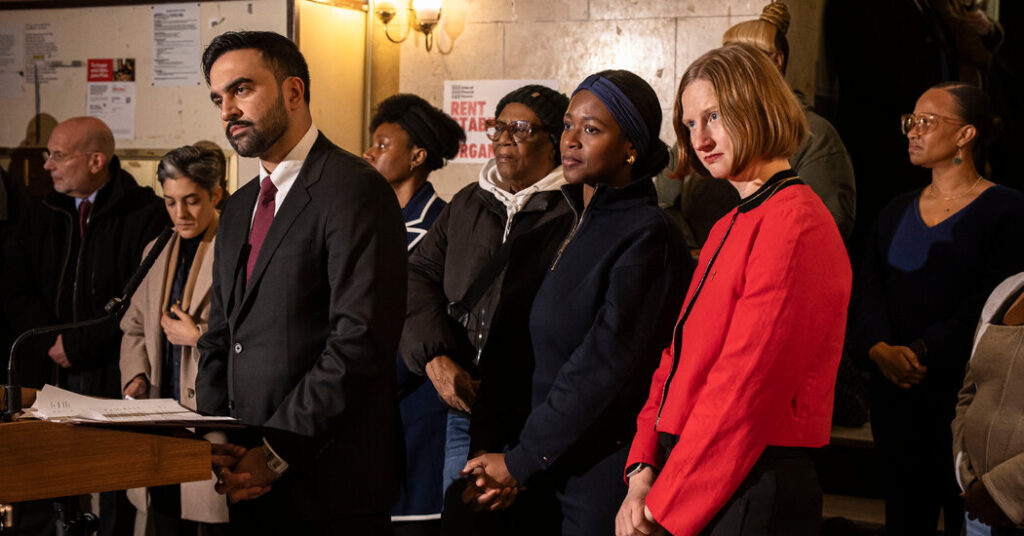
Zohran Mamdani signed an executive order in his first day as mayor on Thursday revoking all orders issued by former Mayor Eric Adams after his indictment on federal corruption charges, including two that he had touted as support for Israel.
One of the revoked orders, signed last month by Mr. Adams, barred city agencies from boycotting or divesting from Israel. Another that the former mayor signed last June adopted an expansive definition of antisemitism that equates some forms of anti-Israel criticism, like opposition to Israel’s ethnically Jewish character, with antisemitism.
Mr. Mamdani did not revoke the creation of the city’s office to combat antisemitism, which Mr. Adams created in May.
Still, the former mayor and some conservative-leaning Jewish leaders, who had opposed Mr. Mamdani’s candidacy and have been wary of his intentions as mayor, criticized the new mayor’s actions.
Inna Vernikov, a Republican councilwoman from Brooklyn, attacked the mayor on Thursday night, saying on social media that one of the revoked orders “protects from discrimination Jews who believe in self determination.” A little more than an hour later, she added that “the pro-Hamas antisemites emboldened by” the mayor “are coming!”
Mr. Adams’s orders were controversial at the time that he signed them, and were seen by many as an effort to stymie his successor.
“Both of those orders appeared to be last-ditch attempts to suppress viewpoints that the mayor and his benefactors disagreed with, especially since one of them was issued just in the last few weeks,” said Donna Lieberman, the executive director of the New York Civil Liberties Union. “It is no surprise and it is good news that our new mayor has revoked them.”
Ms. Lieberman said the orders, and others like them, “have a chilling effect on speech that is protected by the First Amendment.”
“The right to free speech does not depend on your viewpoint, and that is true for speech about Israel or Gaza, it is true about political activism about that conflict, and it is true about any other political issue that we face,” she said.
Mr. Mamdani’s victories in the Democratic primary for mayor and the general election alarmed many Jews who were concerned by his outspoken criticism of Israel. He also won the votes of many other Jewish New Yorkers who said they were inspired by his campaign and unbothered by his views on the Middle East.
Mr. Mamdani has criticized Israel in ways that were once seen as unthinkable for an elected official in New York, which is home to America’s largest Jewish population. He has decried Israel as an apartheid state, said it should ensure equal rights for followers of all religions instead of favoring Jews in its political and legal system, and has supported the movement that seeks to economically isolate it, known as Boycott, Divestment and Sanctions.
Often, Jewish voters who supported him said his views on Israel, and his vocal opposition to its treatment of Palestinians, echoed their own. But others have remained worried about his approach to Israel and the concerns of Jewish New Yorkers.
That unease was only exacerbated by the revelation of antisemitic statements posted more than a decade ago on social media by Catherine Almonte Da Costa, a senior Mamdani adviser who resigned amid an uproar last week. Now 33, she is married to a deputy city comptroller who is Jewish.
But throughout his campaign, Mr. Mamdani has repeatedly vowed to protect the security and celebrate the contributions of Jewish New Yorkers. That was a vow he made again at a news conference on Thursday, when he pointed to “the continued incorporation of the Office to Combat Antisemitism.”
“That is an issue that we take very seriously and as part of the commitment that we’ve made to Jewish New Yorkers: to not only protect them, but to celebrate and cherish them,” Mr. Mamdani told reporters.
The I.H.R.A. definition of antisemitism was proposed by the International Holocaust Remembrance Alliance in 2016 and includes 11 examples intended to illustrate antisemitism, seven of which include or relate in some way to criticism of Israel.
As such, the definition has been a longstanding topic of debate, which has grown more heated as some Jewish groups have urged governments and other institutions to adopt or codify it, as incidents of antisemitism have risen in recent years.
But other groups, including left-leaning Jewish organizations, have objected to the way that framework equates some criticism of Israel to hatred of Jewish people.
“There is not consensus necessarily around whether the I.H.R.A. definition of antisemitism should be codified in this way,” said Phylisa Wisdom, the executive director of the New York Jewish Agenda, a progressive group. “Not everyone thinks you need to codify I.H.R.A to keep the Jewish people safe, in the same way we don’t necessarily have codified definitions of other forms of hate.”
Liam Stack is a Times reporter who covers the culture and politics of the New York City region.
The post Mamdani Revokes Executive Orders That Adams Signed to Support Israel appeared first on New York Times.