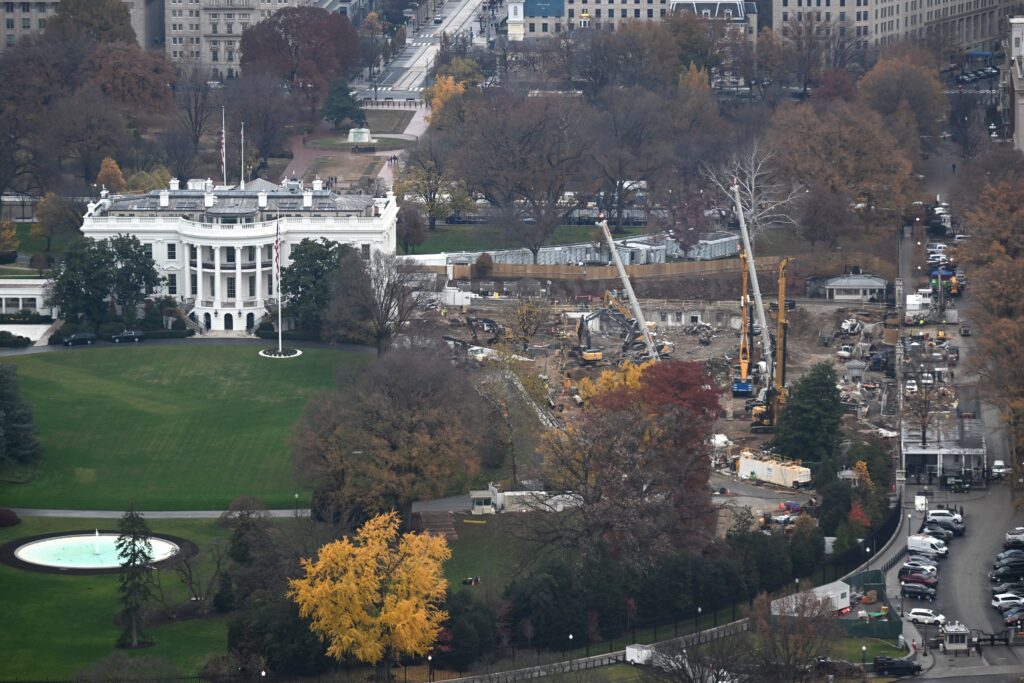
The White House on Wednesday laid out a nine-week timeline to win approval for President Donald Trump’s proposed ballroom, even as one federal review panel said it has yet to receive required building plans and basic details of the project remain unclear.
The dueling accounts and compressed review schedule underscore a central dispute over the project: whether the Trump administration is taking the procedural steps required under federal preservation law, or advancing construction in ways that could foreclose meaningful public review. By pouring millions into early foundation work while approvals remain unresolved, critics argue, the White House risks constraining meaningful scrutiny by oversight bodies.
The Trump administration said it formally submitted applications on Dec. 22 to two committees charged by Congress with reviewing federal construction: the National Capital Planning Commission and the Commission of Fine Arts, according to a White House official. Three days earlier, White House officials met separately with staff members from each commission to present a slide deck and conceptual renderings the administration released in July, the official said.
Fine arts commission Secretary Thomas Luebke confirmed the Dec. 19 meeting and said the White House had filed an application with the CFA to review the ballroom project. Planning commission spokesman Stephen Staudigl said Tuesday that the NCPC had not received such a submission. He did not respond to messages sent Wednesday seeking to reconcile the contradictory information.
The White House also laid out a plan to move the project through approval processes in just over two months — a timeline far shorter than that for comparable large-scale federal construction projects. Officials said they plan informational presentations at the NCPC’s Jan. 8 meeting and the CFA’s Jan. 15 meeting, followed by votes at the fine arts commission on Feb. 19 and the planning commission on March 5.
The Trump administration’s moves followed a Dec. 17 court order from U.S. District Judge Richard J. Leon directing Trump officials to begin “the consultation processes” on the ballroom project with both commissions by the end of December.
“The Court will hold the Government to its word,” Leon, an appointee of President George W. Bush, wrote in his order.
The National Trust for Historic Preservation argued in court filings Wednesday that the Trump administration had failed to take “meaningful steps” toward public review or commission approval.
“They have, repeatedly, broken the rules first and asked for permission later,” wrote lawyers for the National Trust, which sued the Trump administration in an effort to halt construction until required reviews occur.
The White House said meeting with committee staff and submitting conceptual renderings — but not detailed blueprints — satisfied Leon’s instruction to start engaging with both commissions by the end of the year.
The administration’s next step is a public presentation to the planning commission at its Jan. 8 meeting. Commissioners will be allowed to ask questions and offer feedback, according to commission materials posted online, but the public will not be permitted to comment and the 12-member panel will not vote at that meeting. Officials have said those steps will happen later.
Trump administration officials said earlier this month that crews will start aboveground construction on the ballroom no sooner than April — a target that hinges on the commissions granting speedy approval.
The National Capital Planning Commission is led by Will Scharf, the White House staff secretary and Trump’s former personal lawyer, whom the president appointed in July, and its membership tilts toward Trump. The president appointed two other White House officials to the body, which also includes nine seats reserved for sitting Cabinet secretaries and other local and federal officials.
The review process for the ballroom building departs sharply from past practice. Large projects have previously undergone a rigorous, multistage review that begins well before any demolition or site work. Agencies typically engage planning commission staff months or years in advance, former commission officials and construction entities have said. At each stage, commissioners and staff evaluate design, siting and environmental impacts.
The Trump White House has compressed or bypassed some of those steps. Officials plan to complete in months a process that took nearly two years for a White House security fence that was significantly smaller than the ballroom. That project involved five public meetings, during which the commission assessed compliance with federal environmental laws and “the historic and symbolic importance of the White House and the surrounding grounds,” according to planning commission documents.
By contrast, Trump has overseen a rapid, three-month transformation of a large chunk of the White House grounds with no planning commission oversight. In mid-September, crews started clearing foliage and cutting down trees. In late October, the president shocked the public by ordering the demolition of the East Wing. And by early December, cranes and pile drivers were operating daily, as crews worked to create the underground infrastructure necessary to support the building, the White House said.
Scharf has asserted that the planning commission review process covers only “vertical” construction — not demolition or site preparation. Critics have disputed that assertion, arguing that demolition, site work and construction are inseparable and that the commission’s mandate includes preserving existing historic structures.
NCPC records show that commissioners have previously approved site development plans for projects, including the perimeter fence and a tennis pavilion built during Trump’s first term. In both cases, site work began after agencies received approvals.
The commission nevertheless adopted Scharf’s argument in the document it published this month outlining its review process, saying the law doesn’t give it authority over “the demolition of buildings or general site preparation.”
Lawmakers and watchdog groups have repeatedly called for more transparency on the $400 million project, which private patrons are funding — many without disclosing their contributions. Many of the donors the White House has identified — including Amazon, Lockheed Martin and Palantir — have business before the administration, such as seeking future federal contracts or eyeing potential acquisitions. (Amazon founder Jeff Bezos owns The Washington Post.)
Sen. Richard Blumenthal (Connecticut), the top Democrat on the Senate Homeland Security and Governmental Affairs Permanent Subcommittee on Investigations, sent letters last week demanding more information from several attendees of a White House dinner in October to honor ballroom donors.
“The American people are entitled to all the relevant facts about who is funding the most substantial construction project at the White House in recent history,” Blumenthal wrote.
The post White House lays out nine-week timeline to win approval for Trump’s ballroom appeared first on Washington Post.