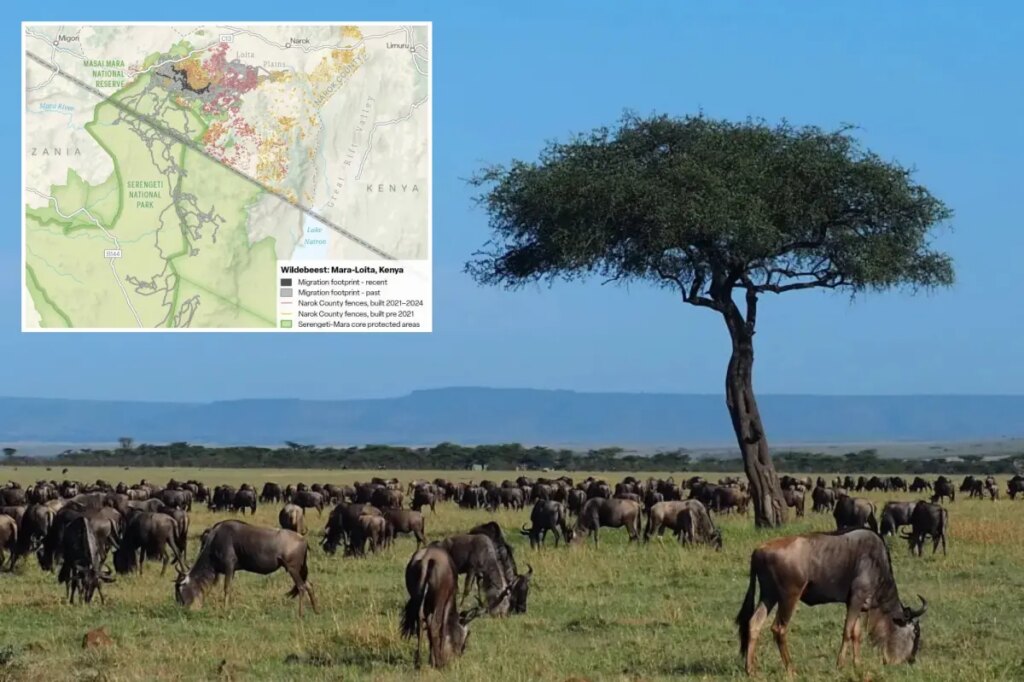
Wildebeest migration has shrunk by 90% in Kenya’s Maasai Mara due to fences being built, reveals new research.
The annual spectacle – a magnet for eco tourists – has seen a “dramatic” decline over the last five years, warn conservationists.
The new study shows Mara-Loita white-bearded wildebeest populations have lost around 90% of their historic migratory footprint since 2020 due to the construction of fencing and other man-made barriers.
Just north of the great Serengeti wildebeest migration – featured in many wildlife documentaries, the research reveals a smaller migration across the Mara ecosystem is “collapsing”.
New maps, published in the Atlas of Ungulate Migration, show the massive impact of fencing on the long-distance movements of one of Africa’s most iconic migratory wildlife species.
Researchers from the Smithsonian’s National Zoo and Conservation Biology Institute (NZCBI), based in Washington DC in the US, partnered with the Global Initiative on Ungulate Migration (GIUM) to map in detail the shrinking wildebeest migration in Kenya’s Greater Mara Ecosystem.
The map and associated tracking data revealed insights into how land use changes are impacting the seasonal migration of the Mara wildebeest population.
Migration, when animals travel to and from seasonal ranges to escape harsh weather or find food, is vanishing.
For ungulates – hooved mammals such as zebras, antelope, or deer – rapid human development in the form of barriers and other infrastructure is cutting off migration routes around the world.
The rate of landscape change is often occurring faster than conservationists can adequately map and protect the routes the animals move along.
The GIUM, a project implemented under the auspices of the UN Convention on the Conservation of Migratory Species, comprises of scientists and migration experts and is dedicated to making migration maps publicly available in the Atlas of Ungulate Migration.
Based on animal tracking data, GIUM migration maps and associated fact sheets are intended to guide conservation and infrastructure development planning and provide information on where key movement corridors need to remain open for the migrations to persist.
The Mara wildebeest migration is the newest map published in the Atlas.
Dr Jared Stabach, terrestrial science lead with the Smithsonian’s Movement of Life Initiative, has studied the population since 2010 and is currently tracking wildebeest movements in the Greater Mara Ecosystem.
He said: “Over the past 10 years, the Mara ecosystem has undergone profound changes and offers a warning to other grassland ecosystems facing similar human pressures.
“As land use shifts in East Africa, there is a tremendous conservation urgency in this region.”
He says more than 100,000 wildebeest once migrated from their wet season in the western portion of the Greater Mara Ecosystem towards their dry season range on the Loita Plains in the north-east.
In the early 1980s, the government allowed lands next to the reserve to be sold and subdivided for agricultural and private use.
The fencing of private land expanded rapidly in the mid-2010s, fragmenting areas across Narok County.
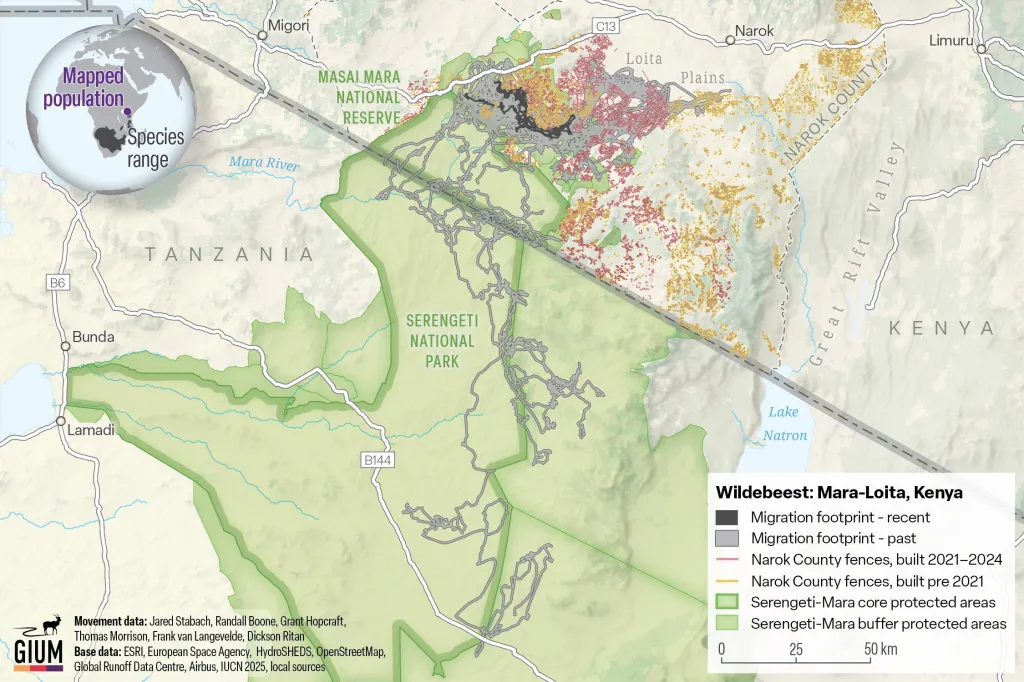
Fences now block key migratory pathways.
Recent movement data collected by Dr Stabach and his colleagues indicate that most wildebeest now live a resident lifestyle, with very few animals still migrating to the east to reach their former wet season range on the Loita Plains.
Although ungulate migrations are being altered and truncated around the world, it is rare for researchers to see and document such a dramatic collapse in real time.
GIUM analysts estimate that the total area of the migration footprint has been reduced by nearly 90% since 2020.
Dr Stabach saysmigration and population abundance often go hand in hand.
No longer able to move long distances to access water, forage, and calving grounds at critical points in their life cycle, the Mara wildebeest population has collapsed from more than 100,000 to less than 25,000, according to estimates provided by the Wildlife Research and Training Institute (WRTI) and the Kenya Directorate of Resource Surveys and Remote Sensing (DRSRS).
In a study published in 2022, Dr Stabach reported that man-made disturbance is constraining wildebeest movements in other grasslands across East Africa.
He says climate change, with the increasing frequency of drought in the region, is compounding the loss of habitat for animals such as wildebeest, which move hundreds of mile in massive herds to find food and water.
Dr Stabach said: “Once lost, migration is difficult to restore, as animals often travel on routes that have been learned and refined over generations.
“However, in other parts of Africa fence removal has led to the recovery of historic ungulate migrations.”
Conservationists believe that careful, nuanced planning that balances both the needs of people and wildlife in shared landscapes can allow migratory wildebeest and other wildlife to thrive.
Dr Stabach’s colleague Dr. Joseph Ogutu, a scientist with the University of Hohenheim in Germany, said: “Maps are a fundamental tool in guiding conservation decision making.
“Human development and wildlife migration in Kenya don’t have to be exclusive, and maps can pinpoint where animals most need freedom of movement.
“Yet, ongoing development has driven the collapse of all Kenya-based migrations, shifting the imperative from conservation alone to active habitat restoration.”
He added: “Maps are essential for reopening and reconnecting blocked or lost migration corridors.”
The research team is continuing to monitor the wildebeests’ movements and the impact of fencing on the herd’s survival.
The post Kenya’s wildebeest annual migration dramatically declines by 90% due to fences appeared first on New York Post.