“We took the freedom of speech away.”
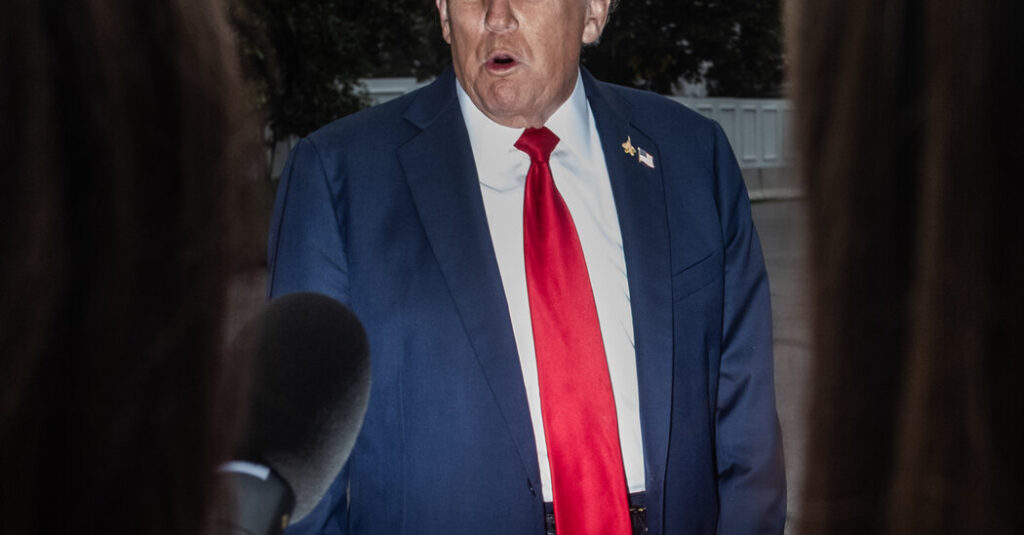
That was part of President Trump’s explanation in October of his executive order that purports to criminalize burning the American flag. Though his words fail as a constitutional rationale, they inadvertently distill many of his efforts at smothering dissent during the past 11 months.
Since returning to office, Mr. Trump and his administration have tried to undermine the First Amendment, suppress information that he and his supporters don’t like and hamstring parts of the academic, legal and private sectors through lawsuits and coercion — to flood the zone, as his ally, Steve Bannon, might say.
Some examples are well known, such as when ABC briefly took Jimmy Kimmel off the air after Brendan Carr, the chairman of the Federal Communications Commission, objected to a reference in one of Mr. Kimmel’s monologues about the killing of Charlie Kirk. Other examples received less attention, but by my count, this year there were about 200 instances of administration attempts at censorship, nearly all of which I outline in a new report.
Mr. Trump’s playbook isn’t random. It employs several recurring modes of attack.
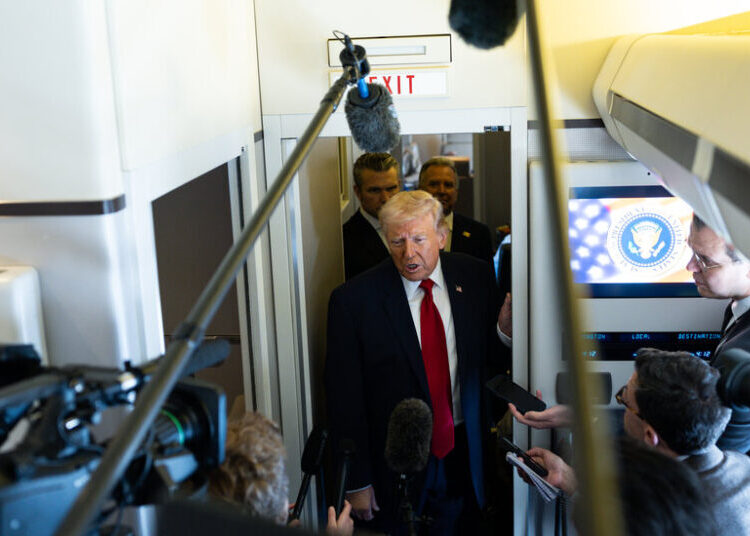
The president has tried to cow the press. His administration banned Associated Press reporters from certain parts of the White House and Air Force One because the outlet uses “Gulf of Mexico” rather than the term Mr. Trump prefers, “Gulf of America.” It tried and failed to force some of the nation’s biggest news organizations to agree to restrictions on coverage of the Pentagon. He has said critical coverage of his initiatives is “really illegal.”
A journalist from El Salvador, Mario Guevara, was arrested while reporting on a No Kings protest in Georgia; he was detained for more than three months, then deported. At an Oval Office meeting between Mr. Trump and Crown Prince Mohammed bin Salman of Saudi Arabia, an ABC News correspondent, Mary Bruce, asked about the killing of the Saudi journalist Jamal Khashoggi and about the Jeffrey Epstein files. Mr. Trump replied by berating her at length, at one point describing one of her questions as “insubordinate” — a characterization that upends the entire notion of a free press.
The administration has used immigration status to try to suppress political speech. In March, Mahmoud Khalil, a green card holder and a leader of pro-Palestinian demonstrations on the Columbia campus, was arrested and detained by immigration officials for several months. That month, Rumeysa Ozturk, a student visa holder, was arrested by immigration officials and detained for several weeks, apparently because she was an author of an opinion essay criticizing Tufts University for its response to the Israel-Hamas war.
It seems almost no one is beyond the scope of administration efforts to muzzle views or decisions that conflict with Mr. Trump’s agenda: After Federal District Court Judge James Boasberg ruled against the administration in a case involving the deportation of Venezuelans to El Salvador, Mr. Trump called for the judge to be impeached. A trainee was dismissed from the F.B.I.’s academy, apparently for having displayed an L.G.B.T.Q. Pride flag. The F.B.I. also appears to have fired agents for kneeling during George Floyd protests.
At a news conference in Tampa, Fla., Kristi Noem, the secretary of homeland security, asserted that filming Immigration and Customs Enforcement officers while they are in the field is tantamount to violence. In Los Angeles, Senator Alex Padilla, Democrat of California, was forced to the ground and handcuffed after interjecting at a news conference held by Ms. Noem.
In just the past few days, the administration has banned a former member of the European Commission and four European researchers from the United States, claiming that their efforts to fight disinformation and hate speech online amount to censorship of Americans.
The president federalized and deployed the National Guard in Los Angeles; a federal appeals court found that his administration had illegally prolonged the deployment. He similarly sent the National Guard to the Chicago area — an action that the Supreme Court, for now, has blocked.
As part of the administration’s war on so-called wokeness, it has identified hundreds of words, with the intent of curtailing their use. Mr. Trump issued an executive order directing staff members at national parks and museums to get rid of content that, he says, portrays America “in a negative light.” Just two days after Inauguration Day, the Justice Department’s chief of staff sent a memo calling for a “litigation freeze” in the department’s civil rights division.
Two of Mr. Trump’s perceived political adversaries — James Comey, a former F.B.I. director, and Letitia James, the New York attorney general — were criminally charged (in cases now both dismissed) that were difficult to see as anything other than revenge prosecutions. A few days into his term, the president fired more than a dozen inspectors general from various federal government agencies.
Some of the nation’s biggest law firms — including Paul, Weiss and Kirkland & Ellis — have caved under presidential pressure and signed deals agreeing to contribute pro bono work for causes dictated by the administration. Several prestigious universities submitted to agreements in which they committed to change certain policies and, in some cases, pay what amounts to millions of dollars in fines.
Mr. Trump has sued social media platforms for their content moderation policies — free-speech decisions, in other words — leading to Meta, X and YouTube capitulating through settlements totaling around $60 million.
These examples are just a sampling from the administration’s relentless campaign to stifle dissent. What is important to recognize is that these efforts work in concert in their frequency and their volume: Even the most egregious cases seem to quickly fade from public consciousness, and in that way, they’re clearly meant to overwhelm us and make us think twice about exercising our rights.
Over the past year, individual and communal acts of resistance have blunted the potency of Mr. Trump’s censorship campaign and contributed to his declining approval ratings. Unquestionably, more and more Americans are rejecting his overreach.
But constitutional rights and democratic norms don’t disappear all at once; they erode slowly. The next three years will require a vigilant defense of free speech and open debate.
Nora Benavidez is the author of the Free Press report “Chokehold: Donald Trump’s War on Free Speech and the Need for Systemic Resistance.”
The Times is committed to publishing a diversity of letters to the editor. We’d like to hear what you think about this or any of our articles. Here are some tips. And here’s our email: [email protected].
Follow the New York Times Opinion section on Facebook, Instagram, TikTok, Bluesky, WhatsApp and Threads.
The post I Counted Trump’s Censorship Attempts. Here’s What I Found. appeared first on New York Times.