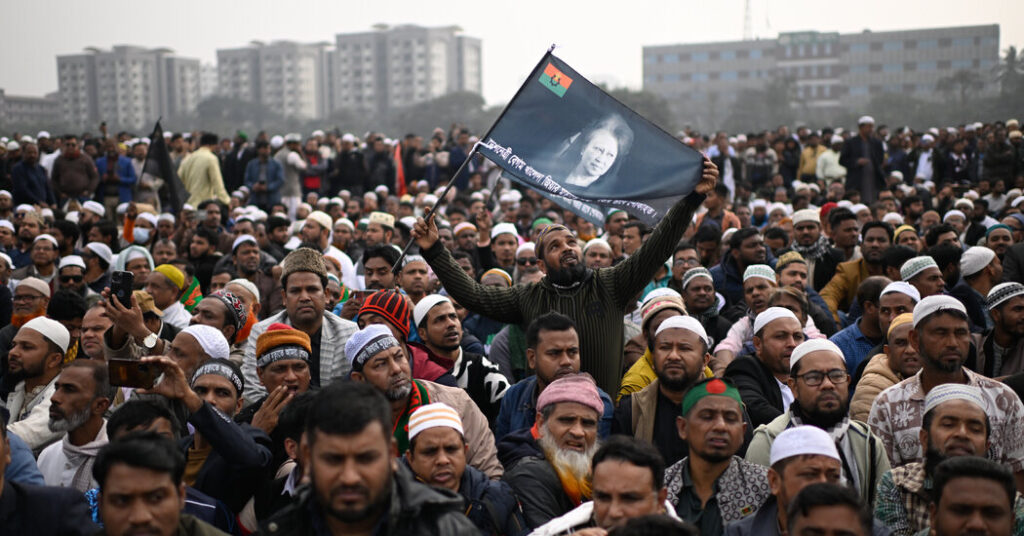
Vast crowds braved an unexpected cold spell in Dhaka, the capital of Bangladesh, on Wednesday to say goodbye to Khaleda Zia, the country’s first female prime minister, who died a day earlier and whose policies helped shape the country and its economy.
As the vehicle carrying Ms. Zia’s body wove its way from her private residence toward Parliament, Bangladeshis lined the streets and waited solemnly, hoping to catch a glimpse of the coffin. Many had scarves wrapped around their heads to protect their ears, unused to temperatures that touched the low 50s.
It took about two hours for the vehicle, which was wrapped in the Bangladeshi flag, to reach the funeral site — a vast, open-air field of around 30 acres in front of Parliament, where rows upon rows of people stood silently under a gloomy sky, awaiting her last rites. Political leaders from various parties stood around Ms. Zia’s coffin as an imam led a funeral prayer in Arabic. After the brief ceremony, Ms. Zia was taken to be buried next to the grave of her husband, Ziaur Rahman, the first military leader of Bangladesh, who was assassinated in 1981.
The hushed nature of the event stood in sharp contrast to the chaos and noise of Dhaka’s streets, which have lately been filled with protesters chanting slogans and waving banners, and the looming threat of the political and religious violence that has gripped Bangladesh in the past year.
Ms. Zia’s death came just weeks before Bangladesh is set to hold a general election on Feb. 12 that could set the country — born of bloodshed and violence nearly 55 years ago and largely ruled by two political dynasties — on a new, more democratic path. The polls will be the first since August 2024, when a student revolution toppled the increasingly authoritarian government of Sheikh Hasina.
Ms. Hasina and Ms. Zia were longtime rivals and members of the two political families that have alternately ruled Bangladesh for most of its existence. Ms. Hasina is the daughter of Sheikh Mujibur Rahman, considered the country’s founding father.
The Bangladesh Nationalist Party, chaired by Ms. Zia until her death, is widely expected to win in the absence of Ms. Hasina’s Awami League, which is banned from conducting any activities in the country following last year’s revolution. If the B.N.P. wins, Ms. Zia’s son Tarique Rahman, who recently returned to Bangladesh after 17 years in exile, will be a leading candidate for prime minister.
On Wednesday, Mr. Rahman posted a video of himself on social media reciting from the Holy Quran. Mr. Rahman, 60, also met with visiting dignitaries.
Many Bangladeshis held Ms. Zia in high regard for her restrained public manner and because of her economic policies, which lifted millions out of extreme poverty.
Bangladesh’s garment industry took off under Ms. Zia’s first term, said Rashed Al Mahmud Titumir, a professor at the University of Dhaka. In Ms. Zia’s second term, the industry became “the main engine of the economy,” he said, adding that her broader efforts to modernize the economy had also begun to bear fruit.
Ms. Zia was given a state funeral by the interim government of Bangladesh, led by Muhammad Yunus, and the country is in the midst of a three-day mourning period.
The air on Wednesday was thick with tension, with more than 10,000 troops deployed to maintain order.
Top government officials from Sri Lanka, Bhutan and other neighbors attended to pay their respects. India, which is facing a rising backlash from many Bangladeshis in part for giving refuge to Ms. Hasina, was represented by S. Jaishankar, the minister of external affairs.
The upcoming election is no guarantee that Bangladesh will rid itself of chaos, but pulling it off will be a feat — and, quite likely, a source of immense relief — for Mr. Yunus. After the Hasina government was overthrown last year, The 85-year-old Nobel laureate was picked by student protesters to stabilize the country and strengthen its institutions to hold free and fair elections.
But Mr. Yunus has struggled in the face of growing turbulence. Earlier this month, riots erupted after a prominent student leader and outspoken critic of the Hasina government, Sharif Osman bin Hadi, was shot by an assailant who then fled to India, according to Bangladeshi police officials. Mr. Hadi later died from his injuries.
Anti-India sentiment has risen in Bangladesh ever since Ms. Hasina fled to India. In November, a domestic Bangladeshi court sentenced Ms. Hasina to death for crimes against humanity, but India is seen as unlikely to facilitate her extradition.
The killing of Hindus in Bangladesh has also enraged Hindu extremists in India, who recently protested outside the Bangladesh High Commission in New Delhi. One of those killed was Dipu Chandra Das, a garment factory worker, whose body was tied to a tree and burned on allegations that he had made derogatory remarks about the Prophet Muhammad.
Anupreeta Das covers India and South Asia for The Times. She is based in New Delhi.
The post Bangladeshis Pay Last Respects to Former Leader in Tense Capital appeared first on New York Times.


